

The Musician's Guide to Healthy Hands and Injury Prevention
Why Musicians' Hands Need Specialized Care

Hand therapy for musicians is a specialized field addressing the unique musculoskeletal demands on performers. It's essential because the repetitive, high-stakes nature of playing an instrument creates extraordinary pressure on nerves and muscles. Standard treatments often fall short for musicians, whose hands are their livelihood.
This specialized care includes instrument-specific rehabilitation, modified return-to-play schedules, neuromuscular reeducation to optimize technique, comprehensive assessments of posture and practice habits, and targeted prevention strategies. The goal is to address the root cause of pain, not just the symptoms.
Many musicians feel a deep connection to their instrument, but hours of daily practice in sustained or awkward positions take a toll. The statistics are sobering: studies show that over 90% of musicians in some groups report play-related pain. These playing-related musculoskeletal disorders (PRMDs) can devastate your physical health, mental well-being, and career.
I'm Lou Ezrick, founder of Evolve Physical Therapy in Brooklyn. For nearly two decades, I've helped musicians recover from complex conditions. Our specialized hand therapy for musicians focuses on restoring the precise motor control and endurance your craft demands, getting you back to playing safely by addressing the root causes of dysfunction.
Understanding Playing-Related Musculoskeletal Disorders (PRMDs)
Playing-related musculoskeletal disorders (PRMDs) are injuries that develop when the body is pushed beyond its limits by the repetitive, intense movements of playing an instrument. These aren't minor aches; PRMDs can derail your career and affect your physical, mental, and financial health. The symptoms often start subtly with pain or fatigue during practice but can escalate to swelling, numbness, or persistent pain affecting the hands, wrists, arms, shoulders, and neck.
Tendinitis and tendinopathy are common overuse injuries. Tendinitis is tendon inflammation, which can progress to tendinopathy—a degeneration of the tendon tissue itself—if not addressed early.
Carpal tunnel syndrome (CTS) occurs when the median nerve in the wrist is compressed, causing numbness, tingling, and weakness in the thumb, index, and middle fingers. Physical therapy is highly effective for mild to moderate CTS, offering improvements comparable to surgery without the risks.
Cubital tunnel syndrome involves compression of the ulnar nerve (the "funny bone" nerve) at the elbow, causing numbness and tingling in the ring and pinky fingers. Instruments requiring prolonged elbow flexion can worsen this condition.
Thoracic outlet syndrome (TOS) happens when nerves and blood vessels between the collarbone and first rib are squeezed, often due to forward head posture common in violinists or keyboardists. Symptoms include pain, numbness, and a heavy feeling in the arm and hand.
Osteoarthritis (OA) can develop in the joints of the hands, wrists, and shoulders from years of cumulative stress. X-ray findings don't always correlate with pain levels.
What is Focal Hand Dystonia?
Among the most devastating conditions is Focal hand dystonia (FHD), or musician's cramp. This is a task-specific neurological movement disorder causing an involuntary loss of finger coordination, but only when playing your instrument. Fingers may cramp, flex, or extend on their own, making precise playing impossible. It is generally painless, which makes it particularly insidious.
FHD is believed to result from use-dependent changes in the brain's sensory cortex—the brain's "map" for the fingers becomes disorganized. Years of intense, repetitive practice contribute to this maladaptive plasticity. While there is no single cure, specialized hand therapy for musicians offers effective management. A promising behavioral treatment is Sensory Motor Retuning (SMR), which involves retraining the dystonic finger by immobilizing others with a splint to perform focused exercises. This and other approaches like sensory discrimination training aim to re-establish normal motor control by essentially retraining the brain to correctly map and control the fingers again. It's a challenging journey, but many musicians successfully manage their symptoms and return to playing.
The Role of Specialized Hand Therapy for Musicians
Your hands are finely tuned instruments, capable of precision and speed that require specialized care. General physical therapy, while valuable, often falls short for musicians. Standard advice like complete rest can be devastating, leading to loss of technique, income, and psychological distress. Our goal isn't just pain reduction; it's achieving full "musical fitness"—the stamina, coordination, and sensory feedback needed for peak performance.
At Evolve Physical Therapy in Brooklyn, our specialized approach begins with a thorough initial assessment. We look at you as a whole musician, analyzing your posture and movement while you play your instrument. We review the specific demands of your instrument, your practice and performance schedule, and broader lifestyle factors like sleep and stress. Your personal musical goals guide every decision, allowing us to create a truly personalized treatment plan.
Your program will be built on several key components. We design individualized home exercise programs to address your specific muscle imbalances and nerve issues, custom to the movements your instrument requires. Our therapists use hands-on manual therapy to reduce pain, improve joint mobility, and release tight tissues. Neuromuscular reeducation is crucial for retraining your body's awareness and control, refining your technique for pain-free efficiency. We also use pain reduction modalities and sensory reeducation to restore the fine tactile feedback that is paramount to your craft.
Crucially, we practice instrument-focused rehabilitation, bringing your instrument into the therapy room. This makes therapy functional and directly relevant to your goals. We develop modified playing schedules to ease you back into playing without re-injury, gradually increasing duration and difficulty. We use your instrument to observe your technique in real-time and integrate therapeutic exercises with actual playing. The results are powerful: a case review found that 97.7 percent of professional musicians returned to full-time playing after using their instrument as a therapeutic tool. At Evolve, we've seen countless musicians return to their craft stronger and smarter than before, equipped for a long and sustainable career.
A Holistic Approach: The Musician's Support System

Recovering from a playing-related injury requires more than just physical exercises. At Evolve Physical Therapy, we believe hand therapy for musicians must address your entire well-being. Your identity, livelihood, and emotional health are all intertwined with your ability to play. That's why we advocate for a multidisciplinary team approach.
Your physician provides the medical diagnosis and foundation for care. Your music teacher offers invaluable insight into your technique, and we collaborate with them to ensure therapeutic changes work in a real-world performance context. A mental health professional is also a key team member. The psychological impact of an injury—anxiety, depression, and even identity crisis—is significant. Managing expectations and developing new, healthier movement patterns is a central part of recovery, and emotional support is vital.
Instrument Modifications, Splinting, and Ergonomics
Sometimes, the most effective treatment involves changing your instrument or environment, not just your body. Musical instruments evolved for sound, not comfort, often requiring awkward postures and excessive force.
Custom splints can be powerful tools. Designed specifically for musicians, they can support an injured joint during modified practice or help retrain movement patterns in conditions like focal hand dystonia.
Instrument adaptations, such as adding padding to reduce pressure points or adjusting straps for better weight distribution, can significantly reduce strain without compromising sound.
Ergonomic practice spaces are critical. We help you optimize your setup by focusing on neutral posture, reducing excessive force, ensuring ease of reach, setting proper instrument height, and minimizing static load and pressure points. These small adjustments compound over hours of practice and can be the difference between a sustainable career and chronic injury.
Proactive Prevention: Strategies for a Long and Healthy Career
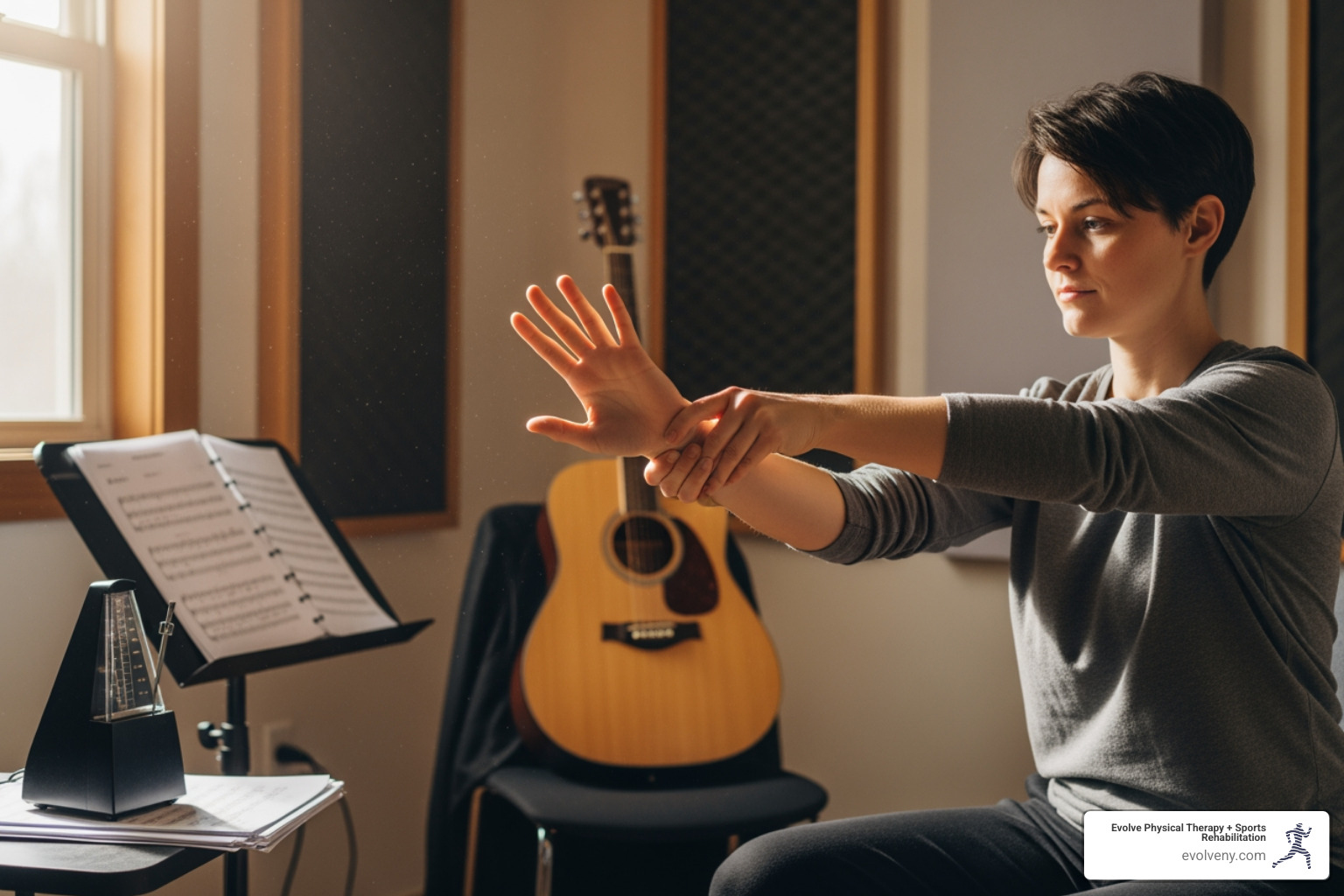
While we excel at helping musicians recover, our ultimate goal is to prevent injuries from happening in the first place. Proactive prevention is the foundation of a long and healthy musical career. Good habits are essential, especially when returning to play after an injury.
Start with proper warm-up routines for your back, neck, and arms, just as an athlete prepares for a game. After playing, cool-down stretches help release tension and promote recovery. It's also crucial to take frequent breaks during practice; your body isn't designed for hours of repetitive motion without rest. If you feel pain after 30 minutes, try practicing for 20 and gradually build endurance.
Posture correction is key. Maintaining good upper back and neck posture prevents a cascade of problems. Likewise, stress management is vital, as performance anxiety and other pressures manifest physically as tension. Finally, a healthy lifestyle—sufficient sleep, a balanced diet, and limiting stimulants—supports your body's ability to perform and heal. The best injury is the one that never happens.
5 Essential Warm-Up Stretches for Musicians:
Wrist Flexor Stretch: Extend one arm, palm up. Use your other hand to gently pull your fingers down toward your body. Hold for 15-20 seconds and switch sides.
Wrist Extensor Stretch: Extend one arm, palm down. Gently pull your fingers down toward your body with your other hand. Hold for 15-20 seconds.
Finger Spreads: Place your hand flat on a table. Slowly spread your fingers as wide as is comfortable, hold, then relax. Repeat several times.
Thumb Stretch: Gently pull your thumb across your palm toward your pinky finger. Hold for 15-20 seconds on each side.
Shoulder Rolls: Roll your shoulders forward in a circle several times, then reverse. This releases tension in your neck and upper back.
Frequently Asked Questions about Hand Therapy for Musicians
What is the difference between a regular physical therapist and a therapist specializing in hand therapy?
A Certified Hand Therapist (CHT) represents the highest level of specialization in upper extremity care. A CHT is an occupational or physical therapist who has completed at least 4,000 hours of direct practice in hand therapy and passed a rigorous certification exam. This advanced training provides an in-depth knowledge of the intricate anatomy from the shoulder to the fingertips. For a musician, this expertise is invaluable for diagnosing and treating complex conditions like PRMDs, nerve compressions, and focal dystonia. A specialist can also analyze your unique playing habits and develop a highly personalized prevention program custom to your instrument.
How long does recovery take, and when can I play my instrument again?
Recovery is a unique journey for every musician, and there's no set timeline. The duration depends on the type and severity of your injury, your body's healing process, and the demands of your instrument. The process is phased: we focus on regaining mobility first, then move on to building strength once pain is managed. The most important step is creating a phased return-to-play plan, where you gradually reintroduce playing in a structured way to prevent re-injury. Patience and consistency with your therapy are key to a successful and lasting return to music.
Can hand therapy really help with a neurological issue like focal dystonia?
Yes. While focal dystonia is a neurological condition, specialized hand therapy for musicians plays a crucial role in its management. The condition involves maladaptive plasticity, where the brain's "map" of the fingers becomes disorganized. Our therapeutic approach focuses on neuromuscular reeducation to retrain the brain's motor control and sensory perception. Behavioral treatments like Sensory Motor Retuning (SMR), which have been shown to be effective, work by guiding your nervous system to re-establish normal movement patterns. It is genuine brain retraining. While there is no magic cure, a multimodal approach combining specific exercises, sensory reeducation, and splinting can lead to significant improvement in your ability to play.
Conclusion: Harmonize Your Health and Your Music
Your hands tell the story of your musical journey. For musicians in Brooklyn, they are the bridge between your artistry and the world. When pain threatens that connection, it can feel like losing a part of yourself. But you don't have to choose between your passion and your health.
Playing-related musculoskeletal disorders are common, but they don't have to end your career. Specialized hand therapy for musicians aims for the precision, endurance, and control your craft demands. Through instrument-focused rehabilitation, comprehensive assessments, and a commitment to prevention, we help you steer recovery and build a foundation for a long, healthy career.
The multidisciplinary approach we use at Evolve Physical Therapy means you're never on this journey alone. Whether you're recovering from an injury or facing the challenges of a condition like focal hand dystonia, we're here with the expertise and compassion you deserve.
Your music matters. Your health matters. With the right support, they can coexist in harmony.
Ready to get back to playing pain-free? Contact us for specialized hand therapy in Brooklyn and let's create your personalized path to recovery.
