

Unlock Relief: The Ultimate How-To for Lower Back Herniated Disc Physical Therapy Exercises
Understanding Your Herniated Disc and the Path to Recovery

Lower back exercises for herniated disc physical therapy offer a proven, non-surgical way to manage pain and restore function. These targeted movements can reduce pressure on spinal nerves and strengthen supporting muscles, especially if you have pain radiating down your leg.
Key Exercises for Herniated Disc Recovery:
- Extension-Based Stretches - Press-ups and Sphinx Pose to reduce disc pressure
- Core Stabilization - Bird-Dog and Plank exercises to support your spine
- Gentle Mobility Work - Cat-Cow and Pelvic Tilts to restore movement
- Nerve Relief Stretches - Knee-to-Chest and Piriformis stretches to ease sciatic symptoms
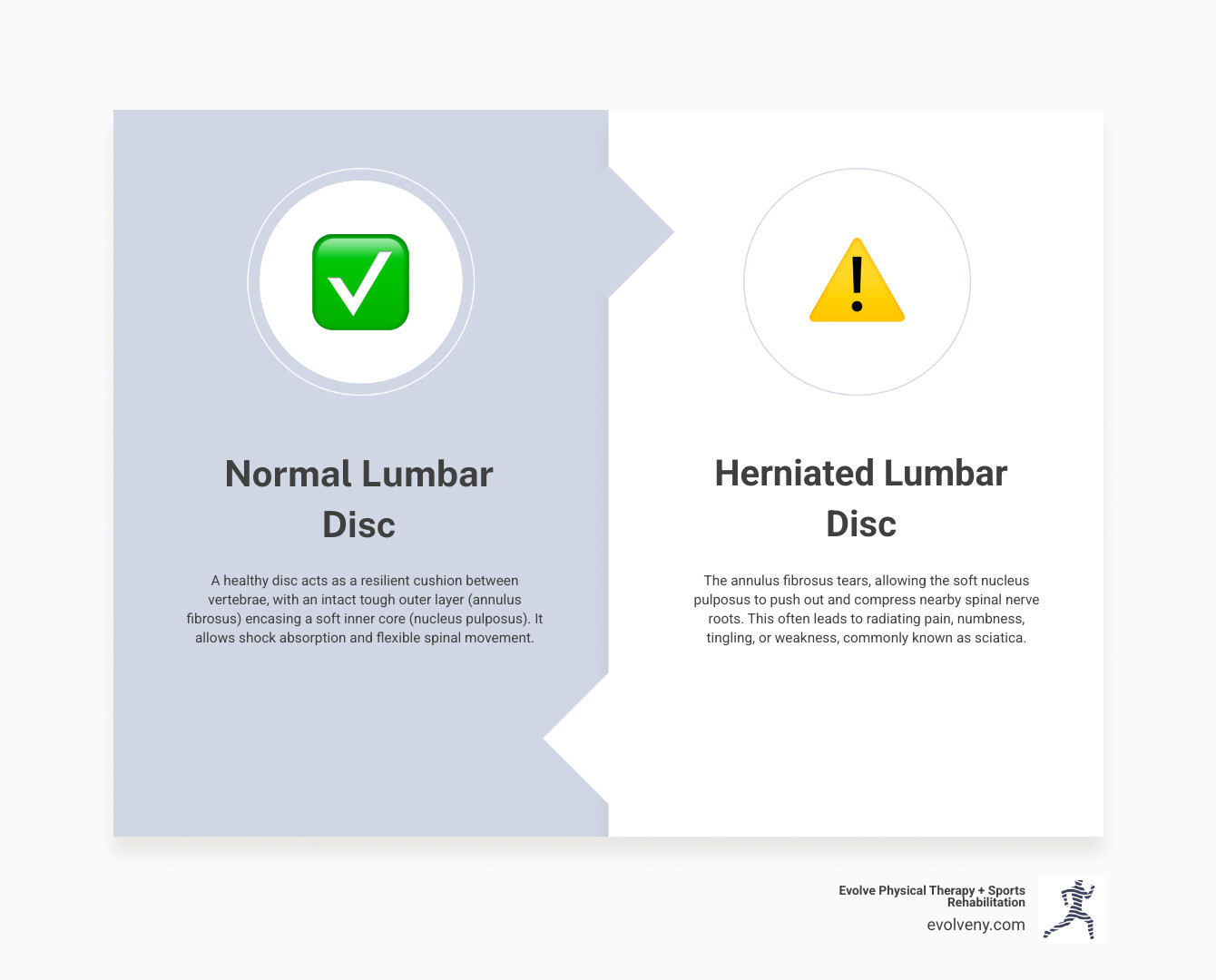
What is a herniated disc? Your spinal discs are gel-filled cushions between your vertebrae. When the tough outer layer tears, the soft inner material can push out and press on nearby nerves, causing pain, numbness, or weakness—often radiating down your leg as sciatica.
Up to 80% of people experience lower back pain, with herniated discs being a common cause. The good news is that patients in an exercise program often report significant pain reduction and improved daily function, typically within 6-8 weeks.
Physical therapy aims to:
- Reduce pain and inflammation
- Centralize symptoms (move pain from your leg back toward your spine)
- Improve flexibility and range of motion
- Strengthen core muscles that stabilize your spine
- Prevent future injury through better movement patterns
I'm Lou Ezrick, founder of Evolve Physical Therapy in Brooklyn. For nearly two decades, I've helped patients recover from complex conditions by developing customized lower back exercises for herniated disc physical therapy programs. My approach combines manual therapy with progressive exercise to help you return to your favorite activities without surgery or long-term medication.
Your Guide to Lower Back Exercises for Herniated Disc Physical Therapy
Think of your spinal disc like a jelly donut. When it gets squished, the jelly can push out through a crack. That's essentially a herniated disc—the soft inner material breaks through the tough outer layer and presses on nearby nerves, causing pain, numbness, or weakness that often shoots down your leg (sciatica).
The good news is that lower back exercises for herniated disc physical therapy can address this problem without surgery. The goal is to help your body heal itself and prevent this from happening again.
Pain centralization is a key concept in your recovery. This is when pain moves from your leg back toward your spine. It's a sign of progress, meaning the exercise is reducing pressure on the irritated nerve root.
This is where the McKenzie Method is often used. According to clinical research, the McKenzie exercise program is believed to be one of the most beneficial for managing lumbar disc herniation. It focuses on specific movements that centralize your pain.
At Evolve Physical Therapy in Brooklyn—serving Marine Park, Gravesend, Midwood, Park Slope, and Mill Basin—we know your injury is unique. We carefully monitor your pain-free range of motion and guide you through gradual progression, always respecting your body's signals.
Core stability is the foundation of our approach. Strengthening the deep muscles around your spine (transverse abdominis and multifidus) builds an internal support system, taking pressure off your injured disc.
Essential Stretches in Your Lower Back Exercises for Herniated Disc Physical Therapy Program
The right stretches can improve blood flow, relieve muscle tension, and gently decompress your spine. The key is to be gentle.
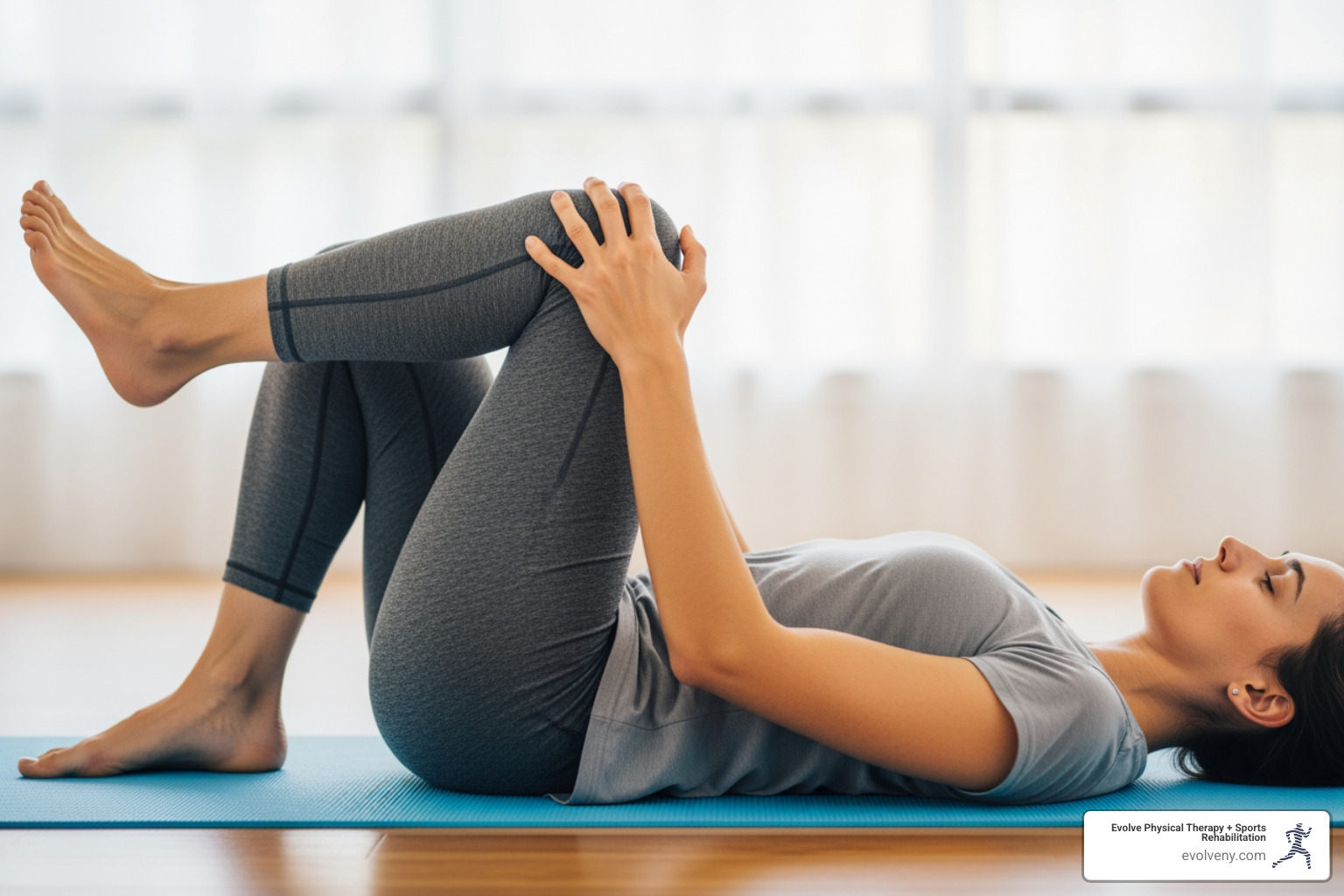
The Knee-to-Chest Stretch is simple and effective. Lie on your back with knees bent. For the single leg variation, gently pull one knee to your chest, holding for 15-20 seconds. Repeat 2-3 times per leg. If comfortable, progress to the double leg variation, pulling both knees to your chest for 15-30 seconds. Aim to do this twice daily.
The Piriformis Stretch targets a deep gluteal muscle that can compress the sciatic nerve. Lie on your back with knees bent. Cross one ankle over the opposite knee and gently pull the uncrossed knee toward your chest. Hold for 15-30 seconds, feeling a stretch in your glute. Repeat 2-3 times per side.
The Cat-Cow Stretch improves spinal mobility. On your hands and knees, inhale to arch your back (Cow Pose), letting your belly drop. Exhale to round your spine (Cat Pose), tucking your chin. Flow between poses for 1-2 minutes, completing 10 reps for 2-3 sets.
The Press-Up or Sphinx Pose is a lumbar extension that often reduces disc pressure. Lie face-down and prop yourself on your elbows under your shoulders (Sphinx Pose). Let your lower back arch gently, keeping your stomach and back muscles relaxed. Hold for 10-30 seconds and repeat 10 times. If comfortable, progress to a full Press-Up by straightening your elbows to push your upper body higher, keeping your hips on the floor. Hold for 6 seconds and repeat 8-12 times. Crucially, monitor your pain. Some back pain is normal, but if your leg pain increases or spreads, stop immediately and consult your physical therapist.
Core Strengthening: The Foundation of Lower Back Exercises for Herniated Disc Physical Therapy
Your core muscles provide essential spinal support. We focus on deep stabilizers like the transverse abdominis and multifidus to prevent recurrence.
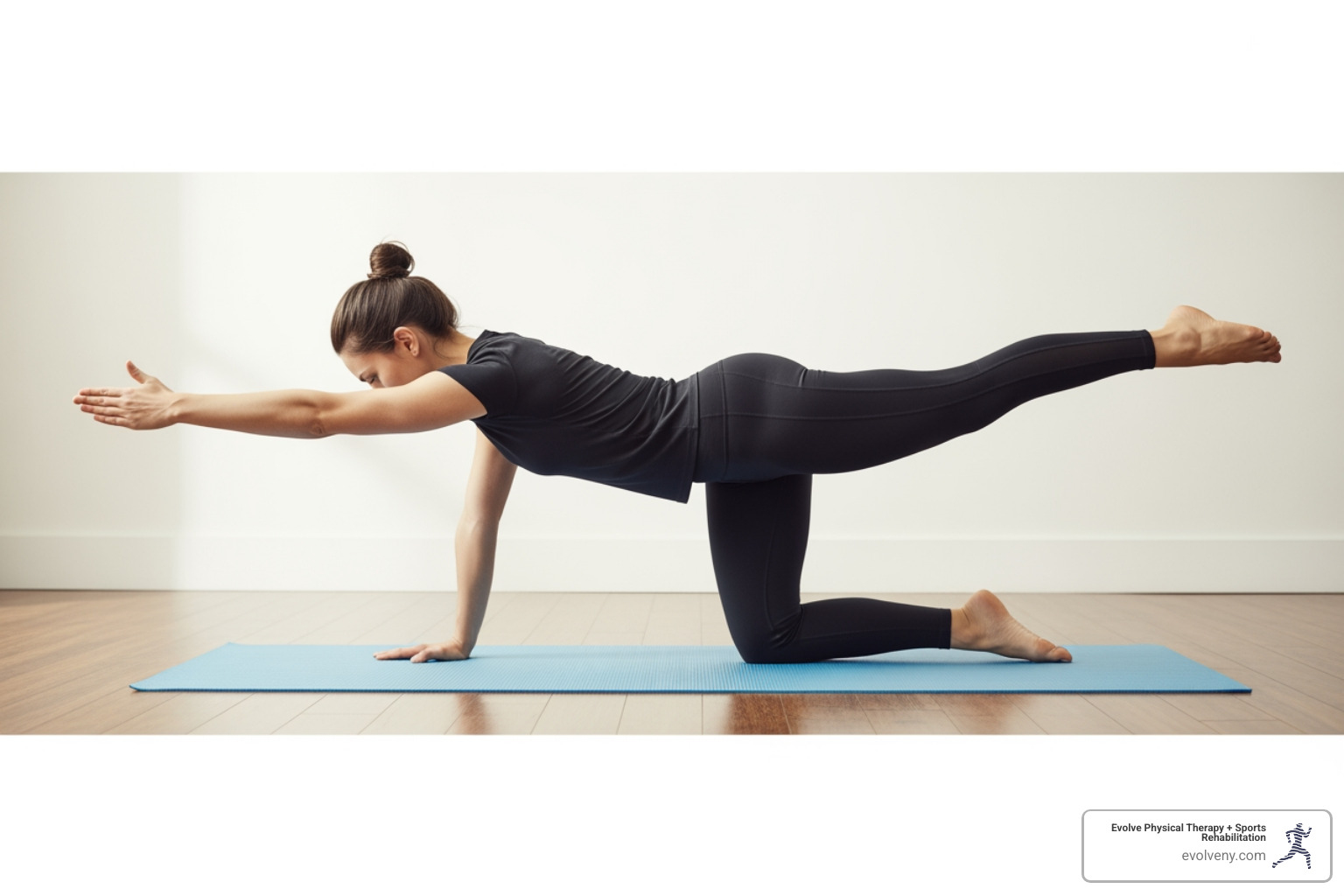
The Bird-Dog teaches you to maintain a neutral spine. On your hands and knees, brace your core. Slowly extend your right arm and left leg, keeping your back flat and hips level. Hold for 2-3 seconds, then switch sides. Aim for 10-12 reps per side for 2-3 sets.
The Bridge activates your glutes and stabilizes your spine. Lie on your back with knees bent. Squeeze your glutes to lift your hips, forming a straight line from shoulders to knees. Avoid arching your back. Hold for 5-10 seconds and lower. Repeat 10-12 times for 2-3 sets.
The Plank builds core endurance. On your forearms, form a straight line from head to heels, engaging your core and glutes. For a modified plank, drop to your knees. Prioritize form over duration. Hold for 20-30 seconds, repeating 2-5 times.
Pelvic Tilts teach you to control your lower back. Lie on your back with knees bent. Gently flatten your lower back against the floor by tilting your pelvis and engaging your abs. Hold this small movement for 5 seconds. Repeat 10-15 times for 2-3 sets.
Exercises to Avoid: Protecting Your Spine During Recovery
Knowing what not to do is just as important as knowing the right exercises for a herniated disc. Certain movements can feel like picking at a wound, setting back your recovery.

High-Risk Movements and Activities
Movements that significantly increase disc pressure or involve excessive spinal flexion can derail your progress.
- Heavy lifting, especially with a rounded back, places enormous compressive force on your discs. A herniated disc can develop from heavy lifting, sudden pressure, or repetitive strenuous activities.
- Twisting motions, particularly while bending or holding weight, create a dangerous shearing force on the disc that can worsen the herniation.
- Toe touches and deep forward bends can be harmful. For a herniated disc, stretches that excessively bend forward are generally not advised because they can push disc material further out.
- Traditional sit-ups and crunches place excessive force on your lumbar spine. Safer, more effective alternatives like planks and bird-dogs are recommended.
- High-impact cardio like running and jumping jars the spine. Instead, choose low-impact alternatives like walking, swimming, or cycling to stay active without aggravating your disc.
Understanding Pain Signals
Learning to interpret your body's signals is crucial when doing lower back exercises for herniated disc physical therapy. Not all discomfort is bad, but some pain requires immediate attention.
- Peripheralization: The most important warning sign is pain moving further down your leg. This means the exercise is worsening nerve compression. Stop immediately and contact your physical therapist.
- Sharp Pain vs. Muscle Soreness: A mild, dull ache or muscle fatigue is often normal. However, sharp, shooting, or intense pain is a warning sign that something is wrong.
- When to Stop an Exercise: Stop any movement that causes increased leg pain, new numbness or tingling, or weakness. This is not a "no pain, no gain" situation; worsening pain can mean you're causing more damage.
At Evolve Physical Therapy, we teach our patients across Brooklyn—from Marine Park to Park Slope—to be their own best advocates. The importance of professional guidance cannot be overstated. It's always better to check in with a question than to push through pain and set back your recovery.
Progressing Safely and The Role of Posture
Recovery from a herniated disc is a gradual process. Lasting relief comes from building strength slowly, listening to your body, and understanding how your daily posture impacts your healing.
How to Safely Progress Your Exercise Program
Approach your lower back exercises for herniated disc physical therapy with patience and awareness, rather than trying to power through discomfort.
- Start Slow: Begin with just a few repetitions. It might feel easy, but you're building a solid foundation. As an exercise becomes comfortable, you can gradually increase the reps over several weeks.
- Use Pain as Your Guide: If pain centralizes (moves toward your spine), you're on the right track. If it increases or radiates down your leg, stop that movement. Differentiate normal muscle soreness from sharp nerve pain.
- Progress in Small Steps: Challenge your body just enough to encourage healing without overwhelming it. For example, hold a modified plank longer before trying a full one, or move from prone press-ups to gentle standing backbends.
- Build a Routine: Consistency is more important than intensity. Aim to do your exercises at the same time each day, even for just ten minutes. This consistency is what creates real change.
The Importance of Posture in Daily Life
You can do perfect exercises for an hour, but if you slouch at your desk for eight hours, you're working against yourself. Good posture is a constant, positive influence on your spine.
- Sitting Posture: Sitting, especially slouching, significantly increases disc pressure. Sit with a neutral pelvis, using a lumbar support roll or towel if needed. Stand up hourly to perform gentle back extensions.
- Standing Posture: When standing, keep your weight even, shoulders relaxed, and head held high. If you stand for long periods, shift your weight or use a small footstool to rest one foot.
- Lifting Technique: To lift, always bend at your knees, not your waist. Keep the object close to your body, engage your core, and use your powerful leg muscles. Never twist while lifting; move your feet to turn.
- Sleeping Position: Use a supportive mattress. Side sleepers should place a pillow between their knees to align the hips and spine. Back sleepers can put a small pillow under their knees. Try to avoid sleeping on your stomach, as this can increase disc pressure.
These posture adjustments, combined with your lower back exercises for herniated disc physical therapy, create an environment where your spine can heal and stay healthy long-term.
Frequently Asked Questions about Herniated Disc Exercises
We hear these questions daily at our Brooklyn clinic. Let's address the most common concerns about lower back exercises for herniated disc physical therapy.
How long does it take to see improvement with exercises for a herniated disc?
While every body heals differently, most patients notice significant improvement within 6-8 weeks of consistent physical therapy. Research supports this timeline, with many becoming symptom-free in 3-4 months.
Your recovery depends on the severity of the herniation, your overall health, and most importantly, your consistency with your exercise program. Active participation is essential for achieving significant pain reduction and returning to the activities you love.
Is walking good for a herniated disc?
Yes, walking is one of the best low-impact activities for a herniated disc. After an initial 2-3 days of rest, gentle walking is encouraged if it doesn't worsen your symptoms.
Walking increases blood flow to the disc, promoting healing and preventing stiffness. It also gently engages your core muscles for support. Start with short 5-10 minute walks around your Brooklyn neighborhood and gradually increase the time as tolerated. Listen to your body; if walking increases leg pain, numbness, or tingling, dial it back. Avoid prolonged bed rest, as studies show it can slow recovery.
When should I see a physical therapist for my lower back pain?
If your back pain is concerning you, it's best to see a physical therapist sooner rather than later.
You should definitely see a PT for:
- Persistent pain that lasts more than a few days.
- Radiating symptoms like pain, numbness, tingling, or weakness down your leg.
- Pain that disrupts your daily life, making it hard to sit, stand, walk, or sleep.
It's also crucial to see a physical therapist before starting any new exercise program for back pain. A proper diagnosis and personalized guidance ensure you perform exercises that help, not harm, your specific condition. Early intervention with physical therapy often leads to better outcomes than medication or surgery for many herniated disc cases. We've helped hundreds of patients in Marine Park, Gravesend, Midwood, Park Slope, and Mill Basin avoid surgery and get back to their lives.
Take Control of Your Recovery
Living with a herniated disc is overwhelming, but your body has an incredible capacity to heal when given the right support and guidance. At Evolve Physical Therapy + Sports Rehabilitation, we've seen this firsthand.
We've helped hundreds of patients from Marine Park, Gravesend, Midwood, Park Slope, and Mill Basin who thought they'd never get back to their normal lives. The difference is a personalized approach to lower back exercises for herniated disc physical therapy that addresses the root cause of your pain, not just the symptoms.
Movement is medicine, but it must be the right movement. A qualified physical therapist can provide the guidance you need to ensure your efforts promote healing.
Listen to your body's signals. Pain moving down your leg (peripheralization) is a sign to stop and adjust. This is where our hands-on guidance becomes invaluable.
Consistency beats intensity. You don't need to push through excruciating pain. Daily gentle exercises, good posture, and trusting the process are what lead to long-term relief.
I've seen patients who could barely walk into our clinic return to running, playing with their kids, and enjoying life without constant pain. It's the result of evidence-based physical therapy, targeted exercises, and a partnership between therapist and patient.
You don't have to steer this journey alone. Our team at Evolve is passionate about empowering you to take control of your recovery. We combine manual therapy with progressive exercise programs customized to your condition and goals.
Ready to start feeling better? Learn more about our specialized physical therapy for herniated discs in Brooklyn and let us help you find lasting relief. Your future self is waiting.
