

An Essential Guide to Pediatric Physical Therapy Options
Why Pediatric Physical Therapy Matters for Your Child's Development

Pediatric physical therapy is a specialized field that helps children from birth to 21 years old develop or regain the skills needed to move, function independently, and participate in daily life. It focuses on improving quality of life through hands-on care and prescribed movement.
Core Elements of Pediatric Physical Therapy:
- Who it serves: Children with developmental, traumatic, or systemic disorders.
- What it addresses: Issues with movement, coordination, balance, strength, and endurance.
- Primary approach: Play-based therapeutic activities, exercise, and functional training.
- Key goal: Promoting independence and participation in home, school, and community life.
- Treatment team: Licensed physical therapists working with families, schools, and medical professionals.
This therapy is distinct in its emphasis on enabling children to enjoy their childhood, not just treating symptoms. Therapists collaborate closely with parents to develop customized treatment plans that fit into a child's daily routines.
As Lou Ezrick, founder of Evolve Physical Therapy, I've spent nearly two decades providing pediatric physical therapy services focused on holistic, hands-on treatment. Our approach at Evolve addresses the root cause of movement challenges while empowering families with the tools they need to support their child's progress.
Understanding Who Benefits and Why
Parents often come to Evolve Physical Therapy with concerns about their child's development. Maybe a toddler isn't walking, a teenager has a persistent sports injury, or a new diagnosis feels overwhelming. Pediatric physical therapy serves children from birth through age 21, supporting them through incredible periods of growth.
While every child develops at their own pace, some need extra support to reach milestones like sitting, walking, or riding a bike. Our therapists understand these developmental pathways and create interventions that meet each child where they are. We practice whole-person care, considering the physical, emotional, and social aspects of a child's life, because all these pieces affect their ability to thrive.
Most importantly, we use a family-centered approach. You know your child best, and we see ourselves as partners. We listen to your concerns, involve you in setting goals, and teach you techniques to use at home, because therapy happens in everyday life, not just in our clinic.
Common Conditions Treated with Pediatric Physical Therapy
Each child receives an individualized approach. Some conditions we frequently see in our Brooklyn clinic include:
- Developmental delays: When a child isn't reaching milestones like rolling, sitting, or walking on a typical timeline.
- Cerebral palsy: We work to improve muscle tone, strength, and coordination to help children with this condition achieve greater independence.
- Muscular torticollis: We use gentle stretches and positioning, ideally before 3 months of age, to treat tight neck muscles that cause an infant's head to tilt.
- Autism spectrum disorder: We address motor coordination difficulties and balance issues to help children participate more fully in activities.
- Down syndrome and other genetic disorders: We create programs to build strength and improve balance for children who often have low muscle tone.
- Spina bifida: Therapy focuses on maximizing mobility and functional independence through gait training and other supports.
- Sports-related injuries: We help young athletes recover safely and learn how to prevent future injuries, understanding the unique needs of growing bodies.
- Post-concussion syndrome: Our vestibular therapy programs help relieve lingering symptoms like dizziness and balance problems.
For more information, visit our page on specialized kids physical therapy.
The Primary Goals and Lifelong Benefits
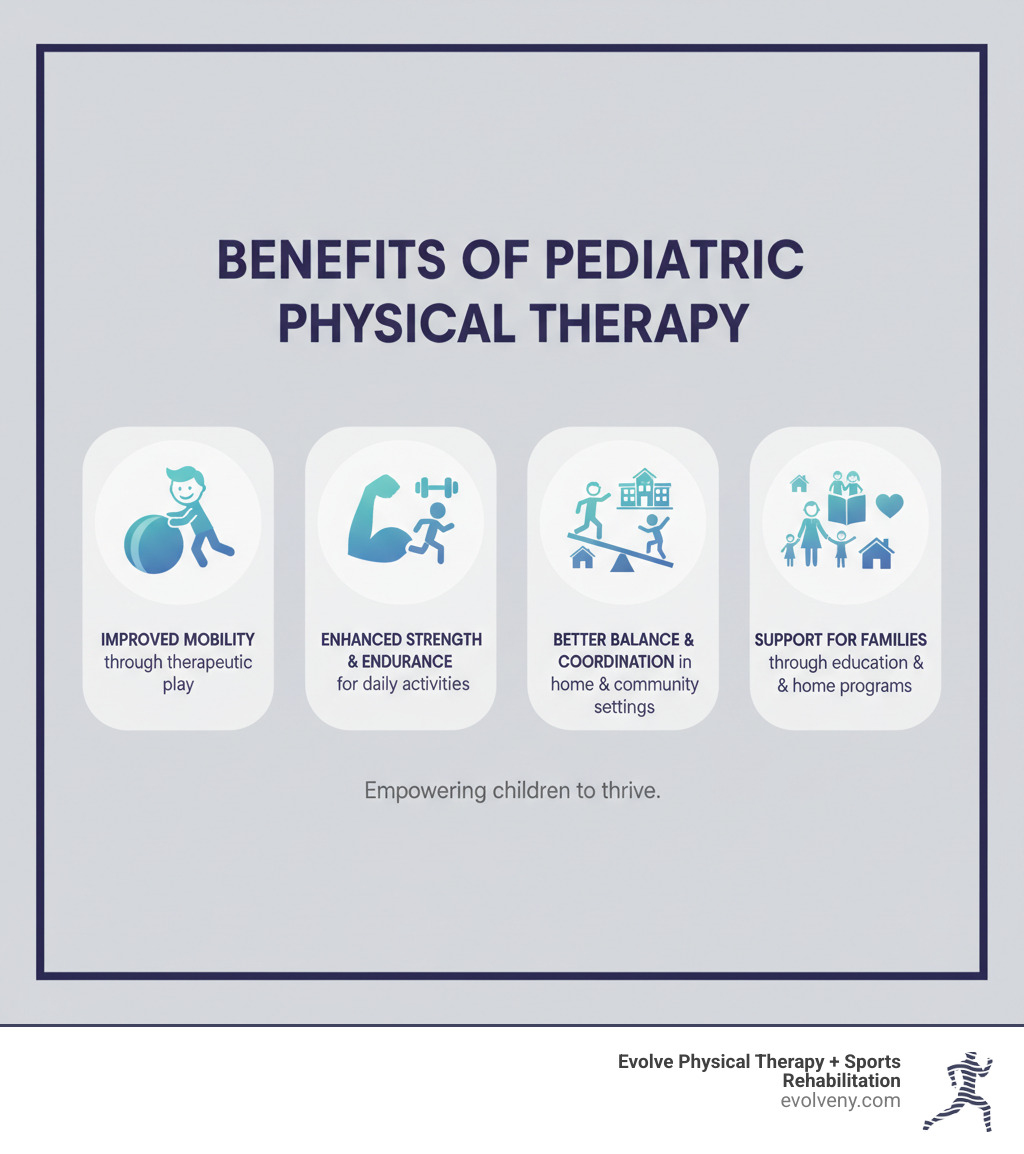
Our interventions aim to help children participate more fully in the activities that matter to them.
- Motor development: We help children acquire and refine the gross motor skills needed to move with confidence.
- Strength and endurance: Building stamina allows children to play longer and keep up with their friends.
- Balance and coordination: Improving these skills boosts confidence and safety in activities from walking to playing sports.
- Participation in home, school, and community: Our ultimate goal is to remove barriers so children can join in with siblings, classmates, and friends.
- Easing daily caregiving: Improved mobility can make daily tasks like dressing and bathing smoother for the whole family.
- Promoting health and fitness: We help children find the joy of movement and build healthy habits for life.
The skills and confidence children develop now shape their entire lives. For additional support, families can explore the Family Resources from APTA Pediatrics.
The Process and Interventions in Pediatric Physical Therapy
When you bring your child to Evolve Physical Therapy, our process is thorough, compassionate, and centered around your family. It begins with a comprehensive evaluation. We discuss your child's medical history, developmental milestones, and your specific concerns. You know your child best, and this conversation is crucial.
During the evaluation, we use careful observational movement analysis and standardized assessments to understand how your child moves and plays. We look for movement patterns and use objective measures to assess motor performance. We also check for any "red flags" that may require follow-up with your pediatrician. Your child's safety and comprehensive care are our top priorities.
From this evaluation, we create a customized treatment plan with specific, meaningful goals custom to your child's needs and your family's priorities. Our treatment blends hands-on care, therapeutic exercise, and functional activities.
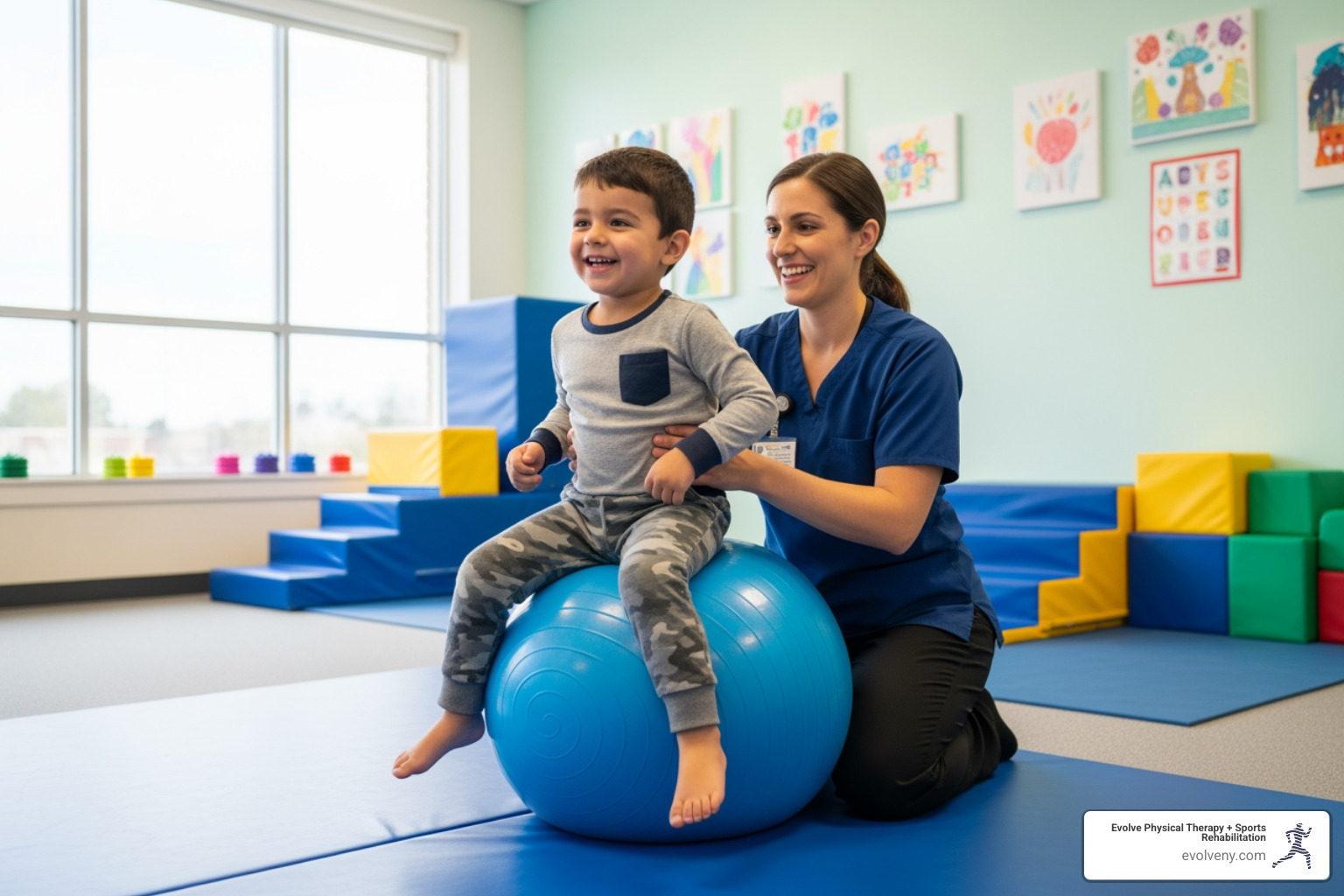
We make therapy feel like play. Therapeutic exercise is woven into games and obstacle courses that motivate children to build balance, strength, and coordination. We also emphasize functional activities—the real-world skills your child needs every day, like navigating stairs or carrying a backpack. This ensures that progress in our clinic translates to greater independence at home and school.
The Crucial Role of Parents and Caregivers
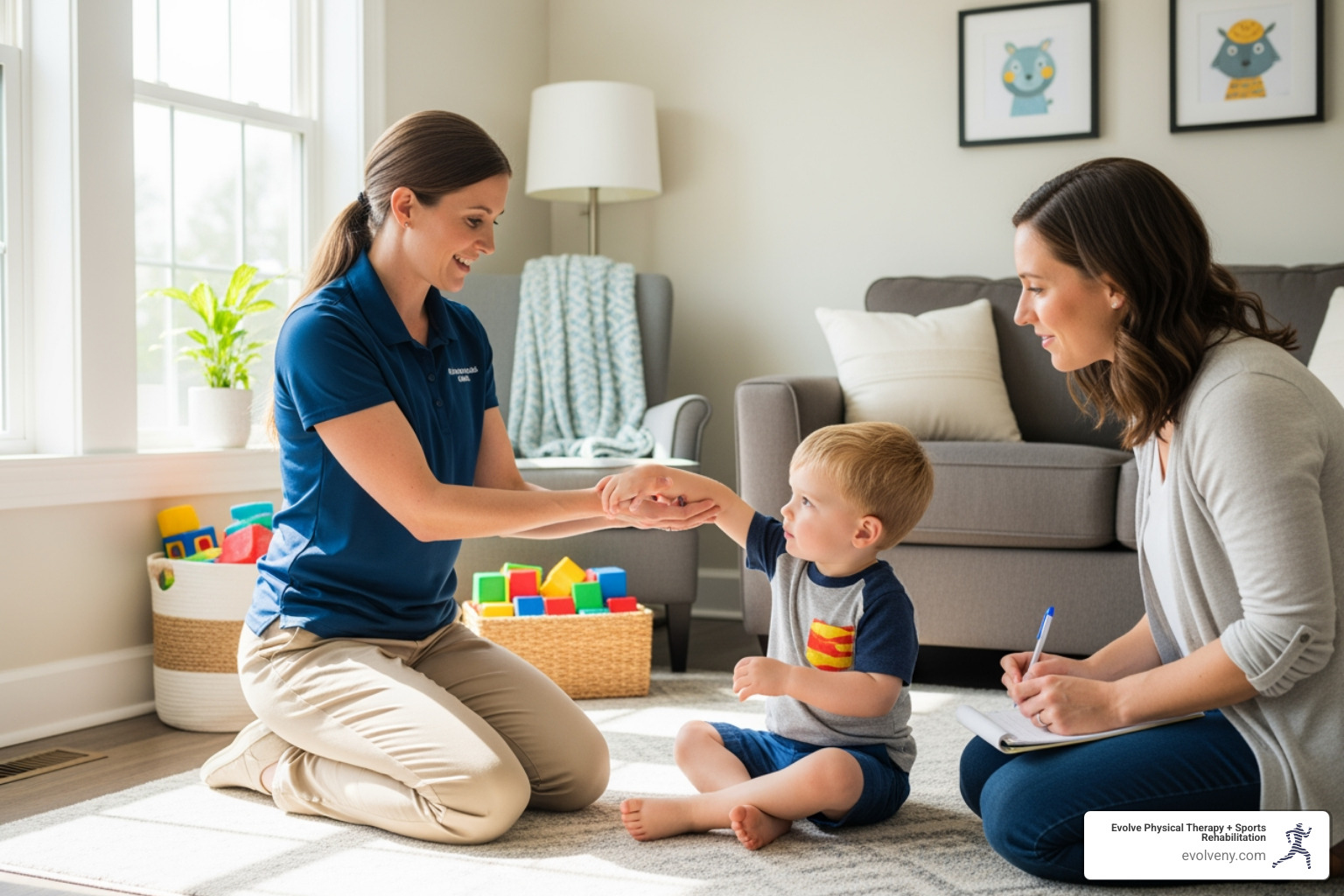
You are an essential part of the therapy team. At Evolve Physical Therapy, we see parents as true partners. Your involvement is vital for your child's long-term success.
Our collaboration begins at the first evaluation, where we invite you to observe and ask questions. We provide a clear home exercise program, demonstrating each activity and explaining its purpose. We also guide you in adapting toys and daily routines to incorporate therapeutic benefits throughout the day. Finally, we support you in advocating for your child within the healthcare and education systems. When families and therapists work together, children thrive.
For more insights, explore More on our approach to pediatric physiotherapy.
Specialized Interventions in Pediatric Physical Therapy
Beyond foundational training, pediatric physical therapy offers specialized interventions. At Evolve, we use evidence-based approaches to address specific challenges.
- Aquatic therapy uses the buoyancy and resistance of water to build strength and coordination with less stress on joints, making it ideal for children who find land-based exercises difficult.
- Specialized exercise programs for scoliosis, such as the Schroth Method, use targeted exercises to improve spinal alignment and posture in children and adolescents.
- Serial casting can be a highly effective treatment for idiopathic toe walking. A series of casts is used to gradually stretch tight muscles and encourage a more typical walking pattern.
- Vestibular therapy is an exercise-based program that retrains the brain to process balance information correctly. It is highly effective for children with balance issues, dizziness, or post-concussion syndrome.
- We also assist families with orthotics and adaptive equipment like braces, walkers, or wheelchairs to provide support, improve alignment, and increase participation.
For young athletes, we offer specialized programs to treat and prevent injuries. Learn more at Pediatric sports PT for young athletes.
Where is Therapy Provided?
Pediatric physical therapy is offered in various settings. At Evolve Physical Therapy, we provide services in our welcoming outpatient clinics in Brooklyn, including Marine Park, Gravesend, Midwood, Park Slope, and Mill Basin. Other settings include:
- In-home therapy, which integrates interventions into a child's natural environment.
- School-based services, which are provided under the Individuals with Disabilities Education Act (IDEA) to help children access their education.
- Hospitals and NICUs, for medically fragile infants or children recovering from acute conditions.
- Community settings like preschools or recreational centers, to help children generalize their skills.
To learn more about our services, visit Learn about our pediatric physical therapy in Brooklyn.
Finding a Qualified Professional and Key Resources
Finding the right pediatric physical therapist is a crucial step. You want a professional who is not only skilled but also patient and invested in your child's success.
Professional Requirements
All licensed physical therapists (PTs) are graduates of accredited Doctor of Physical Therapy (DPT) programs and have passed a national licensure exam. This ensures they have the foundational skills to treat patients safely and effectively.
Many pediatric physical therapists pursue further specialization. The Board-Certified Pediatric Clinical Specialist (PCS) designation is a respected credential that requires extensive clinical experience with children and passing a challenging board exam. A therapist with a PCS has demonstrated advanced knowledge in the field.
At Evolve Physical Therapy, we are committed to evidence-informed practice. We integrate the latest research with our clinical expertise and your family's values to achieve the best outcomes for your child.
How to Find a Qualified Therapist
Navigating the healthcare system can be challenging. Here are a few tips:
- Start with your pediatrician. They can often recommend trusted local therapists. While New York has direct access (no referral needed to start), some insurance plans may still require one.
- Verify your insurance coverage. Our team at Evolve Physical Therapy can help you understand your benefits and any out-of-pocket costs to avoid surprises.
- Ask questions about their experience. Inquire about their background with children, their treatment philosophy, and how they engage kids in therapy. We welcome these conversations.
To search for therapists yourself, the American Physical Therapy Association (APTA) offers online tools like the Find a PT Directory. You can also search for specialists at Find a Board-Certified Pediatric Clinical Specialist.
The Role of APTA Pediatrics
APTA Pediatrics is an organization of nearly 6,000 members dedicated to advancing the field. It supports research, publishes clinical practice guidelines, and offers professional development for therapists. It also publishes the peer-reviewed Pediatric Physical Therapy journal.
For families, APTA Pediatrics provides reliable information. Their fact sheets explain various conditions and what to expect from therapy, empowering you to advocate for your child. We encourage you to Access APTA Pediatrics Fact Sheets to learn more.
Frequently Asked Questions about Pediatric PT
It's natural to have questions when starting pediatric physical therapy. Here are answers to some of the most common ones we hear from families in Brooklyn.
What is the difference between pediatric physical therapy and occupational therapy?
This is a common question. The key difference is the primary focus:
Pediatric physical therapy focuses on gross motor skills—the large movements of the body. We work on strength, balance, and coordination for activities like sitting, walking, running, and jumping.
Occupational therapy (OT) focuses on fine motor skills and the daily activities (or "occupations") of childhood. OTs help with skills like writing, buttoning a shirt, using utensils, and sensory processing.
Often, a child benefits from both. For example, a physical therapist helps a child gain the core strength to sit up, while an occupational therapist helps them use their hands to play while sitting. The two disciplines work together to provide comprehensive support.
How long will my child need physical therapy?
The duration of therapy is unique to each child and depends on several factors:
- Your child's diagnosis and its severity: A minor delay may resolve in a few months, while a complex condition like cerebral palsy may benefit from ongoing therapy over several years.
- Your child's response to treatment: Some children progress quickly, while others need more time and repetition.
- Your participation at home: Consistently practicing home exercises makes a significant difference and can speed up progress.
- Your family's goals: We work with you until your child achieves the meaningful goals you've set together.
We conduct regular re-evaluations to assess progress and adjust the plan, always with the goal of empowering you to maintain gains independently.
Is a physician's referral required to see a physical therapist?
In New York, you have direct access to physical therapy, meaning you can schedule an evaluation with us at Evolve Physical Therapy without a doctor's referral. This allows families to get help faster.
However, it's important to note that many insurance plans still require a physician's referral to cover the cost of therapy. We strongly recommend checking with your insurance provider, and our team is happy to help you verify your benefits.
Additionally, if our evaluation reveals anything that requires further medical assessment, we will refer you to a physician. We work as part of your child's total healthcare team.
Conclusion
Pediatric physical therapy is a transformative field dedicated to helping children build strength, confidence, and freedom of movement. From addressing developmental delays to recovering from sports injuries, the goal is to help children participate fully in life.
The benefits extend far beyond the clinic. When a child gains the ability to play with friends or master a new skill, they are building a foundation for a lifetime of health and joy. These are the victories, big and small, that drive us every day.
At Evolve Physical Therapy, our hands-on, holistic approach focuses on the whole child. We have been honored to serve families throughout Brooklyn, including Marine Park, Gravesend, Midwood, Park Slope, and Mill Basin, for nearly two decades. We don't just treat symptoms; we empower families with the tools for long-term success.
If your child is struggling with movement or development, you don't have to steer this journey alone. Our experienced team is ready to partner with you.
Take the first step today. Schedule a consultation for pediatric physical therapy in Brooklyn and let us help your child move toward a brighter, more active future.
