

The Road to Recovery: Why Hand Therapy is Crucial After Surgery
Why Post-Surgery Hand Therapy is Essential for Your Recovery

Post-surgery hand therapy is a specialized rehabilitation program designed to restore strength, mobility, and function after hand or wrist surgery. Here's what you need to know:
Key Benefits of Post-Surgery Hand Therapy:
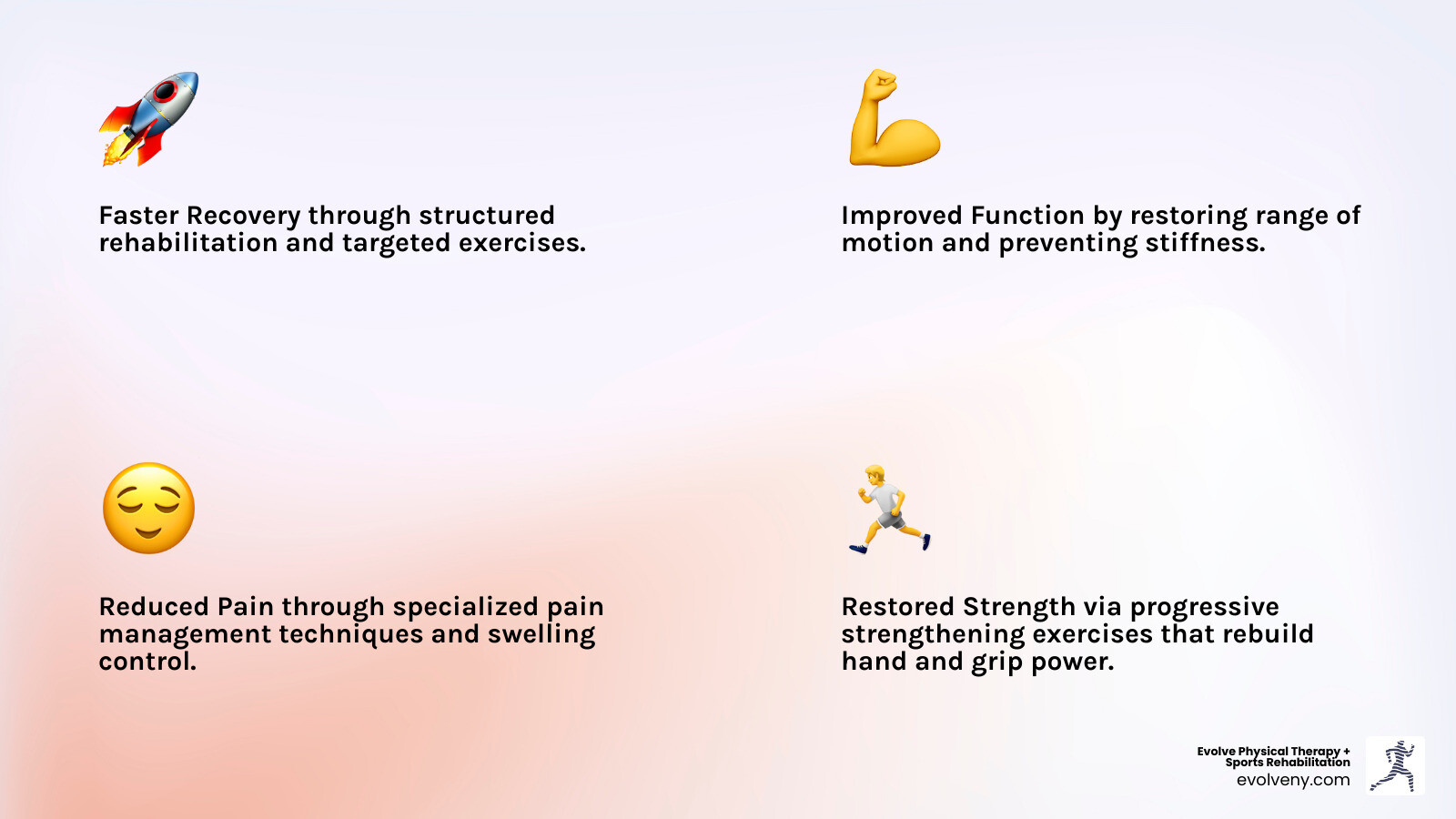
- Faster Recovery - Structured exercises and treatments accelerate healing
- Improved Range of Motion - Prevents stiffness and maintains joint flexibility
- Reduced Pain and Swelling - Specialized techniques manage discomfort effectively
- Restored Strength - Progressive strengthening returns your hand to full function
- Minimized Scar Tissue - Manual therapy prevents adhesions and contractures
Surgery is just the first step in treating hand conditions. While the procedure addresses the underlying problem, the real work of recovery begins afterward.
After hand surgery, you can expect some pain, swelling, and a period of immobilization with bandages or splints. Your doctor may restrict certain activities while your hand heals. But here's what many patients don't realize: rehabilitation may be even more important than the surgery itself.
Recovery after hand surgery depends greatly on the type of procedure you had and your underlying condition. But one thing remains constant—your active participation in therapy directly impacts your outcome. The hand is an intricate and very sensitive part of the body, requiring specialized care to regain its remarkable function.
Progress will be slow but steady. A serious injury or major surgery typically takes about 6 months to really loosen up scar tissue. This isn't a quick fix—it's a commitment to your long-term recovery and quality of life.
I'm Lou Ezrick, founder of Evolve Physical Therapy in Brooklyn, and I've spent nearly two decades helping patients steer complex rehabilitation cases, including specialized post-surgery hand therapy for conditions ranging from carpal tunnel release to traumatic injuries. My approach focuses on hands-on treatment and addressing the root cause of dysfunction, not just managing symptoms.
The Vital Role of Hand Therapy in Your Recovery
When we talk about recovery after hand surgery, we often focus on the surgical procedure itself. However, at Evolve Physical Therapy + Sports Rehabilitation, we understand that surgery is truly just the beginning. The journey to regaining full function in your hand and wrist relies heavily on dedicated post-surgery hand therapy.
What Exactly is Hand Therapy?
Hand therapy is a specialized form of rehabilitation focused on the upper extremity—from the shoulder to the fingertips. Our goal is to restore your upper limb's ability and ensure a safe and sustainable return to daily activities. It's not just about addressing the immediate surgical site; it's about optimizing the entire arm's function to support your hand.
A key aspect of specialized hand therapy is the expertise of a Certified Hand Therapist (CHT). A CHT is either an occupational therapist or a physical therapist who has undergone extensive training and accumulated at least 4,000 hours of direct practice in treating hand, wrist, elbow, and shoulder disorders. They must also pass a rigorous certification exam and maintain their credentials through ongoing education every five years. This advanced certification means they possess a deep understanding of the complex anatomy and mechanics of the hand, making them uniquely qualified to guide your recovery. You can learn more about this specialized field through our guide, What is hand physical therapy?.
The Unwavering Benefits of Post-Surgery Hand Therapy
The benefits of engaging in post-surgery hand therapy are profound and multifaceted:
- Regaining Strength: After surgery, your hand muscles may weaken due to disuse or the healing process. Our therapists guide you through progressive strengthening exercises, rebuilding your grip, pinch, and overall hand power.
- Improving Range of Motion: Stiffness is a common and challenging side effect of surgery. Hand therapy exercises are specifically designed to improve your hand's range of motion, preventing contractures and ensuring your joints move freely. This is crucial for performing everyday tasks.
- Managing Swelling (Edema): Swelling can impede healing and cause pain. Hand therapy incorporates techniques like elevation, compression, and specific movements to reduce edema and improve circulation.
- Scar Tissue Management: Surgery inevitably leaves scar tissue. If not properly managed, it can become thick, tight, and restrict movement. Through specialized massage, mobilization techniques, and even silicone applications, we help soften and flatten scar tissue, preventing adhesions and improving flexibility.
- Pain Reduction: While some discomfort is expected, our therapists use various modalities and techniques to manage and reduce your post-operative pain, allowing you to participate more effectively in your rehabilitation.
- Sensory Re-education: Nerves can be affected by injury or surgery. Hand therapy includes desensitization and sensory re-education to help your hand regain normal sensation and prevent issues like Complex Regional Pain Syndrome (CRPS).
Your Active Participation is Key
We cannot stress this enough: your effort and dedication to your daily home therapy program are just as important as the surgeon's skill during the operation. Excellent results are consistently seen in motivated patients who diligently follow their rehabilitation plan. Don't rely solely on scheduled therapy appointments; consistent, daily work is essential. As outlined by Johns Hopkins Medicine, management after surgery is a comprehensive process where patient adherence is paramount. We recommend a minimum of a full half-hour of focused exercises, five times a day, to truly make progress.
Your Guide to Post-Surgery Hand Therapy Treatments and Exercises
At Evolve Physical Therapy + Sports Rehabilitation in Brooklyn, we believe in a holistic, hands-on approach to your recovery. Every patient's journey is unique, which is why we develop customized treatment plans custom to your specific surgery, condition, and personal goals. We work in close collaboration with your surgeon, ensuring our therapy aligns perfectly with your post-operative protocol. This integrated approach, as highlighted in our guide to hand surgery rehab in Brooklyn, is critical for optimal outcomes. The importance of a specialist cannot be overstated, especially when dealing with the intricate mechanics of the hand.
Common Hand Therapy Treatments
Our comprehensive post-surgery hand therapy programs incorporate a variety of proven treatments:
- Splinting and Bracing: Often, protective orthotics (splints or braces) are custom-made or adjusted to support and protect the healing tissues. They can immobilize specific joints, provide controlled motion, or offer stability during activities, preventing re-injury and promoting optimal healing.
- Manual Therapy: This involves hands-on techniques performed by your therapist to mobilize joints, stretch tight tissues, reduce swelling, and improve circulation. It’s a cornerstone of our hands-on approach.
- Massage Techniques: Targeted massage can help reduce pain, improve blood flow, and, importantly, manage scar tissue. Massaging the surgical scar helps to soften it, prevent adhesions to underlying structures, and improve skin elasticity.
- Heat and Cold Therapy: Heat therapy helps to relax muscles, increase blood flow, and prepare tissues for stretching and exercise. Cold therapy, on the other hand, is excellent for reducing pain and inflammation, especially after exercise or if swelling is present.
- Desensitization for Nerve Sensitivity: After nerve injury or surgery, the hand can become overly sensitive. Desensitization techniques involve exposing the area to various textures and pressures to gradually reduce sensitivity and help nerves interpret sensations normally.
- Nerve Gliding Exercises: These specific exercises are designed to help nerves move freely within their sheaths, preventing adhesions and reducing symptoms like tingling or numbness, particularly after procedures like carpal tunnel release.
- Scar Mobilization: Beyond general massage, scar mobilization focuses on specific techniques to prevent fibrosis (thickening) and adhesions of scar tissue, which can severely limit movement and cause pain.
Essential Exercises for Post-Surgery Hand Therapy

Exercises are the backbone of your post-surgery hand therapy. They are carefully chosen and progressed to meet your healing needs:
- Range of Motion (ROM) Exercises: These are fundamental. They help to restore the flexibility and movement of your joints. We often start with gentle, pain-free movements and gradually increase the range as your healing progresses. Examples include wrist bends (bending your wrist up and down, side to side), finger bends (making a gentle fist and then straightening your fingers), and tabletop exercises (placing your hand flat on a table and lifting individual fingers or gliding them in a wave-like motion).
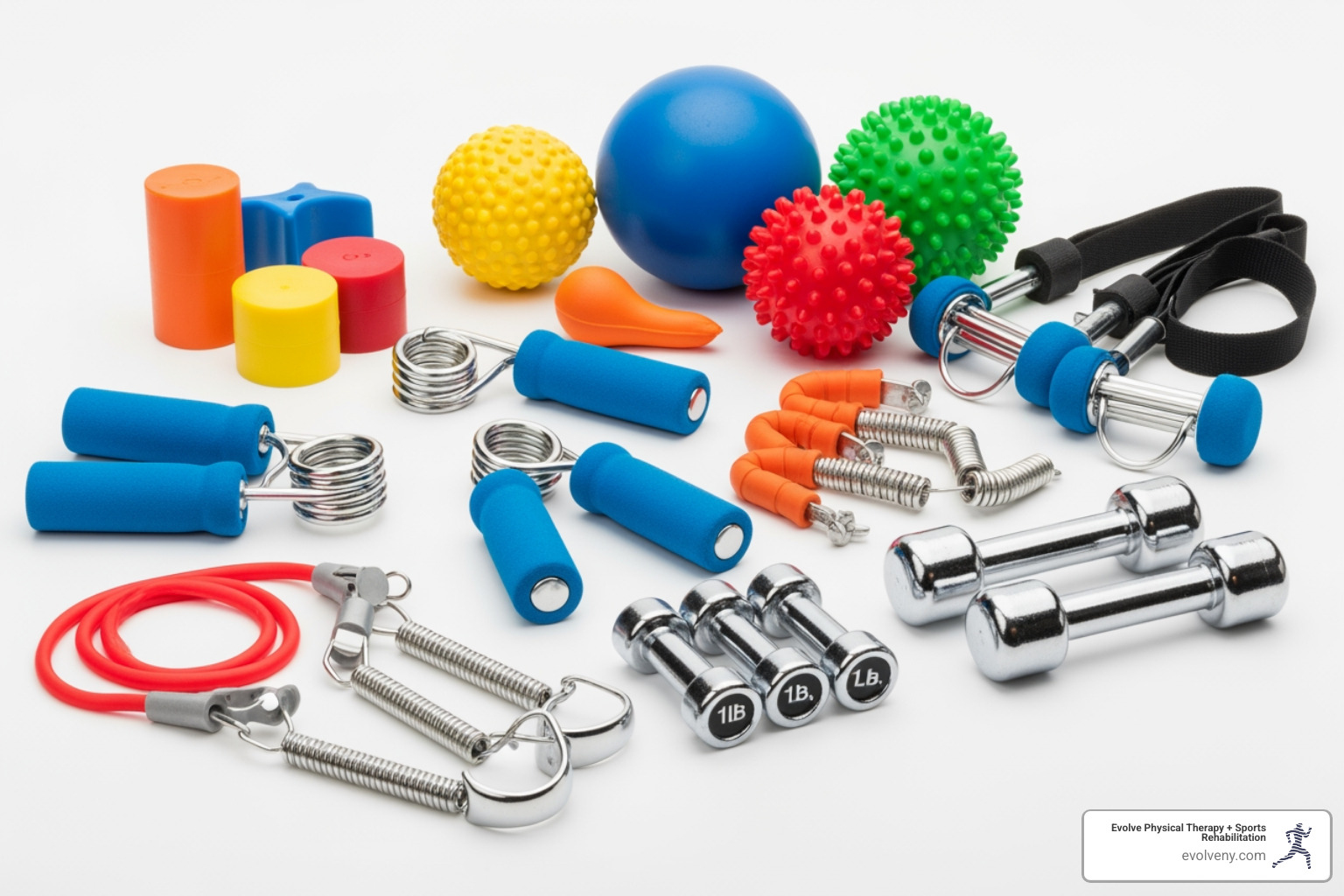
- Strengthening Exercises: Once sufficient healing has occurred, we introduce exercises to rebuild your hand and forearm strength. This might involve squeezing a soft ball, using putty for resistance, or carefully lifting light weights. Progressive strengthening is vital for returning to daily tasks and activities.
- Functional Task Training: The ultimate goal of therapy is to get you back to doing what you love. Functional task training involves practicing movements and activities specific to your daily life, work, or hobbies. This could include picking up small objects, writing, typing, or simulating work-related movements.
For a deeper dive into how movement helps recovery, explore how post-surgery range-of-motion exercises are crucial for improving flexibility and reducing pain.
Understanding Range of Motion in Your Post-Surgery Hand Therapy
Understanding the different types of range of motion is crucial in your recovery. They dictate how much movement you can achieve and how your muscles are engaged.
- Passive Range of Motion (PROM): In PROM exercises, your therapist, or sometimes a special device, moves your hand or a joint for you. You don't use your own muscles to perform the movement. This is typically done in the very early stages of recovery when active movement might be painful or restricted, helping to maintain joint flexibility and prevent stiffness.
- Example: Your therapist gently bends and straightens your fingers or wrist while you relax your hand.
- Active-Assisted Range of Motion (AAROM): With AAROM, you actively participate in the movement, but with some assistance from your therapist or your other hand. This bridges the gap between passive and active exercises, helping you regain control and build initial muscle strength.
- Example: You use your healthy hand to gently guide your surgical hand through a wrist circle, or your therapist provides light support as you try to make a fist.
- Active Range of Motion (AROM): AROM exercises involve you moving your hand or joint entirely on your own, using only your own muscles. This is a critical step for strengthening and improving coordination.
- Example: You independently perform finger spreads, wrist flexion/extension, or thumb opposition exercises without any external help.
Navigating Your Recovery Timeline and Maximizing Results
Recovery after hand surgery is undeniably a process, not a race. It requires patience, consistency, and a clear understanding that progress will be slow but steady. A bad injury or major surgery will make your hand stiff, and it usually takes about 6 months to really loosen up scar tissue. This is why a comprehensive and phased approach to healing, guided by expert post-surgery hand therapy, is so important. For more insights into the duration of therapy, you can read our article, how long is physical-therapy after hand-surgery.
Typical Recovery Phases After Hand Surgery
While timelines can vary based on the specific surgery and individual healing, we generally follow a phased approach to rehabilitation, often spanning several months:
Phase 1: Inflammatory Phase (Weeks 1-3 Post-Op)
- Principle: Protection of the injured hand to facilitate uneventful healing.
- Focus: Managing pain and swelling, protecting the surgical site, and initiating very gentle, pain-free motion. Your hand will likely be immobilized in a splint or dressing.
- Activities: We emphasize rest, ice, compression, and elevation (RICE). You'll learn how to perform full active/passive range of motion exercises for your shoulder, elbow, and forearm, as well as light, pain-free movements of your digits (fingers and thumb) if permitted by your surgeon. Patient education on self-management is crucial.
- Goal: Healing without complications, limited swelling, and full (or pre-op) ROM in uninjured joints.
Phase 2: Early Repair Phase (Weeks 4-6 Post-Op)
- Principle: Continued protection with promotion of directed tissue repair.
- Focus: Controlled mobilization, scar management, and beginning to restore basic strength.
- Activities: Your splint use may become part-time. We'll introduce tendon and nerve gliding exercises, gentle passive range of motion, and light resisted grip/pinch strengthening using soft objects or putty. We'll also start scar hydration, compression, and mobilization to prevent adhesions. You'll begin using your hand for pain-free, light household activities (e.g., lifting less than 20 lbs).
- Goal: Established tissue healing with isometric strength, flat and minimally sensitive scars, and improved wrist ROM (e.g., >50% of the other side).
Phase 3: Late Repair and Early Tissue Remodeling Phase (Weeks 7-12 Post-Op)
- Principle: Reestablishment of proprioception (your hand's sense of position in space) and encouraging normal tissue structure.
- Focus: Graduated strengthening, improving endurance, and functional reactivation.
- Activities: Daytime splint use is typically discontinued. We progress to more resisted grip/pinch strengthening, isotonic/eccentric wrist strengthening, and workplace-specific functional tasks. You'll gradually increase your lifting capacity (e.g., up to 40 lbs) and participate in more moderate household activities.
- Goal: Normal tissue structure and reinnervation through daily activities, approximately 75% of pre-op wrist ROM, and 50-75% of pre-op grip and pinch strength.
Phase 4: Remodeling and Reintegration Phase (Week 13+ Post-Op)
- Principle: Normalization of proprioceptive function with optimal biomechanics.
- Focus: Maximal medical improvement, endurance training, and full return to activities.
- Activities: We focus on advanced strengthening, power development, and practicing complex functional tasks relevant to your work, sports, or hobbies. This phase emphasizes fine-tuning your hand's capabilities and ensuring optimal endurance. For some, functional bracing might be used during "at-risk" activities.
- Goal: Optimal endurance, normalized tissue structure, and greater than 75% of pre-op wrist ROM and grip/pinch strength, enabling you to meet most critical job demands and return to desired activities.
It’s important to note that while formal therapy might conclude around 8-12 weeks, continued improvements in functional tolerance, mobility, strength, and nerve recovery can be expected for up to nine months post-surgery, largely dependent on your adherence to a home exercise program.
How to Maximize Your Recovery
Maximizing your recovery after hand surgery involves active participation and careful attention to your body's signals. Here's how you can make the most of your post-surgery hand therapy:
- Follow Your Therapist's Instructions Diligently: Your hand therapist is your expert guide. They've crafted a specific plan for you, and adhering to their instructions for exercises, splint wear, and activity modification is crucial. The absolute minimum is a full half-hour of dedicated exercise, five times a day.
- Adhere to Your Home Exercise Program (HEP): Your HEP is designed to reinforce the work done in therapy sessions. Consistency is key. Frequent sets of low-amplitude, high-repetition movements are often safer and more effective than infrequent, high-intensity efforts.
- Manage Swelling with Elevation: Keeping your hand liftd, especially in the early stages, is vital for reducing swelling. When sitting, keep your hand higher than your elbow. When resting or sleeping, use pillows to position your hand above your heart. Even between exercise sets, rest your hand in a posture that avoids dependent swelling.
- Prioritize Proper Nutrition and Hydration: A healthy diet rich in protein, vitamins, and minerals supports tissue repair and overall healing. Staying well-hydrated is also important for cellular function.
- Listen to Your Body: While some discomfort during therapy is normal as you stretch and strengthen, exercises should not provoke sharp or persistent pain. If something feels wrong, communicate it immediately to your therapist. Pushing too hard too soon can lead to setbacks or re-injury.
When to Seek Professional Help
While post-surgery hand therapy is designed to guide you through a smooth recovery, recognize when your body might be signaling a problem that requires immediate professional attention. Contact your surgeon or therapist if you experience any of the following:
- Persistent or Worsening Pain: If your pain doesn't improve with rest, medication, or your rehabilitation program, or if it suddenly gets worse, it's a red flag.
- Severe Swelling That Doesn't Subside: Some swelling is normal, but if it's excessive, doesn't decrease with elevation and ice, or is accompanied by increased pain or tightness, it could indicate a complication.
- Loss of Function or Movement: A sudden or progressive inability to move your hand or fingers, or a significant decrease in your range of motion, is a serious concern.
- Signs of Infection: Look out for increased redness, warmth, pus, foul odor, or fever. These require immediate medical evaluation.
- Numbness or Tingling That Worsens: While some nerve sensations can be normal during healing, increasing numbness, tingling, or weakness could indicate nerve compression or damage.
Frequently Asked Questions about Post-Surgery Hand Therapy
We understand you likely have many questions as you start on your recovery journey. Here are answers to some of the most common inquiries we receive about post-surgery hand therapy:
How long does hand therapy typically last after surgery?
The duration of post-surgery hand therapy is highly individualized and depends on several factors, including the type of surgery you had, the severity of your initial injury, your personal healing rate, and your dedication to your home exercise program.
Generally, you can expect formal, in-clinic therapy to last anywhere from 8 to 12 weeks. For example, after an Open Carpal Tunnel Release, formal therapy might be delayed by 1 to 3 weeks initially and then continue for about 8 weeks. However, this doesn't mean your recovery stops there. Significant improvements, particularly in loosening scar tissue and regaining maximal function, can continue for up to 6 months, and even up to 9 months post-surgery for some conditions, especially with consistent home exercise compliance.
Our goal is to equip you with the tools and knowledge to manage your recovery long-term, ensuring you continue progressing towards your maximal medical improvement even after your formal therapy sessions conclude.
Will hand therapy be painful?
It's a common concern, and we want to be clear: while some discomfort or soreness is a normal part of the healing and rehabilitation process, post-surgery hand therapy should not be excruciatingly painful. Our guiding principle is that exercises should not provoke sharp or unbearable pain.
We work carefully within your comfortable limits, gradually increasing intensity as your body heals and adapts. You might experience some stretching sensations, muscle fatigue, or mild soreness, especially as we work to improve range of motion or strengthen weakened muscles. This is a sign that your tissues are adapting.
Communication with your hand therapist is absolutely key. If you experience pain that feels too intense, persistent, or sharp, tell us immediately. We have various techniques, including manual therapy, modalities like heat or cold, and desensitization for nerve sensitivity, to help manage discomfort and ensure your therapy is effective without causing undue suffering.
What's the difference between a Physical Therapist and a Certified Hand Therapist (CHT)?
The distinction between a general physical therapist (PT) and a Certified Hand Therapist (CHT) is an important one, especially when dealing with the intricate complexities of the hand and wrist.
- Physical Therapists (PTs) are healthcare professionals trained to diagnose and treat movement dysfunctions throughout the entire body. They have a broad scope of practice, helping patients recover from injuries, manage chronic conditions, and improve overall physical function.
- A Certified Hand Therapist (CHT) is a specialized credential held by either a physical therapist or an occupational therapist. To become a CHT, an individual must:
- Be a licensed physical therapist or occupational therapist.
- Accumulate a minimum of 4,000 hours of direct clinical experience specifically in hand and upper extremity therapy.
- Complete extensive continuing education in the field.
- Pass a rigorous certification examination.
- Maintain their certification every five years through ongoing advanced training.
This advanced certification means CHTs possess a unique depth of knowledge in the anatomy, biomechanics, and pathology of the hand, wrist, elbow, and shoulder. They are experts in designing and implementing highly specialized treatment plans for complex upper extremity conditions and post-surgery hand therapy. While all our therapists are highly skilled, a CHT brings a level of focused expertise that is invaluable for optimal hand recovery.
Conclusion: Take the Next Step in Your Hand Recovery Journey
Your hand is a marvel of engineering, essential for nearly every aspect of your daily life. After surgery, starting on a dedicated post-surgery hand therapy program isn't just recommended—it's absolutely critical for restoring its remarkable function. We've seen how a comprehensive, custom approach, combined with your commitment, can make all the difference in achieving the best possible outcomes.
Getting a good result from surgery has a lot to do with the therapy that comes after. Excellent results are seen in well-motivated and dedicated patients who work hard with their daily home therapy. By actively participating, diligently following your therapist's guidance, and understanding the phased nature of healing, you can regain strength, improve flexibility, reduce pain, and ultimately return to the activities you love.
At Evolve Physical Therapy + Sports Rehabilitation in Brooklyn, we offer holistic physical therapy services, focusing on thorough evaluation, effective healing, and sustainable strengthening. Our unique hands-on approach ensures personalized care, guiding you through each step of your recovery journey. Don't let stiffness, pain, or limited mobility define your post-surgery experience.
Are you ready to take control of your recovery and open up the full potential of your hand? Start your specialized hand therapy in Brooklyn today with Evolve Physical Therapy + Sports Rehabilitation. We're here to help you evolve past your injury.
