

Beyond the Ache: A Comprehensive Guide to Physical Therapy for Herniated Discs
Understanding Your Back Pain: Why Physical Therapy Matters
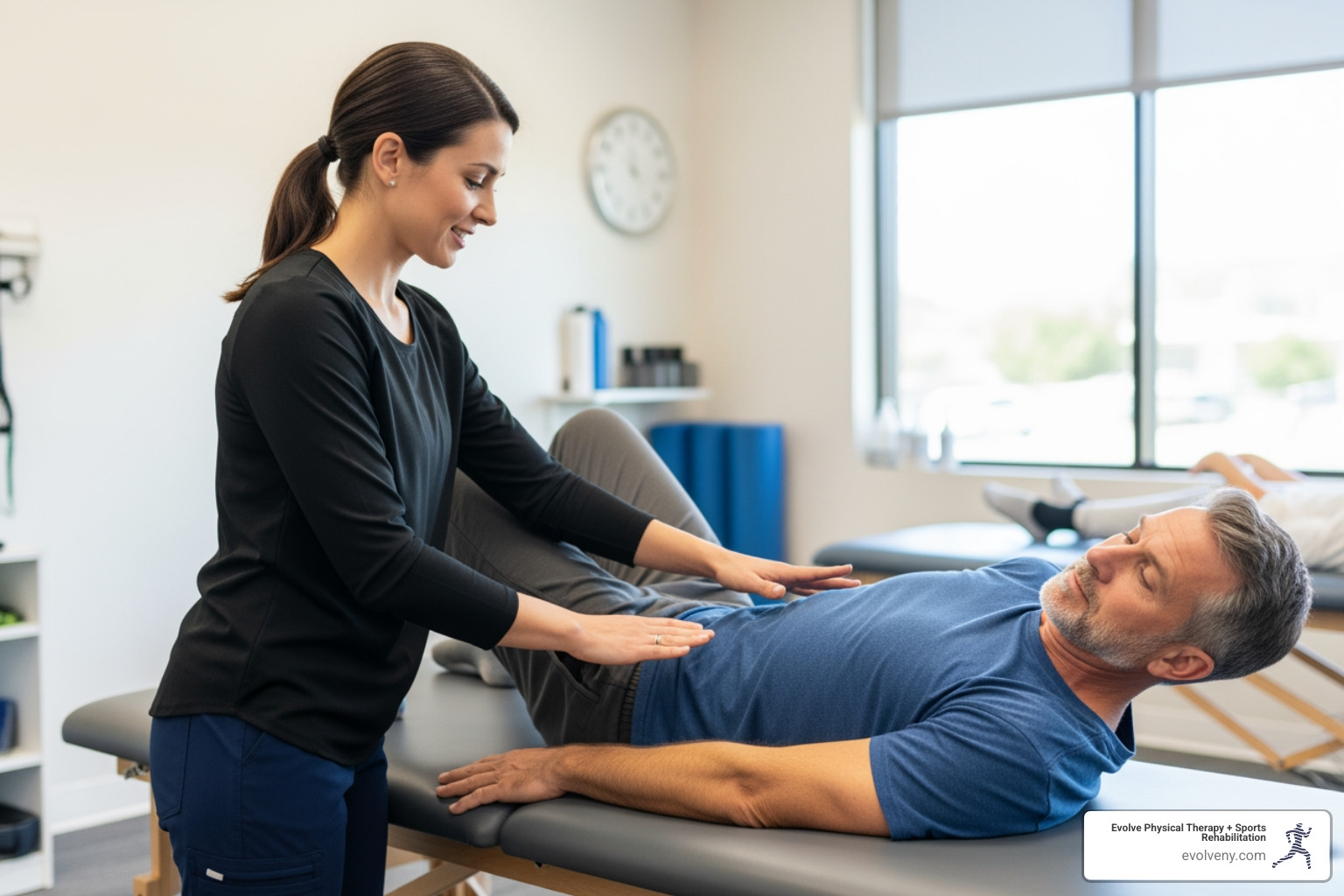
Is physical therapy good for herniated disc treatment? The answer is a resounding yes. Here's what the research shows:
Key Findings:
- 80-90% of patients with herniated discs improve without surgery
- 87% experience pain reduction within 3 months using conservative care
- Physical therapy often produces better long-term results than surgery or pain medications
- Most people see improvement within a few weeks of starting treatment
- Surgery offers faster relief, but outcomes at 1 year are similar to conservative treatment
If you're one of the roughly 3 million people with a herniated disc this year, you're likely dealing with disruptive pain, numbness, or weakness. The good news is your body can heal itself with the right support.
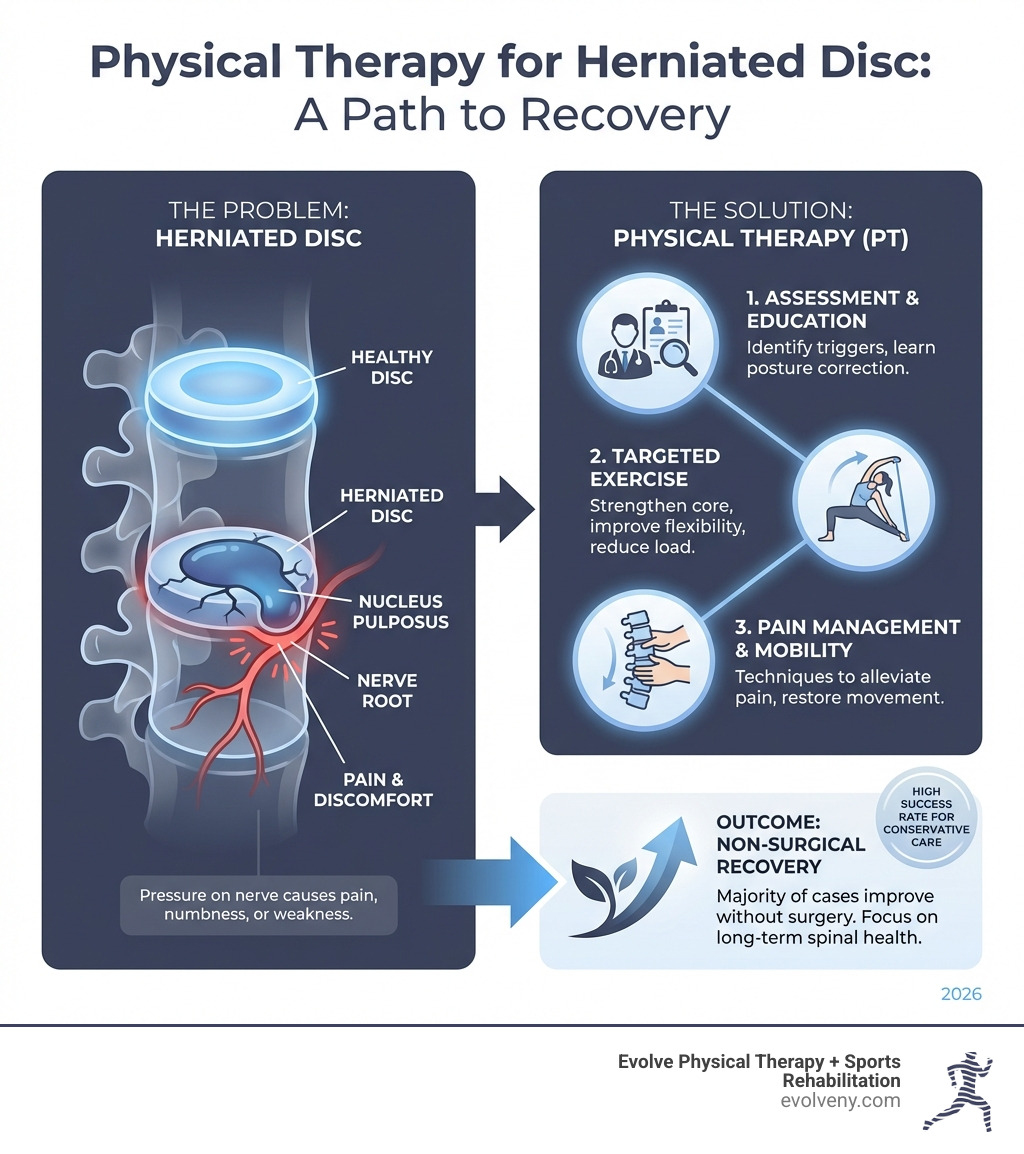
A herniated disc occurs when a disc's soft center pushes through its tougher outer layer due to age, strain, trauma, or improper lifting. This material can press on nerves, causing radiating pain in your leg (sciatica) or arm.
While it sounds serious, most cases resolve with conservative treatment. Physical therapy addresses symptoms and the underlying movement patterns and muscle imbalances that caused the problem.
I'm Lou Ezrick, founder of Evolve Physical Therapy in Brooklyn. For nearly two decades, I've helped thousands recover from herniated discs with manual therapy and personalized rehab. Is physical therapy good for herniated disc recovery? Research and clinical experience show it's often the most effective first-line treatment.
So, Is Physical Therapy Good for a Herniated Disc?
Absolutely. For the vast majority of people with a herniated disc, surgery isn't the answer. A remarkable 80-90% of patients with a new disc herniation improve significantly without it. This statistic highlights the body's capacity for healing when guided by effective conservative care.
At Evolve Physical Therapy in Brooklyn, a well-structured program is a game-changer. We use non-invasive, drug-free methods to reduce pain and address its root causes. Research shows conservative care like physical therapy often yields better long-term results than surgery or opioids, offering lasting relief without the associated risks or dependency.
Our primary goal is to alleviate pain and restore your function. Our personalized programs reduce nerve pressure, decrease inflammation, and strengthen spinal support muscles, helping you return to a pain-free, active life in Brooklyn.
For more detailed information on managing pain, explore our insights on pain management for herniated discs.
The Core Benefits: Answering "is physical therapy good for a herniated disc?"
When we talk about whether is physical therapy good for herniated disc recovery, we're really asking about the comprehensive benefits that go beyond just temporary pain relief. Our team of expert physical therapists in Brooklyn focuses on a multi-faceted approach to healing, ensuring you not only feel better but stay better.
Here are the core benefits you can expect:
Pain and Inflammation Reduction: A herniated disc pressing on a nerve causes significant pain and inflammation. We use gentle movements, manual therapy, and modalities like ice or heat to reduce swelling and calm nerves. This initial phase breaks the pain cycle, allowing for active rehabilitation.
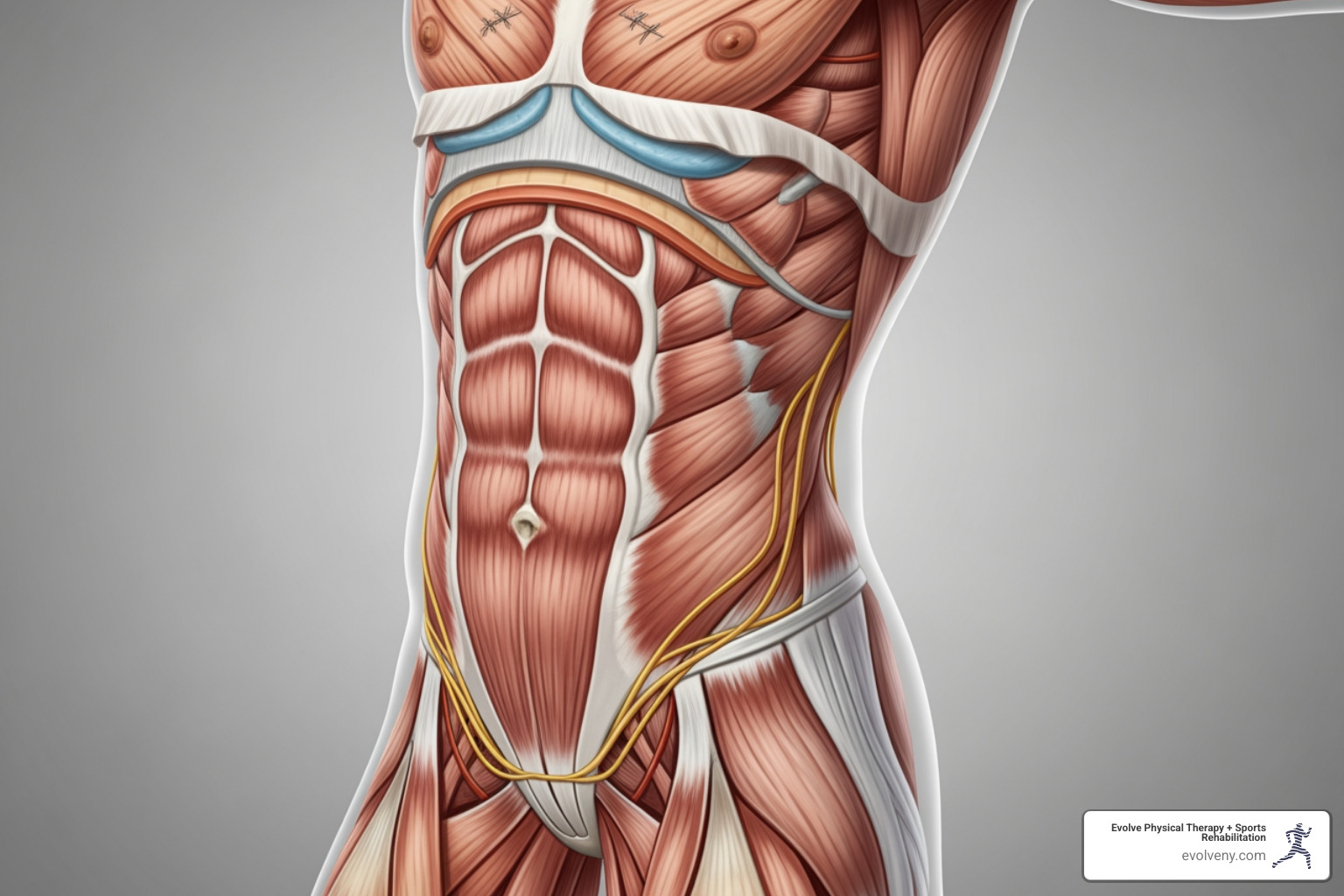
Core Muscle Strengthening: Your core muscles act as a natural corset for your spine. Strong core muscles (abdominals, back, upper thigh, and glutes) stabilize your back, reduce pressure on the disc, and prevent further damage. Our targeted exercises build this vital strength, creating a protective shield for your spine.
Improved Flexibility and Mobility: Pain can cause stiffness and reduced mobility. We guide you through specific stretches and exercises to gently restore spinal flexibility and movement. This eases discomfort and helps normalize movement patterns that contributed to the issue.
Posture and Body Mechanics Education: How you sit, stand, lift, and sleep impacts your spinal health. We educate you on proper posture and body mechanics, teaching you to move in ways that protect your spine, reduce strain, and prevent future injuries. This gives you the tools for long-term management.
Reduced Pressure on Spinal Nerves: These benefits combine to reduce pressure on your spinal nerves. By strengthening muscles, improving posture, and restoring alignment, we create more space around the nerves, which decreases pain, numbness, and tingling.
Physical Therapy and Other Conservative Approaches: What the Research Shows
Scientific evidence overwhelmingly supports physical therapy for herniated discs. Research shows a "favorable natural history," with 87% of patients seeing pain decrease within three months without surgery. This highlights the body's healing capabilities, which our PT programs are designed to improve.
Multiple studies show conservative care like physical therapy often produces better long-term results than surgery or pain medication. While surgery may offer faster initial relief, outcomes at one year are similar to conservative treatment. This means you can achieve the same results without the risks, recovery time, and costs of surgery.
Physical therapy is a comprehensive approach that empowers you to manage your condition. However, further medical intervention is sometimes necessary. If you don't improve after about six weeks, or experience severe symptoms like progressive weakness, loss of bladder/bowel control, or uncontrolled pain, we work with your physician to explore other options. These rare situations require immediate medical attention.
For a deeper dive into the comparison of treatment outcomes, you can review the findings presented in this article on herniated lumbar intervertebral discs.
Your Recovery Roadmap: What to Expect from Physical Therapy
Starting physical therapy for a herniated disc can feel new, but we're here to guide you. At Evolve Physical Therapy in Brooklyn, our goal is to create a clear, effective, and custom recovery roadmap for you.
Your journey begins with a thorough initial evaluation. We'll listen to your history, ask about symptoms, and perform a comprehensive physical assessment, checking your range of motion, strength, sensation, and posture. This detailed evaluation helps us understand your unique condition and how it affects you.
Based on this assessment, we develop a personalized treatment plan. This bespoke program is designed for your individual needs and goals, outlining the techniques, exercises, and education we'll use to help you heal.
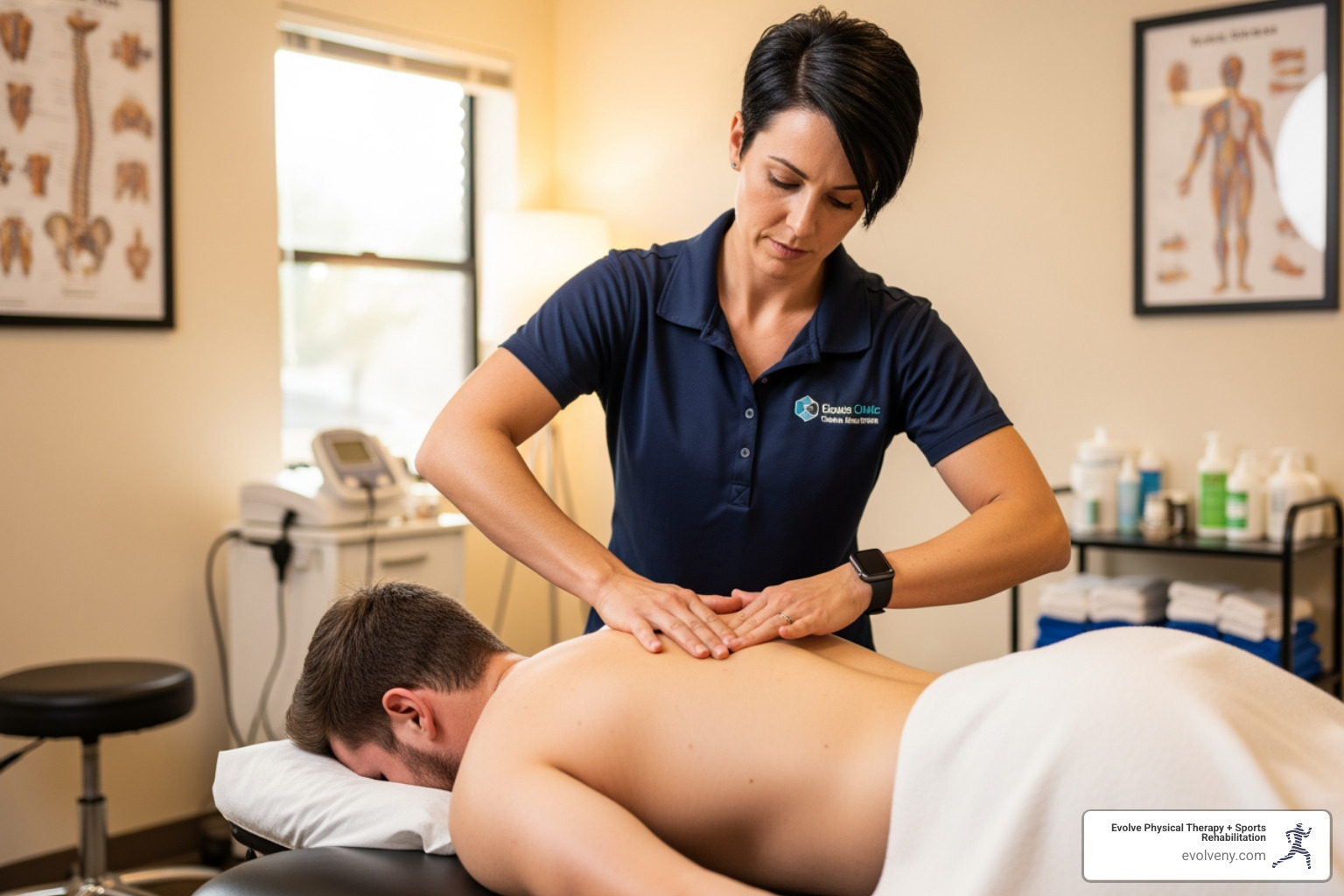
You’ll experience our commitment to hands-on care. Our skilled therapists in Marine Park, Gravesend, Midwood, Park Slope, and Mill Basin use manual therapy to mobilize joints, release tight muscles, and improve tissue mobility. This direct approach is effective for reducing pain and restoring movement.
A cornerstone of our philosophy is patient education. Understanding your condition is key to long-term success. We’ll teach you about your spine, safe movement, and correct home exercises, empowering you to participate in your recovery and prevent future issues.
To learn more about our comprehensive services, visit our complete guide to physical therapy in Brooklyn.
The Phases of Rehabilitation: How is physical therapy good for a herniated disc over time?
The healing process for a herniated disc isn't a sprint; it's a carefully orchestrated journey that typically unfolds in phases. Understanding these phases helps illustrate how is physical therapy good for herniated disc recovery, providing targeted interventions at each stage.
Phase 1: Pain and Inflammation Control Initially, pain and inflammation are at their peak. Our first focus is calming these symptoms using modalities like ice and heat, plus gentle movements and positions of comfort to alleviate nerve pressure. The goal is to break the pain cycle and prepare for active rehab.
Phase 2: Restoring Mobility As pain subsides, we focus on restoring mobility and flexibility. We combat stiffness with targeted stretching and manual therapy to gently mobilize your spine and surrounding joints. Our hands-on techniques improve joint movement and lengthen tight muscles, helping you move more freely.
Phase 3: Building Strength Next, we build your body's internal support system. We introduce exercises to strengthen your core (abdominals, back, glutes, hips) and other supporting muscles. A strong core is vital for stabilizing the spine, reducing disc load, and preventing re-injury. We progress exercises carefully to be challenging yet safe.
Phase 4: Returning to Function and Prevention In the final phase, we focus on returning you to your normal activities. We use activity-specific training for your work, sports, or hobbies. We also emphasize prevention by reinforcing proper body mechanics, lifting techniques, and posture. Our goal is to equip you with tools to maintain your spinal health independently and reduce future risks.
How Long Does Recovery Take?
One of the most common questions we hear is, "How long until I feel better?" While every recovery is unique, we can offer general timelines based on experience and research.
Many people see initial improvement within a few weeks of starting physical therapy. This often includes reduced pain, better sleep, and easier daily movement. This quick response is encouraging and motivating for the rest of your recovery.
However, achieving full recovery—returning to your prior level of function—typically takes several months. For severe cases, it might take up to a year. The duration is influenced by several factors:
- Severity of the Herniation: A smaller herniation might resolve faster than a larger one.
- Adherence to the Program: Consistency with your home exercises and following your therapist's advice is paramount. Think of it as teamwork; we guide, you do the work!
- Individual Healing Capacity: Everyone's body heals at its own pace.
- Lifestyle Factors: Maintaining a healthy weight, avoiding smoking, and managing stress can all positively impact your recovery.
The key takeaway here is the importance of consistency. Continuing your exercises and maintaining good body mechanics, even when you feel better, is crucial for long-term success and preventing recurrence. Our team in Brooklyn will be there to support you every step of the way.
For more information on back pain physical therapy, including recovery insights, visit our page on back pain physical therapy in Brooklyn.
The Building Blocks of Healing: Key PT Exercises and Techniques
To understand if physical therapy is good for a herniated disc, it's helpful to know the techniques we use. We combine evidence-based practices with hands-on expertise to create a personalized, effective treatment plan.
A key concept is pain centralization, where pain retreats from a limb back toward the spine. When an exercise causes pain to centralize, it's a strong indicator of a good prognosis and that we're on the right track.
The McKenzie Method, also known as Mechanical Diagnosis and Therapy (MDT), is a widely recognized approach. It uses a systematic assessment to find movements or positions that reduce symptoms by promoting pain centralization. This empowers you to manage your pain with specific exercises. Research shows MDT can be superior for improving short-term pain and disability.
Manual therapy is another cornerstone of our treatment. Our therapists use skilled, hands-on techniques to mobilize joints, manipulate soft tissues, and reduce muscle spasms. These techniques can include:
- Joint Mobilizations: Gentle, rhythmic movements applied to spinal joints to improve their range of motion and reduce stiffness.
- Soft Tissue Mobilization: Techniques like massage or myofascial release to address muscle tightness, trigger points, and fascial restrictions that contribute to pain and limit movement.
- Thrust Manipulation: In specific cases, our therapists may use controlled, precise thrusts to restore normal joint mechanics, particularly in the middle back. This can often provide prompt relief by breaking up scar tissue and freeing up restricted joints.
At Evolve Physical Therapy, we integrate these techniques with exercises, education, and functional training for a holistic path to recovery. For a deeper dive into lower back exercises for herniated discs, check out our blog post on lower back exercises.
Safe and Effective Exercises
Movement might feel daunting with a herniated disc, but the right exercises are crucial for healing. We'll guide you through a personalized program to reduce pain, improve flexibility, and build strength. Here are some common exercises we often recommend:
Neck Stretches (Chin Tucks): If your herniated disc is in your neck, gentle stretches can make a big difference. A simple chin tuck, where you gently pull your chin back as if making a double chin, helps to lengthen the back of your neck and reduce pressure. For more on neck exercises, refer to this guide.
Hamstring Stretches (Towel Hamstring Stretch): Tight hamstrings can pull on your pelvis, increasing stress on your lower back. Lying on your back, loop a towel around your foot and gently pull your straight leg towards your chest. Hold for 30-60 seconds. You can find more hamstring stretches in this resource and this video.
Back Flexion (Single and Double Knee-to-Chest): These gentle stretches can help decompress the lumbar spine.
- Single Knee-to-Chest: Lie on your back, bring one knee towards your chest, holding it for 15-20 seconds.
- Double Knee-to-Chest: Lie on your back, bring both knees towards your chest, holding for 15-30 seconds. For details on these, see double knees to chest and single knee to chest/neck-and-back/).
Piriformis Stretch: The piriformis muscle, located deep in the buttocks, can sometimes refer pain similar to sciatica. Lie on your back, cross one ankle over the opposite bent knee, and gently pull the bent knee towards your chest. Hold for 15-30 seconds.
Perform these movements slowly, stopping if you feel sharp pain. Your physical therapist will teach you the correct form and adjust exercises as you progress.
Movements and Exercises to Avoid
While movement is medicine, some activities can worsen your condition and should be avoided initially. Our Brooklyn therapists will educate you on how to move safely and effectively.
Here's a list of movements and exercises that generally should be avoided with a herniated disc:
High-Impact Activities: Avoid high-impact activities like running, jumping, and contact sports. These create jarring forces on the spine. Wait until you've healed and rebuilt sufficient strength.
Heavy Lifting with Spinal Flexion (Bending Forward): Lifting heavy objects with a rounded back puts immense pressure on your discs. Avoid heavy lifting during recovery. When you resume, use proper mechanics: lift with your legs and keep your back straight.
Sudden, Forceful Twisting: Avoid quick, forceful twisting, especially when bending, as it places dangerous shear forces on your discs. Activities like swinging a golf club without proper form can be problematic. We'll teach you to rotate safely from your hips.
Exercises Causing Pain: The most important rule: if an exercise causes sharp, radiating pain, stop immediately. Avoid exercises like straight-leg sit-ups or toe touches if they increase nerve pain. Your physical therapist will help you identify safe movements.
Prolonged Sitting: Prolonged sitting increases pressure on lumbar discs. Take frequent breaks to stand, walk, and stretch. We can discuss ergonomic adjustments for your office job in Brooklyn to minimize sitting's impact.
As the experts at OrthoInfo state, people with a herniated disc should avoid doing strenuous activities during recovery. Our guidance is always personalized, so what to avoid specifically for you will be part of your custom treatment plan.
Frequently Asked Questions about Herniated Discs and PT
It's natural to have questions when dealing with a herniated disc. We've compiled some of the most common inquiries our patients have, along with our expert answers, to help you feel more informed and empowered on your recovery journey.
Can a herniated disc heal completely with physical therapy?
This is a hopeful question, and the answer is an encouraging "yes" for many. While PT can't magically reverse a disc to its pre-injury state, it can lead to complete symptom resolution and functional recovery.
Here's how:
- Symptom Resolution: For most people, the pain, numbness, and weakness from a herniated disc can resolve completely with PT, allowing a return to normal activities without discomfort.
- Disc Material Reabsorption: The body can heal itself. Often, the herniated disc material is reabsorbed over time. Specific PT exercises can help shrink the herniation and stop it from pressing on nerves, aiding this natural process.
- Strengthening and Prevention: PT strengthens surrounding structures like core muscles and ligaments. This creates a robust support system for your spine, protecting the disc and preventing future irritation or symptom recurrence.
- Focus on Function: Our goal isn't a perfect MRI, but restoring your ability to move freely and without pain. We focus on achieving optimal function, which for most means a complete, lasting recovery from their symptoms.
So, for practical purposes, physical therapy often achieves a complete and permanent resolution of the problem.
Is walking good for a herniated disc?
Yes, gentle walking is highly recommended and an essential part of recovery for most people.
Here's why:
- Improves Blood Flow and Nutrient Exchange: Walking circulates blood and nutrients to spinal discs. Since discs lack a direct blood supply, they rely on this movement to get nutrients and remove waste, aiding healing.
- Prevents Stiffness: Too much bed rest can cause stiffness and weakness, prolonging recovery. Gentle walking keeps joints mobile and muscles engaged.
- Reduces Pain: Walking can reduce pain by promoting spinal mobility and releasing endorphins, your body's natural painkillers.
- Gradual Progression: Start slowly and listen to your body. Begin with short, 5-10 minute walks several times a day. Gradually increase duration and distance as pain decreases. If pain worsens, ease back and consult your physical therapist.
- Encouraged by Experts: The American Association of Neurological Surgeons (AANS) encourages walking if it feels comfortable and doesn't cause additional discomfort. Our physical therapists in Brooklyn will help you develop a safe and effective walking program custom to your specific condition.
So, lace up your shoes and enjoy a gentle stroll through one of Brooklyn's beautiful neighborhoods – it's a step in the right direction for your healing!
Do I need a doctor's referral to start physical therapy?
Thanks to "Direct Access" laws in New York State, you generally do not need a doctor's referral to start physical therapy. You can come directly to Evolve Physical Therapy for an evaluation and begin treatment right away. This is a huge benefit because:
- Early Intervention: You can get help sooner, which is often crucial for herniated disc recovery. Starting physical therapy as soon as possible after diagnosis can effectively manage pain, prevent worsening of symptoms, and initiate strengthening of your spinal support muscles.
- Time and Cost Savings: You can bypass the need for an initial doctor's visit solely to get a referral, potentially saving you time and money.
While you don't need a referral to start, consider these points:
- Insurance Coverage: Some insurance plans may still require a referral for reimbursement. Check with your provider or contact our Brooklyn office; our team can help you understand your benefits.
- Collaboration with Your Doctor: We believe in a collaborative approach. With your permission, we'll gladly communicate with your physician to ensure integrated care.
If you have symptoms of a herniated disc, don't wait. Contact a physical therapist directly to start your recovery.
Take Control of Your Recovery in Brooklyn
Navigating herniated disc pain is challenging, but relief and recovery are highly probable with the right approach. Is physical therapy good for herniated disc treatment? Supported by research and clinical success, our answer is an emphatic yes.
Physical therapy offers a non-surgical, long-term solution. It's about understanding your body, strengthening its foundations, and learning to maintain spinal health. We don't just treat symptoms; we teach you how to live better, move smarter, and prevent future issues.
At Evolve Physical Therapy + Sports Rehabilitation in Brooklyn, we take a holistic approach. Our expert therapists in Marine Park, Gravesend, Midwood, Park Slope, and Mill Basin focus on comprehensive evaluation, hands-on healing, and progressive strengthening. We craft custom programs to help you overcome your herniated disc and live without chronic pain.
Don't let a herniated disc dictate your life. Take the first step towards a stronger, healthier you. We're ready to partner with you on your recovery journey.
Ready to take control? Learn more about how we can help with physical therapy for herniated and bulging discs in Brooklyn.
