

Heal Your Neck: A How-To Guide for Cervical Herniated Disc Physical Therapy
Relieving Neck Pain: Your Introduction to Cervical Disc Herniation and Physical Therapy Exercises

If you're seeking relief for a cervical herniated disc, here are some commonly recommended physical therapy exercises:
- Chin Tucks (Neck Retraction): Gently tuck your chin towards your throat to align your head.
- Neck Extensions: Carefully extend your head backward, often supported by a towel.
- Shoulder Retractions (Scapular Squeeze): Squeeze your shoulder blades together to improve posture.
- Lateral Bends: Gently tilt your head side-to-side to stretch neck muscles.
- Scalene Stretch: Isolate neck side muscles for relief of tension.
Struggling with neck pain that radiates into your arm? You might have a cervical herniated disc. This occurs when a disc between your neck vertebrae presses on a nerve, causing pain and limiting movement. The good news is that conservative treatment, like the physical therapy exercises for cervical disc herniation in this guide, is often highly effective.
This guide will show you how specific movements and stretches can empower you to manage your symptoms, strengthen your neck, and improve your well-being from home.
As Louis Ezrick, MSPT, founder of Evolve Physical Therapy, I've spent nearly two decades helping patients with conditions like cervical disc herniation. My expertise in movement optimization and chronic pain management allows me to guide you through these effective exercises.
Understanding Your Cervical Herniated Disc: Causes, Symptoms, and Key Principles
Your spine is a stack of vertebrae with soft, cushiony discs between them that act as shock absorbers. Each disc has a soft, gel-like center (nucleus pulposus) and a tough outer ring (annulus fibrosus). A herniated disc occurs when the inner gel pushes through a tear in the outer ring, which can then press on or "pinch" a nearby nerve root in your neck.
This condition, called cervical radiculopathy, often causes symptoms that travel down your arm. The American Academy of Orthopaedic Surgeons notes that cervical radiculopathy symptoms include burning sensations, tingling, and weakness in the arm, shoulder, or hand.
What causes a disc to herniate? Aging is the most common factor, as discs lose flexibility over time, typically affecting people in their 30s to 50s. Trauma from accidents or injuries can also cause a sudden herniation. A major contributor for many is poor posture.
The common forward head position from phone and computer use puts immense stress on your neck. This chronic strain can lead to herniation over time. Good posture is essential for protecting your neck from unnecessary strain.
Symptoms of a cervical herniated disc vary but often include:
- Radiating arm pain that is sharp or burning.
- Numbness or tingling ("pins and needles") in your arm or fingers.
- Weakness in arm or hand muscles, affecting grip strength.
- Neck pain, muscle spasms, and stiffness.
A key principle in physical therapy exercises for cervical disc herniation is centralization of symptoms. This means we want exercises to move your symptoms from your arm or hand back toward your spine. This is a good sign. If symptoms spread further down your arm (peripheralization), it's a red flag to stop the exercise as it may be irritating the nerve.
Posture and ergonomics are also vital. Adjusting your computer screen to eye level, using a supportive chair, and keeping your head balanced over your shoulders are essential parts of your healing process.
Your Guide to Physical Therapy Exercises for Cervical Disc Herniation
Beginning your recovery with physical therapy exercises for cervical disc herniation requires a thoughtful and consistent approach. Before starting, warm up gently with shoulder rolls or a warm compress to prepare your muscles. As you perform each exercise, move slowly and deliberately, as jerky movements can aggravate your condition.
Consistency trumps intensity. Daily, correct exercise for 10 minutes is more effective than one intense weekly session. Research supports this, with a 2009 randomized clinical trial showing that patients who actively participated in physical therapy and home exercises had significantly better outcomes. The exercises below are categorized into foundational movements, stretches, and strengthening to provide a comprehensive approach to healing.
Foundational Physical Therapy Exercises for Cervical Disc Herniation
These movements are designed to decompress your cervical spine and improve alignment. Remember the centralization principle: symptoms moving toward your neck is a positive sign.
Chin Tucks (Neck Retraction)

This is one of the most powerful exercises for correcting forward head posture.
How to perform: Sit or stand tall. Gently tuck your chin straight back, as if making a double chin, feeling a stretch at the base of your skull. Keep your eyes level. Hold for 5-10 seconds, then release slowly.
Reps and sets: Start with 2-3 sets of 10 repetitions. Aim to do them frequently throughout the day (10-15 times).
Purpose: This exercise strengthens deep neck flexors, promotes proper head alignment over your shoulders, and relieves pressure on cervical discs.
Neck Extensions (Supported or Supine)
This exercise gently opens the front of your neck to reduce disc pressure.
How to perform (Supported with a towel): Sit upright. Place a rolled-up towel behind your neck, holding both ends. Gently extend your head backward over the chair's backrest, using the towel for support and control. Perform 5-10 slow extensions.
How to perform (Supine – lying on your back): Lie on a bed with your head hanging gently off the edge. Slowly lower your head backward to feel a stretch. For less intensity, place a pillow under your upper back. Hold for 1 minute, rest for 1 minute, and repeat 5-10 times.
Purpose: Neck extensions counteract forward bending, release tension in front neck muscles, and can help guide disc material away from irritated nerves.
Stretches to Complement Your Physical Therapy Exercises for Cervical Disc Herniation
Stretching addresses the muscle tension that accompanies a herniated disc. Stop if you feel sharp pain or symptoms spreading down your arm.
Lateral Neck Bend

This targets the muscles on the sides of your neck.
How to perform: Sit tall and gently tilt your head, bringing your ear toward your shoulder without shrugging. For a deeper stretch, use your hand to apply very light pressure. Hold for 20-30 seconds. Repeat on the other side.
Purpose: Improves side-to-side flexibility and releases tension.
Upper Trapezius Stretch
This stretch targets the muscles running from your neck to your shoulders.
How to perform: Sit comfortably and place one hand behind your back to anchor the shoulder down. With your opposite hand, gently pull your head down and toward your shoulder in a diagonal direction. Hold for 20-30 seconds. Repeat on the other side.
Purpose: Releases chronic tightness in the upper trapezius, which can contribute to neck pain and headaches.
Scalene Stretch
This targets deep muscles in the front and sides of your neck, which can contribute to nerve irritation.
How to perform: Sit tall and grasp the bottom of your chair with one hand to anchor your shoulder. Gently tilt your head to the opposite shoulder, then rotate your head slightly upward. You should feel a stretch in the front/side of your neck. Hold for 20-30 seconds. Repeat on the other side.
Purpose: Lengthens the scalene muscles to reduce pressure on nerves traveling to your arm.
Pectoral (Chest) Stretch
Tight chest muscles pull shoulders forward, worsening neck strain.
How to perform: Stand in a doorway. Place one arm on the frame with your elbow bent at 90 degrees. Step forward gently with the opposite foot until you feel a stretch across your chest. Hold for 30-60 seconds. Repeat on the other side.
Purpose: Opens the chest to improve shoulder posture, which indirectly supports better neck alignment.
Strengthening for Long-Term Support
Once initial pain subsides, strengthening exercises provide long-term stability and protection for your cervical spine.
Scapular Retraction (Shoulder Blade Squeeze)
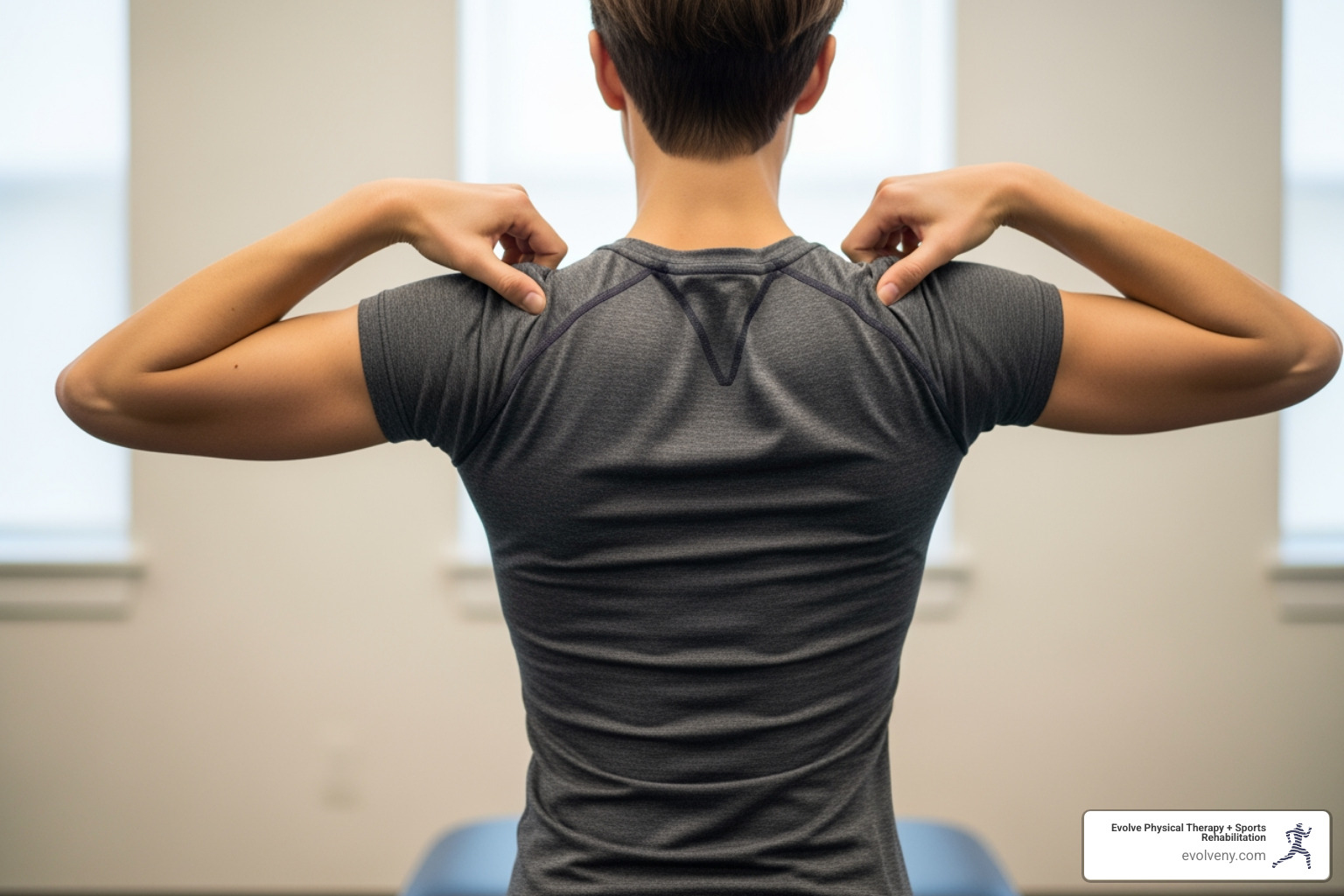
This strengthens the muscles between your shoulder blades, which are essential for good posture.
How to perform: Sit or stand tall. Squeeze your shoulder blades back and down, as if holding a pencil between them. Avoid shrugging your shoulders up. Hold the squeeze for 3-5 seconds, then release slowly.
Reps and sets: Start with 2 sets of 10 repetitions, gradually increasing to 3 sets of 10-15. You can add a resistance band for more challenge.
Purpose: Strengthens key postural muscles to counteract the forward shoulder position from daily activities.
Isometric Neck Holds
These exercises build strength by contracting muscles without movement, which is safe for your discs.
How to perform: Sit or stand tall. For each direction, gently press your head against your hand while your neck muscles resist the movement. Your head should not move. Hold each contraction for 5-10 seconds.
- Forward: Place your palm on your forehead and press forward.
- Backward: Clasp hands behind your head and press backward.
- Side: Place your hand on the side of your head and press sideways. Repeat on the other side.
Reps and sets: Perform 3 repetitions for each of the four directions, twice daily.
Purpose: Builds muscular endurance and stability in all supporting neck muscles without stressing the discs, serving as a bridge to more advanced strengthening.
Movements to Avoid and When to See a Professional
Knowing what not to do is as important as knowing which physical therapy exercises for cervical disc herniation to perform. Protecting your neck during healing is crucial.
Exercises and Activities to Skip
To prevent worsening your symptoms, avoid these activities for now:
- High-Impact Activities: Running, jumping, and other jarring movements can compress the spine and aggravate a herniated disc.
- Heavy Lifting and Powerlifting: Straining, especially with overhead lifts, puts significant pressure on cervical discs. Holding your breath during exertion can also worsen the issue.
- Sudden, Sharp Movements: Avoid quick twists, jerks, or abrupt neck movements. Stick to gentle, controlled motions.
- Full Neck Circles: These can put unnecessary strain on an injured disc. It's better to perform specific, controlled stretches.
- Any Exercise Causing Peripheralization: This is the most important rule. If an exercise causes pain, numbness, or tingling to spread down your arm or hand, stop immediately. This signal means the nerve is being irritated.
Understanding Other Treatments and Red Flags
Beyond exercises, other treatments can support your recovery.
Cervical Traction
Cervical traction gently stretches your neck to create space between vertebrae, which can relieve pressure on compressed nerves. At Evolve Physical Therapy, we use advanced, non-surgical spinal decompression that incorporates active movements to isolate specific spinal segments for improved relief. We generally advise against home-based, over-the-door traction units, as they can sometimes stress the jaw (TMJ) and may only provide temporary relief. Professional, controlled methods are safer and more effective.
Ice and Heat Therapy
- Ice Therapy: Use for 15-20 minutes at a time during the acute phase (first 48-72 hours) or after an activity that causes a flare-up to reduce inflammation and numb pain.
- Heat Therapy: After the initial inflammation subsides, use a moist heat pack for 15-20 minutes to relax tight muscles and promote healing by increasing blood flow.
When to Seek Professional Help
Always consult a physician or physical therapist before starting a new exercise program, especially if your pain is from an accident or is worsening. Certain red flag symptoms require immediate medical attention:
- Worsening Weakness: Progressive loss of strength in your arm or hand.
- Loss of Coordination: Difficulty with fine motor skills (like buttoning a shirt) or balance issues.
- Severe, Unrelenting Pain: Pain that doesn't improve with rest.
- Bowel or Bladder Changes: Any new incontinence or difficulty with urination/defecation.
These symptoms could indicate significant nerve or spinal cord compression (cervical myelopathy) and require prompt medical evaluation.
Frequently Asked Questions about Neck Pain from a Herniated Disc
We hear these questions often from our patients across Brooklyn, from Marine Park to Park Slope. Here are answers to the most common concerns.
How long does it take for exercises to help a cervical herniated disc?
Healing time varies for each person. Some notice improvement within a few days, while for others, it may take several weeks to feel significant relief. There is no one-size-fits-all timeline.
Consistency is crucial. Performing your physical therapy exercises for cervical disc herniation regularly is key to success. Research on cervical radiculopathy shows that active treatment, including physical therapy, has a significant positive impact on pain and disability at the 6-week mark. While immediate results aren't guaranteed, many people see measurable progress within a month to six weeks of consistent effort. Patience and persistence are your allies.
Should I feel pain when doing these exercises?
It's important to distinguish between discomfort and sharp pain. A gentle stretch or muscle fatigue is normal and expected. However, sharp, shooting, or stabbing pain is not okay.
If an exercise intensifies your pain or causes symptoms to spread down your arm (peripheralization), stop immediately. This is a red flag that the movement is irritating the nerve. The goal is for symptoms to move closer to your neck (centralization). The point of these exercises is to reduce your pain, not add to it.
Can these exercises make my herniated disc worse?
When performed correctly and with attention to your body's feedback, the risk of worsening your condition with these specific exercises is very low. They are designed to be gentle and promote healing.
However, improper form or pushing through sharp pain can aggravate your condition. Ignoring peripheralization (symptoms spreading down your arm) is also counterproductive. This is why starting gently and moving slowly is so important.
If you are ever unsure about an exercise or if a movement consistently worsens your symptoms, stop and consult with a physical therapist. At Evolve Physical Therapy, we ensure your form is correct and tailor your program to your specific needs, making sure every movement is safe and effective for your recovery.
Take the Next Step in Healing Your Neck
Living with a cervical herniated disc is challenging, but you now have a roadmap to recovery. The key takeaways are to understand your condition, follow safe exercise principles, and stay consistent. Evidence shows that conservative treatment, especially physical therapy exercises for cervical disc herniation, is remarkably effective for most people, often avoiding the need for surgery.
At Evolve Physical Therapy + Sports Rehabilitation, we treat the whole person, not just the symptoms. Our Brooklyn team, serving Marine Park, Gravesend, Midwood, Mill Basin, and Park Slope, uses a hands-on approach to guide you through recovery. We'll evaluate your unique situation and give you the confidence to take control of your health. From our innovative Rock Steady Boxing program for Parkinson's patients (featured on NBC News) to our comprehensive disc rehabilitation, we are passionate about helping you move better and live fully.
Your neck pain doesn't have to be a constant. You've learned the exercises and principles; now it's time to take action. We're here to create a plan customized for you.
Get a personalized physical therapy plan for your herniated disc in Brooklyn
