

Say Goodbye to Stiff Hips: Exercises for Better Internal Rotation
Why Limited Hip Internal Rotation Is Sabotaging Your Movement
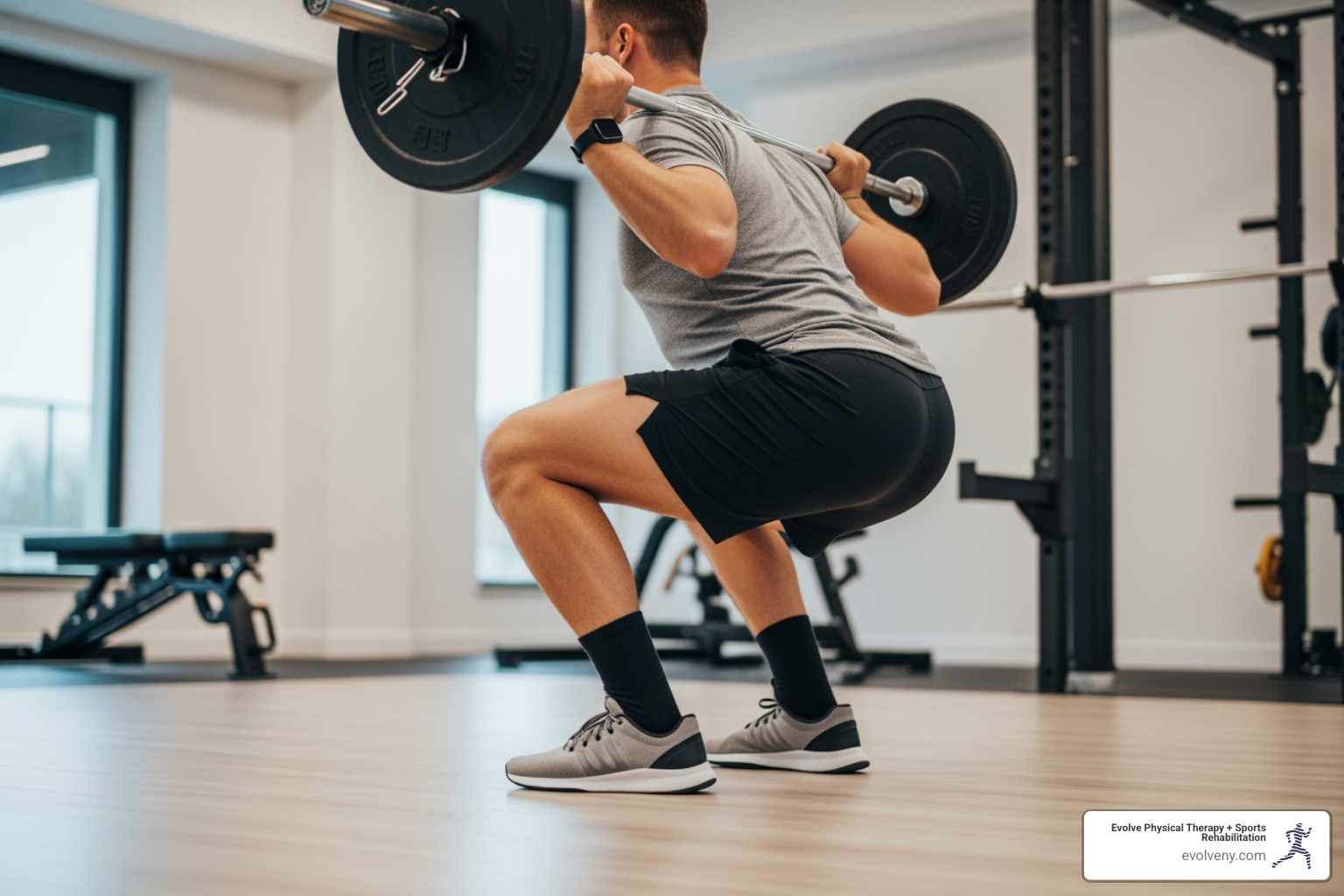
Limited hip internal rotation is when your hip joint can't rotate inward properly—and it's likely contributing to your knee pain, back discomfort, or difficulty squatting.
Quick Answer: What You Need to Know
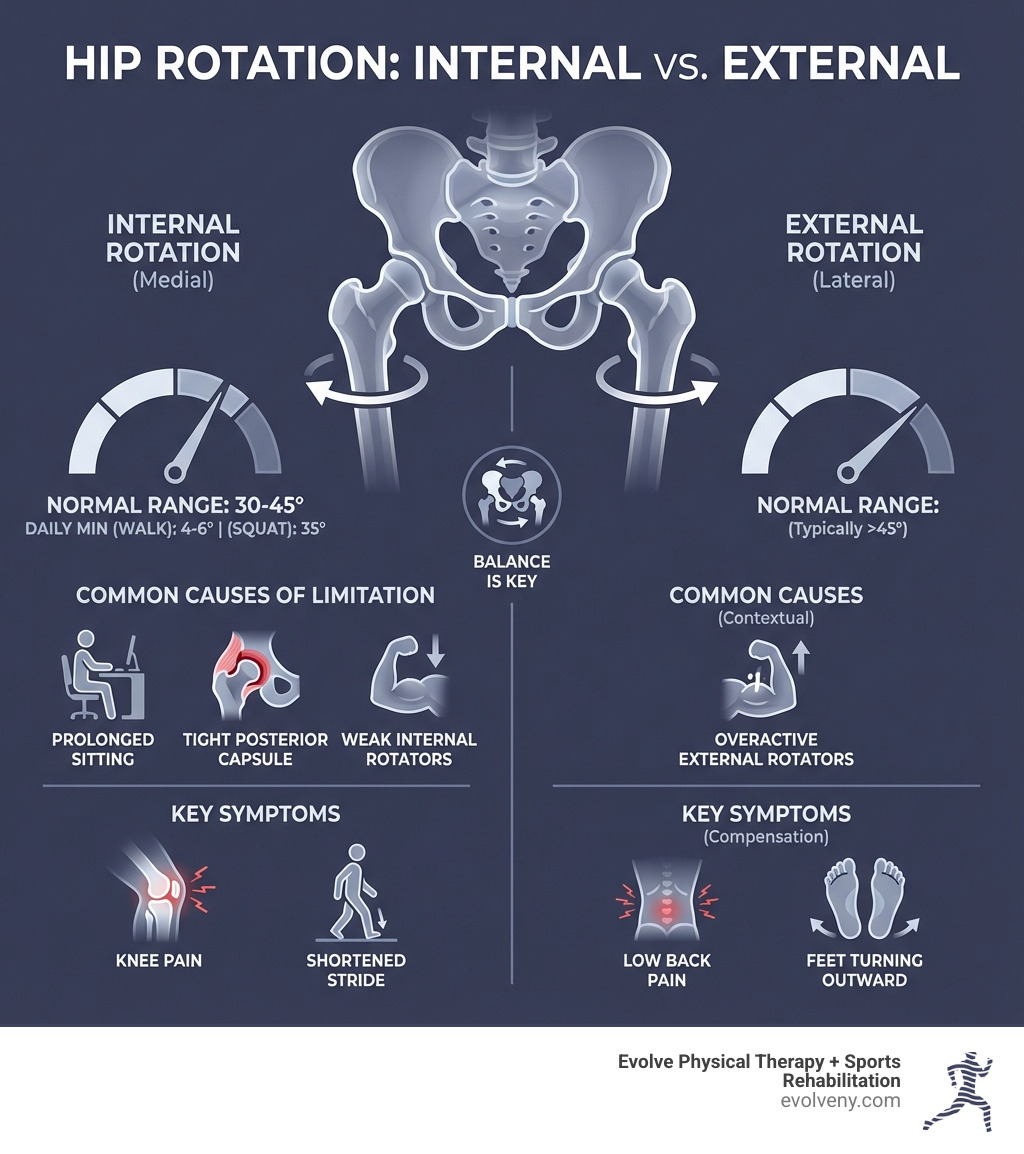
- Normal range: 30-45 degrees of hip internal rotation
- Minimum needed for daily function: 35 degrees for a full squat, 4-6 degrees for walking
- Common signs: Knee pain, low back pain, shortened stride, feet turning outward when you walk
- Main causes: Prolonged sitting, tight hip capsule, weak internal rotators, overactive external rotators
- Solutions: Targeted stretches to create space + strengthening exercises to control the new range
Hip internal rotation happens when your thigh bone (femur) rotates inward within the hip socket. It's not a movement you think about, but you need it constantly—every time you walk, climb stairs, or shift your weight. Without enough internal rotation, your body compensates by overworking your lower back, forcing your knees inward, or flattening your feet. These compensations pile up over time, leading to pain and injury in areas that seem unrelated to your hips.
As Aristotle once said (or at least, something like it): "The hips are the gateway to the soul." While that's a bit dramatic, the research backs up the importance. Studies show that athletes with less than 30 degrees of internal rotation are more than twice as likely to suffer lower extremity injuries. A 30-degree reduction in hip internal rotation increases your odds of an ACL tear by over 4 times in the same leg and over 5 times in the opposite leg.
I'm Lou Ezrick, founder of Evolve Physical Therapy in Brooklyn, and I've spent nearly two decades helping patients resolve chronic pain and movement dysfunction. Throughout my career, I've seen how addressing limited hip internal rotation can eliminate knee pain, reduce back strain, and restore athletic performance that patients thought was gone for good.
The Hidden Consequences of Poor Hip Mobility
When your hips can't move as they should, your body finds other ways to get the job done. This might sound clever, but it often leads to a cascade of problems throughout your body. Think of your body as a finely tuned machine; if one part isn't working efficiently, other parts have to pick up the slack, leading to overuse and eventual breakdown. This is precisely what happens with limited hip internal rotation.
Why Hip Rotation is Crucial for Your Pelvic Floor
The intricate symphony of the human body means seemingly unrelated areas often impact each other in surprising ways. The relationship between hip internal rotation and pelvic floor health is a testament to this interconnectedness.
- Pelvic Alignment: Our hips are directly connected to our pelvis. When hip internal rotation is restricted, it can pull the pelvis out of its optimal alignment. This misalignment can place undue stress and tension on the pelvic floor muscles, which are designed to function best within a balanced pelvic posture. Proper hip mobility allows the pelvis to maintain a neutral position, creating a stable base for the pelvic floor to operate efficiently.
- Functional Stability: Efficient hip internal rotation is vital for functional stability during movement. Whether we're walking, running, or changing direction, our hips need to rotate internally to allow for smooth transitions and proper weight distribution. Without this, our body compensates, often by gripping or overworking the pelvic floor muscles to create a sense of stability. This constant overactivity can lead to pelvic floor dysfunction.
- Reciprocal Inhibition: This is a fancy term for how our muscles work in pairs. When one muscle contracts, its opposing muscle relaxes. In the context of our hips and pelvic floor, proper hip internal rotation helps to coordinate muscle activity. If certain hip muscles are constantly tight or overactive due to limited hip internal rotation, they can prevent the pelvic floor muscles from relaxing and contracting effectively. This can lead to hypertonicity (excessive tension) in the pelvic floor, which is a common cause of pelvic pain and dysfunction.
- Posture Influence: When our hips lack the ability to internally rotate, we often adopt compensatory postures, such as standing with our feet turned out or excessively arching our lower back. These postural shifts can alter the mechanics of the entire trunk and pelvis, placing increased strain on the pelvic floor. A mobile hip that can achieve full internal rotation encourages a more upright and aligned posture, which, in turn, supports the natural function of the pelvic floor.
- Reducing Strain on Pelvic Floor Muscles: Maintaining optimal hip internal rotation reduces the overall strain on our pelvic floor muscles. By allowing the hips to move freely and efficiently, we prevent compensatory patterns that force the pelvic floor to work harder than it should. This can lead to a healthier, more resilient pelvic floor, capable of performing its crucial roles in continence, support, and sexual function.
Curious about how to improve your hip internal rotation mobility and control and its impact on your pelvic floor? Check out @lpimomsclub for more information.
The Link Between Stiff Hips and Serious Injuries
When our hips are stiff and lack internal rotation, our bodies are incredibly clever at finding workarounds. Unfortunately, these "workarounds" often lead to pain and injury in other areas.
- Low Back Pain: One of the most common complaints we hear is low back pain. When your hips can't internally rotate, your lower back often has to twist or compensate excessively during movements that would normally involve hip rotation. This increased demand on the lumbar spine can lead to muscle strain, disc issues, and chronic pain. The hip joint's limitation causes lumbopelvic compensatory motions, accumulating tissue stress on the lumbar spine.
- Knee Pain: Anterior and lateral knee pain, which many people attribute to a "tight IT band," can often be due to limited hip internal rotation. The IT band is a very thick and strong piece of fascia that has been shown to take ~2,000 lbs of force to deform. Therefore, the IT band being "tight" is highly unlikely. Instead, the pain often comes from overactive muscles (like the glute max/med and TFL) pulling on the IT band because your hip isn't rotating properly. This creates a painful cycle where your knee is taking the brunt of your hip's immobility.
- ACL Tears: The connection between limited hip internal rotation and ACL injuries is significant. Restriction in hip internal rotation is associated with an increased risk of ACL injury. A study found that a 30-degree reduction in left hip internal rotation was associated with 4.06 and 5.29 times greater odds of ACL injury in the ipsilateral and contralateral limbs, respectively. The in silico model simulation predicted an increase in peak AM-ACL strain as the range of hip internal rotation was decreased. This means that if your hip can't rotate internally enough, your knee is put under much greater stress during dynamic movements like pivoting or landing, making it more vulnerable to injury. You can read more about this in the research article, "Restriction in hip internal rotation is associated with an increased risk of ACL injury" on PubMed.
- Femoroacetabular Impingement (FAI): FAI, or hip impingement, is a condition where extra bone grows along one or both of the bones that form the hip joint, giving the bones an irregular shape. This can cause them to rub against each other during hip movements, leading to pain and limiting range of motion, particularly internal rotation. Less hip range of motion is associated with a greater alpha angle in people with longstanding hip and groin pain, where the alpha angle is a marker for cam morphology (a type of FAI).
- Chronic Groin Pain and Osteoarthritis Precursor: Dysfunctional hip internal rotation is a biomechanical fault that can lead to a host of injuries from the lower back to the lower limb. A decrease in hip internal rotation can be a precursor to lower back pain, labral tears, femoroacetabular impingement, and even osteoarthritis of the hip.
Ignoring limited hip internal rotation is like driving a car with misaligned wheels – you might keep going, but you're doing some serious damage along the way.
What Causes Limited Hip Internal Rotation and How to Check Yours
Why do some of us struggle with hip internal rotation while others seem to move effortlessly? The causes are often multi-faceted, ranging from our daily habits to our unique anatomy. Understanding these causes is the first step toward finding effective solutions.
Common Causes of Limited Hip Internal Rotation
- Prolonged Sitting: In our modern world, many of us spend the majority of our waking hours seated. This prolonged static position can lead to shortened and overactive hip flexors, while simultaneously deactivating our glutes. This imbalance restricts the natural movement of the hip, making internal rotation particularly challenging. It’s like your body forgets how to access that range of motion.
- Posterior Hip Capsule Tightness: One of the biggest roadblocks people hit when trying to improve hip internal rotation is the lack of space for the femoral head to rotate within the hip socket. For us to internally rotate our hip, the femoral head needs to push back (posteriorly) within the acetabulum. If the posterior hip capsule (the connective tissue surrounding the joint) is tight or restricted, it can physically block this movement. This is especially true if the femur has been in an externally rotated position for a long time, causing a "capsular restriction" to build up.
- Tight External Rotator Muscles: Our hip's external rotators (muscles that turn the leg outward) can become tight and overactive. Muscles like the piriformis and the deeper gluteal muscles, while crucial for hip stability, can inadvertently limit internal rotation if they're constantly "on" or in a shortened state. This is a common issue with conditions like Piriformis Syndrome, where the piriformis muscle can compress the sciatic nerve, leading to pain and further limiting hip mobility.
- Weak Internal Rotator Muscles: Conversely, the muscles responsible for internal rotation—primarily the TFL (tensor fasciae latae) and some adductor muscles—might be weak or underused. If these muscles aren't strong enough to actively pull the hip into internal rotation, the range of motion will remain restricted, even if the external rotators are released.
- Structural Issues like FAI: Sometimes, the limitation isn't just about soft tissue. Conditions like Femoroacetabular Impingement (FAI), where the bones of the hip joint have an irregular shape, can physically block the normal movement of the hip, making internal rotation difficult or painful.
How to Assess Your Hip Internal Rotation at Home
We can do a simple self-assessment to get a general idea of your hip internal rotation. This isn't a diagnostic tool, but it can highlight potential areas of concern.
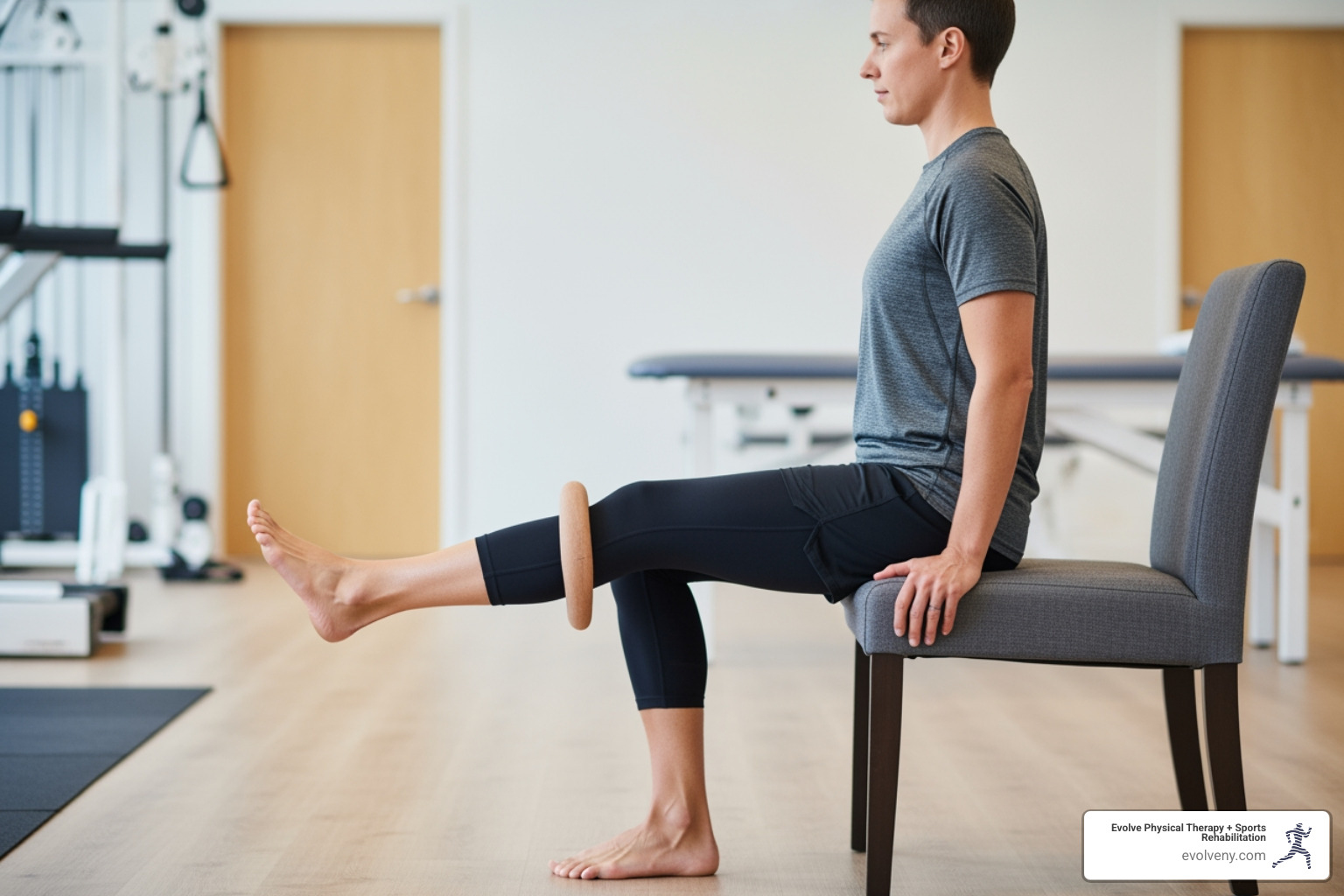
- The Seated Hip Internal Rotation Test:
- Sit on the edge of a chair or a sturdy surface, with your knees bent and feet flat on the floor, hip-width apart.
- Place your hands on the chair behind you for support, ensuring your spine is tall and neutral.
- Keeping your thigh stable and your knee pointing forward, slowly lift one foot off the floor and rotate it laterally (outward) as far as you comfortably can without lifting your hip or shifting your body weight.
- Observe how far your foot moves outward. The movement of your shin/foot away from the midline indicates hip internal rotation.
- Repeat on the other side.
**What to Look For:**
*   **Normal Range:** Ideally, your foot should rotate out to at least a 30-degree angle, with some individuals achieving 45 degrees or more.
*   **Asymmetry:** Do you notice a big difference between your left and right sides? It's common to have a relatively more limited ability to access internal rotation on the left side for many people.
*   **Signs of Limitation:** If your foot barely moves, or if you feel a sharp pinch or pain, you likely have **limited hip internal rotation**.
If you're unsure about your assessment or concerned about your hip mobility, we encourage you to book a free movement consultation with our expert physical therapists at Evolve Physical Therapy in Brooklyn.
A Step-by-Step Guide to Improving Hip Mobility
Improving limited hip internal rotation requires a strategic, two-pronged approach: first, we need to release any tightness or restrictions that are physically blocking the movement, and then, we need to strengthen the muscles that control this newly gained range of motion. Consistency is key here; a little bit every day goes a long way.
Stretches to Release Tightness and Create Space
These stretches are designed to address the common culprits of limited hip internal rotation, such as a tight posterior hip capsule and overactive external rotators.
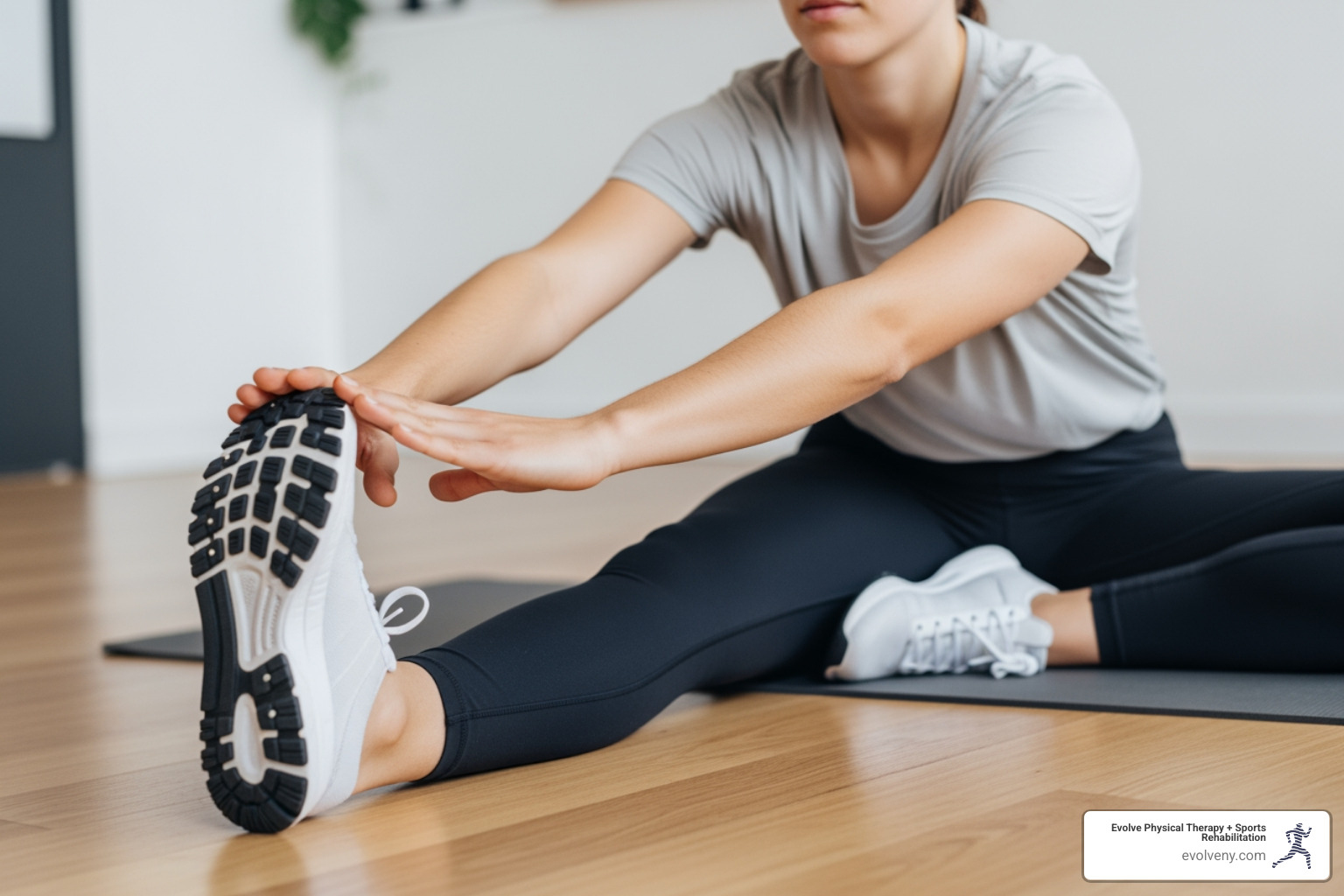
- 90/90 Stretch (Seated Hip Rotation):
- Sit on the floor with one leg internally rotated in front of you (shin parallel to your body) and the other leg externally rotated to your side (shin perpendicular to your body), both knees bent at 90 degrees.
- Maintain a tall, upright posture.
- From this position, gently lean forward over your front leg, feeling the stretch in your hip.
- To target internal rotation, you can also gently rotate your torso towards the internally rotated hip, deepening the stretch.
- Hold for 30-60 seconds, breathing deeply. Repeat 2-3 times per side.
Supine Windshield Wipers:
- Lie on your back with your knees bent, feet flat on the floor, wider than hip-width apart.
- Keep your feet planted and slowly let both knees fall inward towards each other, like windshield wipers.
- Hold the inward rotation for 30 seconds, feeling the stretch in your outer hips and glutes.
- Return to the center and repeat for 2-3 rounds. This is a gentle way to encourage internal rotation.
Posterior Hip Capsule Stretch (Knee to Opposite Shoulder):
- Lie on your back. Bring one knee towards your chest.
- Grasp the knee with both hands and gently pull it across your body towards your opposite armpit.
- You should feel a deep stretch in the buttock and outer hip of the leg you are stretching. This targets the posterior hip capsule and external rotators.
- Hold for 30-60 seconds, taking deep breaths. Repeat 2-3 times per side.
Best Practices for Stretching:
- Hold for 30-60 seconds: This duration is generally effective for increasing tissue extensibility.
- Breathe Deeply: Use your breath to help your body relax into the stretch. Exhale as you deepen the stretch.
- Avoid Sharp Pain: You should feel a stretch or tension, but never sharp, pinching, or burning pain. If you do, ease off or stop.
- Warm-up First: Perform these stretches after a light warm-up or at the end of your day.
Exercises to Strengthen and Control Your New Mobility
Once we've created a bit more space and released some tension, it's crucial to teach our bodies how to actively use and control that new range of motion. These exercises focus on strengthening the internal rotators and improving overall hip stability.
Reverse Clamshells:
- Lie on your side with your knees bent at a 90-degree angle, one leg stacked directly on top of the other. Keep your feet aligned with your hips.
- Keeping your knees together, slowly lift your top foot away from your bottom foot, rotating your top hip internally. Imagine your top thigh bone rotating inward in the socket.
- Control the movement as you lower your foot back down.
- Perform 3 sets of 15 repetitions on each side. A resistance band around your ankles can add challenge.
Prone Frog Internal Rotations:
- Lie on your belly in a "frog" position: knees wide, bent at 90 degrees, and the soles of your feet together.
- Keeping your knees on the ground, slowly lift one foot off the ground by rotating your hip internally.
- Hold for 1-2 seconds at the top, then slowly lower.
- Perform 3 sets of 15 repetitions on each side, focusing on slow, controlled movement.
Wall Bridge with Yoga Block Squeeze:
- Lie on your back with your knees bent and feet flat against a wall, hip-width apart. Place a yoga block or small ball between your knees.
- Squeeze the block gently with your knees.
- Engage your glutes and lift your hips into a bridge position.
- As you hold the bridge, gently shift the hip that feels tighter slightly to the side, pressing that foot into the wall a bit more. This encourages subtle internal rotation.
- Hold for 10 seconds, then lower. Repeat 10-15 times.
Cross-Body Kickstand RDL (Romanian Deadlift):
- Stand in a "kickstand" position with one foot slightly behind the other, heel lifted, for balance. The front leg will be doing most of the work.
- Hold a light dumbbell in the hand opposite your working leg.
- Hinge at your hips, pushing your butt back as you lower the dumbbell towards the instep of your working foot, crossing your body slightly.
- As you hinge, focus on allowing a subtle internal rotation in the working hip.
- Return to the starting position, squeezing your glute.
- Perform 3 sets of 10-12 controlled repetitions on each side.
Consistency is paramount. We recommend performing these exercises once a day, or at least 3-5 times a week, working both sides evenly to prevent imbalances. You should feel tension and muscle activation, but never sharp pain.
Frequently Asked Questions about Hip Mobility
We often get asked specific questions about limited hip internal rotation and how it impacts daily life and athletic performance. Here are some of the most common ones:
How does limited hip internal rotation affect my squat?
Ah, the squat – the king of exercises! To sit into a full, deep squat, you need a surprisingly specific amount of hip internal rotation, typically around 35 degrees. If you lack this crucial mobility, your body will try to find a way down, often by compensating in ways that can lead to problems.
Without enough hip internal rotation, you might notice:
- "Butt Wink": This is when your lower back rounds at the bottom of the squat. It's your lumbar spine compensating for a lack of hip mobility, putting excessive stress on your spinal discs.
- Knees Caving In (Knee Valgus): Your knees might collapse inward as you descend. This places unhealthy strain on your knee ligaments and can lead to conditions like patellofemoral pain.
- Foot Pronation: Your feet might flatten or roll inward excessively, trying to gain mobility from your ankles when your hips aren't providing it.
These compensations not only make your squat less efficient but also significantly increase your risk of injury over time. Improving your hip internal rotation is key to a safer, stronger, and deeper squat.
Are there specific people who should focus on hip internal rotation?
Absolutely! While good hip internal rotation benefits everyone, certain populations have an even greater need or are more susceptible to limitations:
- Athletes in Rotational Sports: Think golfers, tennis players, baseball pitchers, soccer players, and anyone involved in sports requiring powerful twisting motions. These athletes rely heavily on hip internal rotation for generating force and protecting their spine. A body lacking internal hip rotation is like a car with no back wheels – it might keep going, but it’s gonna do some damage along the way.
- Postpartum Individuals: Pregnancy and childbirth place immense strain on the pelvic floor and surrounding structures. Re-establishing optimal hip mobility, including internal rotation, is crucial for supporting pelvic floor health and returning to pain-free movement. The hip-pelvic floor connection is incredibly important during this phase.
- Office Workers and Anyone with Prolonged Sitting: Our sedentary lifestyles are a major culprit. Spending hours seated can shorten hip flexors and create muscular imbalances that directly contribute to limited hip internal rotation. Breaking up sitting time and incorporating hip mobility exercises is vital.
- Individuals Experiencing Hip, Knee, or Low Back Pain: As we've discussed, limited hip internal rotation is often a hidden factor in pain syndromes throughout the lower body and back. Addressing it can be a game-changer for long-term relief and prevention.
How long does it take to see improvement?
We understand you're eager for results, and the good news is that you might feel some immediate, temporary improvements in your range of motion right after a stretching session. That feeling of "more space" is a great motivator!
However, achieving lasting change in limited hip internal rotation requires consistent effort. We're not just stretching muscles; we're also influencing joint capsules and retraining movement patterns that might have been ingrained for years. You can expect to see meaningful, sustained improvements over several weeks to months.
Think of it like building a house – you don't just lay the foundation and expect it to be ready. You need to build the walls, put on the roof, and furnish it. Similarly, we stretch to create the potential for movement, and then we use strengthening exercises to teach your body to "own" and control that new range. Stick with it, and your hips will thank you!
Take the Next Step Towards Pain-Free Movement
We've explored the critical role of hip internal rotation, its far-reaching impact on our bodies, and the steps we can take to improve it. From alleviating nagging low back and knee pain to enhancing athletic performance and supporting pelvic floor health, optimizing your hip mobility is a cornerstone of overall well-being.
Ignoring limited hip internal rotation can lead to a cascade of compensatory movements and potentially more significant injuries down the line. But the good news is that with targeted stretches and strengthening exercises, you have the power to reclaim your hip health.
If you've been struggling with persistent pain, significant limitations, or just want a clearer path to achieving optimal hip mobility, a professional evaluation can identify the root cause and provide a personalized roadmap. At Evolve Physical Therapy + Sports Rehabilitation in Brooklyn, we offer holistic physical therapy services, focusing on evaluation, healing, and strengthening. Our unique hands-on approach and specialized programs, even those featured on NBC News, are designed to get you moving better and feeling stronger.
Don't let stiff hips hold you back any longer. We're here to help you move freely and live fully.
Get a personalized assessment from our Brooklyn physical therapists
