

Personal Training for Sports Performance: Your Ultimate Guide
Why Sports Performance Personal Training is Essential for Athletes at Every Level

Sports performance personal training is specialized coaching designed to improve athletic abilities through targeted programming that improves strength, speed, power, and agility while reducing injury risk. Unlike general fitness, this training focuses on biomechanical analysis, movement optimization, and individualized programming customized to your sport, position, and competitive goals.
Key Differences Between General Personal Training and Sports Performance Training:
| Aspect | General Personal Training | Sports Performance Training |
|---|---|---|
| Primary Goal | Overall health, weight loss, general fitness | Improved athletic performance, competitive edge |
| Assessment | Basic fitness evaluation | Comprehensive movement screening, sport-specific analysis |
| Programming | General strength and cardio | Periodized, sport-specific power, speed, agility work |
| Focus | Looking good, feeling better | Moving better, performing better, injury prevention |
| Clientele | General population | Athletes from youth to professional, tactical athletes |
The global sports performance market is projected to reach $3.5 billion by 2030, reflecting the growing recognition that greatness is built, not born. Whether you're a weekend warrior, a high school athlete aiming for a scholarship, or a professional seeking a competitive edge, sports performance training offers a science-backed pathway to your full potential.
As Lou Ezrick, founder of Evolve Physical Therapy + Sports Rehabilitation, I've spent nearly two decades helping athletes optimize movement and overcome injuries. My approach combines manual therapy expertise with functional movement training to help active individuals like you maintain peak fitness and prevent recurring injuries.

What is Sports Performance Training and How Does It Differ from General Fitness?
What separates a good athlete from a great one often lies in how they train. Sports performance personal training is specialized coaching that goes far beyond a standard gym workout. Instead of just getting you "in shape," it's laser-focused on making you better at your specific sport.
Think of it this way: general fitness is like learning to drive a car, while sports performance personal training is like racing school—it teaches you to handle every curve and maximize acceleration. The difference comes down to sport-specific goals, where every exercise has a purpose tied directly to your performance. For a basketball player, we develop vertical jump power; for a runner, we optimize stride efficiency.
Key differentiators include:
- Biomechanical Analysis: We don't just watch you move; we analyze how you move to identify inefficiencies that can limit performance or cause injuries.
- Energy System Development: We train your body to efficiently fuel the specific demands of your sport, whether it's a 100-meter sprint (phosphagen system) or a marathon (aerobic system).
- Movement Pattern Optimization: We break down sport-specific movements, like a pitcher's throw or a soccer player's cut, and rebuild them for maximum efficiency and power.
The fundamental shift is from general health to peak athletic output. General fitness makes you healthier; sports performance training pushes you to your competitive edge safely and strategically.
| Aspect | General Personal Training | Sports Performance Training |
|---|---|---|
| Primary Goal | Overall health, weight loss, general fitness | Improved athletic performance, competitive edge |
| Assessment | Basic fitness evaluation | Comprehensive movement screening, sport-specific analysis |
| Programming | General strength and cardio | Periodized, sport-specific power, speed, agility work |
| Focus | Looking good, feeling better | Moving better, performing better, injury prevention |
| Clientele | General population | Athletes from youth to professional, tactical athletes |
The Athlete-Centric Approach
Your training should be as unique as you are. At Evolve Physical Therapy + Sports Rehabilitation, we don't use cookie-cutter programs. Our approach begins with a thorough needs analysis of your strengths, weaknesses, injury history, and goals. This shapes your individualized programming.
Positional demands are critical. A football lineman and a wide receiver require vastly different physical attributes, and their training reflects that. We also adjust for in-season versus off-season training. The off-season is for building foundational strength, while the in-season focuses on maintenance, fatigue management, and peak performance.
We also integrate mental conditioning. Physical ability is only part of the equation. We help you build focus, manage pressure, and develop the mental resilience needed to excel. The NSCA discusses how specific coping skills can improve performance under pressure, a key component of our training.
Who Can Benefit from This Specialized Training?
If you compete or push your body athletically, this training can help you perform better and safer. It's for:
- Youth athletes: Building a proper athletic foundation prevents injuries and creates healthy lifelong habits.
- High school athletes: Gaining a competitive edge for varsity spots or college scholarships through targeted speed, power, and agility training.
- Collegiate athletes: Withstanding the intense physical demands of a longer, more competitive season.
- Professional athletes: Refining technique, extending careers, and finding that critical advantage.
- Adult recreational athletes: Improving performance and staying injury-free in triathlons, golf, or competitive leagues.
- Tactical athletes: For first responders and military personnel, physical readiness is about job performance and saving lives.
The Core Components of a Sports Performance Personal Training Program
A comprehensive sports performance personal training program builds a body that's not just strong but also resilient, explosive, and capable of handling the demands of your sport. We address every piece of the performance puzzle.
Building a Foundation: Strength, Power, and Endurance
A solid athletic foundation starts here. We use smart principles like progressive overload and periodization to build functional strength. The Wall Street Journal highlights exercises that maximize leg strength and balance.
- Power development teaches your body to use strength explosively. We incorporate Olympic lifts and medicine ball throws to train your muscles to generate maximum force in minimum time.
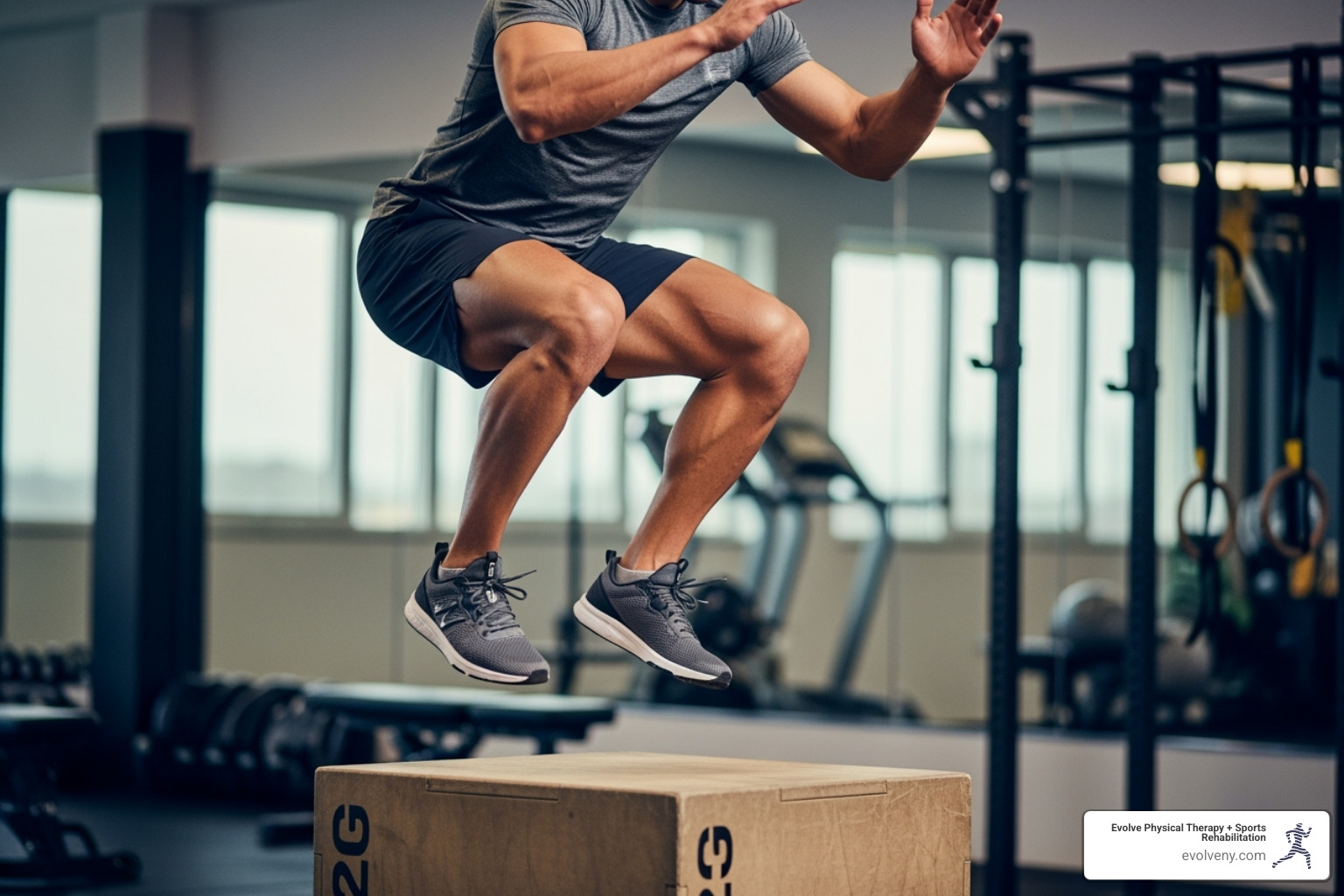
- Plyometrics, such as box jumps and bounding drills, are highly effective for building explosive power. Even beginners can safely incorporate these exercises.
- Endurance conditioning is custom to your sport, whether it requires sustained aerobic capacity or repeated anaerobic bursts.
Enhancing Athleticism: Speed, Agility, and Mobility
Once the foundation is set, we focus on dynamic qualities.
- Speed training involves breaking down the mechanics of acceleration, top-end speed, and safe deceleration using drills like resisted and assisted sprints.
- Agility work, including ladder drills and cone drills, improves footwork, coordination, and your ability to change direction quickly without losing balance.
- Mobility is the ability to move a joint through its full range of motion with control. Unlike passive flexibility, active mobility is crucial for performance. Ankle mobility, for example, is vital for squatting, jumping, and running. We prioritize it to improve movement and power generation.
- Reaction time training sharpens your cognitive and physical responses using drills that mimic unpredictable game conditions.
The Crucial Role of Injury Prevention and Recovery
The best ability is availability. At Evolve Physical Therapy + Sports Rehabilitation, we train you to perform better and stay healthy.
- Corrective exercise addresses specific imbalances and movement dysfunctions identified in your assessment before they become injuries.
- Movement screening, like the Functional Movement Screen (FMS), helps us identify weak links in your movement patterns that could lead to injury.
- Active recovery techniques like foam rolling and dynamic stretching help your body bounce back faster by reducing muscle soreness and improving blood flow.
- Rest and regeneration are non-negotiable. Your body gets stronger during rest, so we build adequate recovery time and rest days into your program to avoid overtraining.
Our sports performance personal training programs are designed by professionals who understand both performance and rehabilitation. Learn more about how our physical therapy expertise helps athletes perform better and stay injury-free.
Finding Your Trainer: Qualifications, Costs, and What to Look For
Choosing the right guide for your sports performance personal training is a critical investment in your athletic future. It can be the difference between reaching your goals and getting injured.
Essential Qualifications for Sports Performance Personal Training
When vetting a trainer, look for specific credentials that prove their expertise in athletic development.
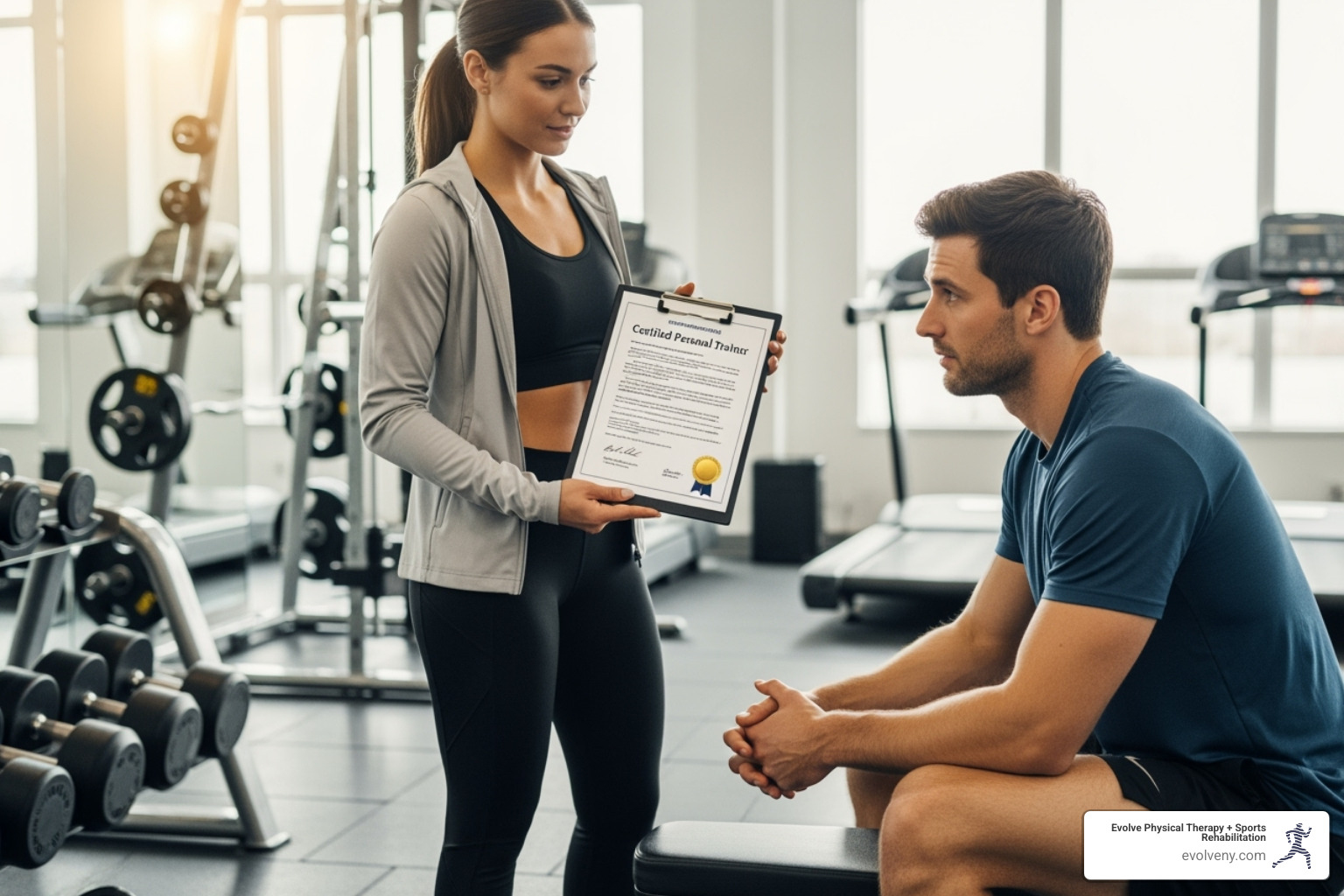
- The CSCS (Certified Strength and Conditioning Specialist) from the NSCA is the gold standard in sports performance training.
- The NASM-PES (Performance Improvement Specialist) is another respected credential from the National Academy of Sports Medicine, often considered a leader in personal training.
- A Bachelor's or Master's degree in Kinesiology, Exercise Science, or a related field provides a strong academic foundation.
Beyond credentials, look for relevant experience with athletes in your sport and position. A great trainer should also have deep sport-specific knowledge, a clear communication style, and an assessment process that is thorough and individualized.
Understanding the Investment: Costs and Program Structures
The cost of sports performance personal training is an investment in your body, performance, and athletic future. Prices vary by location and experience, but here's a general guide.
- One-on-one training typically ranges from $75 to $200+ per hour. You're paying for years of education, experience, and customized programming.
- Package pricing for multiple sessions or monthly/seasonal training can reduce the per-session cost and increase accountability.
- Program duration is custom to your goals, from a focused 8-12 week program to ongoing, year-round training.
- Group training offers a budget-friendly option that provides a competitive, motivating environment while still allowing for personalized attention.
When evaluating cost, consider the value of expertise. You're investing in reduced injury risk, improved performance that could lead to scholarships or professional opportunities, and long-term physical health. The sports training market is expected to grow significantly, reflecting the results that athletes at all levels are achieving through specialized training.
The right trainer with the right qualifications will help you achieve more than you could on your own, making it a worthwhile investment.
Advanced Concepts: Technology, Nutrition, and Measuring Success
Modern athletic training is about working smarter, not just harder. Today's sports performance personal training combines cutting-edge technology with fundamental nutrition principles to create holistic, measurable athlete development.
Integrating Technology and Data to Track Progress
Technology provides objective insights into your body's performance, moving beyond guesswork.
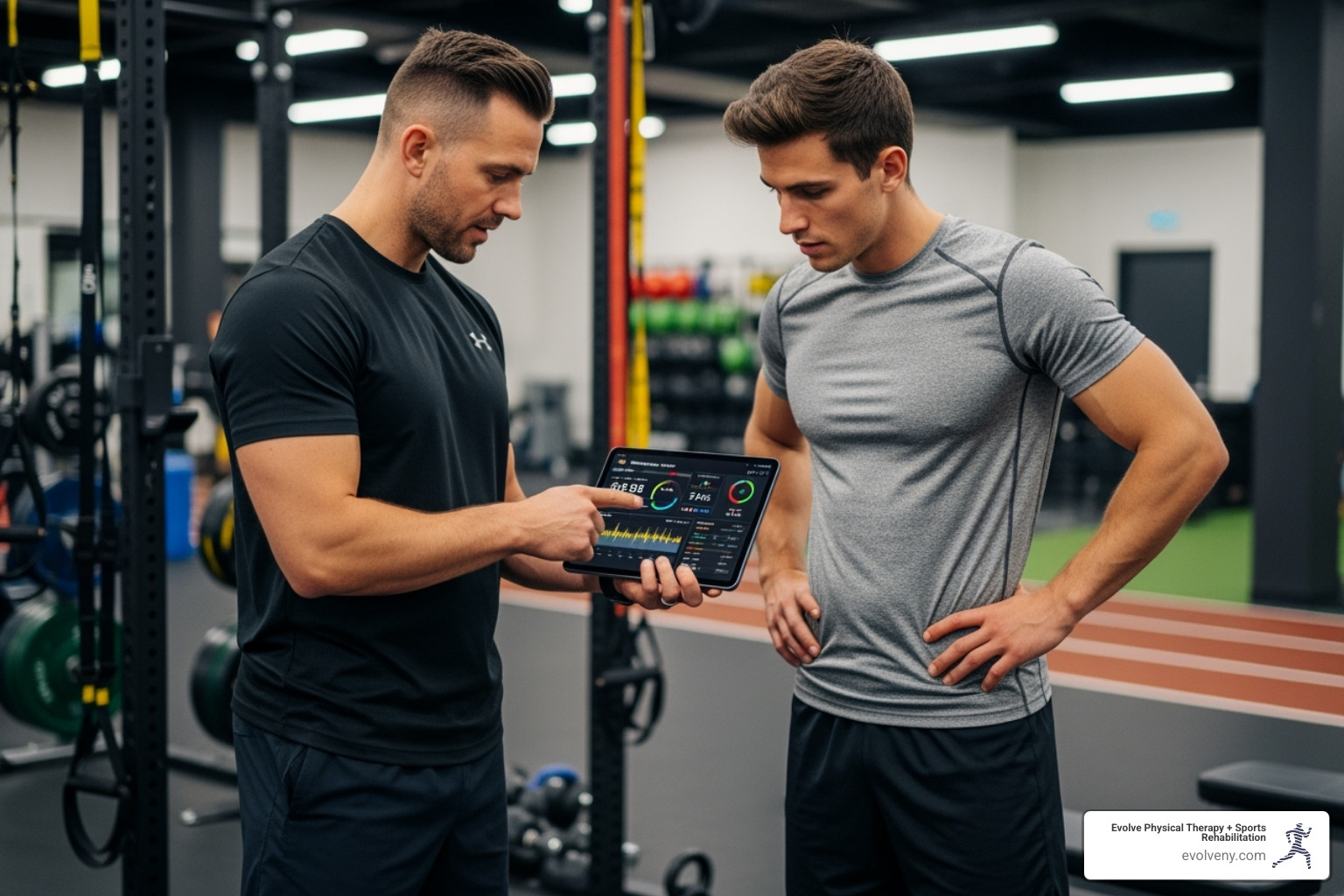
- Wearable technology like GPS trackers and heart rate monitors provides real-time data on speed, distance, and exertion, allowing us to adjust training loads precisely.
- Video analysis software allows for frame-by-frame breakdown of your technique, revealing subtle inefficiencies in a jump shot or sprint start.
- Force plates measure ground reaction forces during movements like jumps, giving us objective data on power output, explosiveness, and balance.
- Velocity-based training (VBT) uses the speed of your lifts to ensure you're always training at the optimal intensity for your specific goal, whether it's strength or power.
This data-driven approach is used to track your key performance indicators (KPIs)—specific, measurable benchmarks relevant to your sport. Regular re-testing shows us what's working and where to adjust, turning training into a calculated path to success.
Fueling for Peak Performance: The Role of Nutrition
You can't out-train a bad diet. Nutrition is the foundation for recovery, energy, and adaptation.
- Macronutrient timing involves eating the right things at the right times—carbohydrates for energy, protein for muscle repair, and healthy fats for overall function.
- Hydration strategies are critical for both physical and mental performance. We help develop a personalized plan based on your training and sweat rate.
- Pre-competition meals should provide sustained energy without causing digestive issues. We help you find the right strategy for your body.
- Post-workout recovery nutrition, typically a combination of protein and carbs, replenishes depleted stores and accelerates adaptation.
- Supplement guidance is offered based on evidence. We help you steer which supplements may genuinely support your goals and which to avoid.
At Evolve Physical Therapy + Sports Rehabilitation, we understand that performance is a complete picture. This holistic approach—combining smart training, proper fueling, and quantifiable progress—is what transforms good athletes into great ones.
Frequently Asked Questions about Sports Performance Training
How does training differ for team sports versus individual sports?
While fundamentals like strength and speed are universal, the application changes significantly.
For team sports, training must account for positional needs and inter-player dynamics. A football lineman's program will differ greatly from a wide receiver's. We incorporate drills that simulate the chaotic, reactive nature of game situations, focusing on agility, decision-making under fatigue, and developing the capacity for repeated high-intensity efforts.
For individual sports (e.g., swimming, golf, running), training allows for a hyper-personalized focus. We can dedicate more time to perfecting highly technical, repetitive movements with surgical precision. Mental conditioning also emphasizes sustained focus and self-motivation, as there are no teammates to lean on during competition. Conditioning is custom to the exact energy systems demanded by the specific event.
How does age impact a sports performance training program?
Age is a critical factor in designing safe and effective programs. We never use a one-size-fits-all approach.
- Youth athletes: The focus is on long-term athletic development. We build fundamental movement skills, coordination, and balance in a fun environment, prioritizing variety over early specialization.
- Adolescent/Young Adult athletes: As athletes mature, we can safely introduce more advanced strength work, power development, and sport-specific conditioning to meet competitive demands.
- Masters athletes: The priority shifts to maintaining strength and power while protecting joint health and emphasizing recovery. We adjust training volume and incorporate more mobility work to mitigate age-related decline and promote longevity in sport.
Injury risk also changes with age, and our programs are designed to address these age-specific vulnerabilities, from overuse injuries in youth to slower recovery in older athletes.
How quickly can I expect to see results from training?
The timeline for results depends on several factors, but consistency is the most important. Athletes who commit to the process see the best outcomes.
- Adaptation Timeline: You will likely feel changes within the first few weeks, such as increased energy and better movement quality. Measurable improvements in strength or speed often appear around the 4-6 week mark.
- Goals: More significant physiological adaptations—like substantial gains in muscle mass or endurance—generally take 8-12 weeks or more of dedicated training. Short-term goals may be achieved faster than long-term development goals.
- Individual Response: Genetics, training history, nutrition, sleep, and stress levels all influence how quickly your body adapts. Some people are rapid responders, while others progress more gradually.
At Evolve Physical Therapy + Sports Rehabilitation, we emphasize that sports performance personal training is a journey, not a quick fix. We are building resilient, high-performing athletes for the long haul.
Conclusion: Build Your Greatness and Open up Your Potential
We've explored how sports performance personal training differs from general fitness, its core components, and what to look for in a trainer. The key takeaway is that your athletic potential is waiting to be open uped through intelligent, consistent training.
Greatness is built, not born. Every rep, sprint, and recovery session is a building block for your future. Performance is a journey of deliberate steps that compound into remarkable results.
At Evolve Physical Therapy + Sports Rehabilitation, we have spent nearly two decades guiding athletes on this journey. Our holistic physical therapy services across Brooklyn—serving Marine Park, Gravesend, Midwood, Park Slope, and Mill Basin—are built on hands-on care that addresses the whole athlete. We blend physical therapy expertise with a performance-focused mindset to help you not just return to the game, but to come back stronger and more resilient.
The same dedication that drives our specialized programs, like our Rock Steady Boxing for Parkinson's patients, powers our commitment to helping every athlete perform without limits.
Are you ready to invest in your athletic future? We're ready to help you get where you want to go.
Your journey toward peak performance starts with a single step. Take it today.
Start your journey with sports rehabilitation physical therapy in Brooklyn today.
