

Which Manual Therapy Technique is Right for You? Maitland, Mulligan, or Kaltenborn
Understanding Manual Therapy: Three Proven Approaches to Joint Mobilization
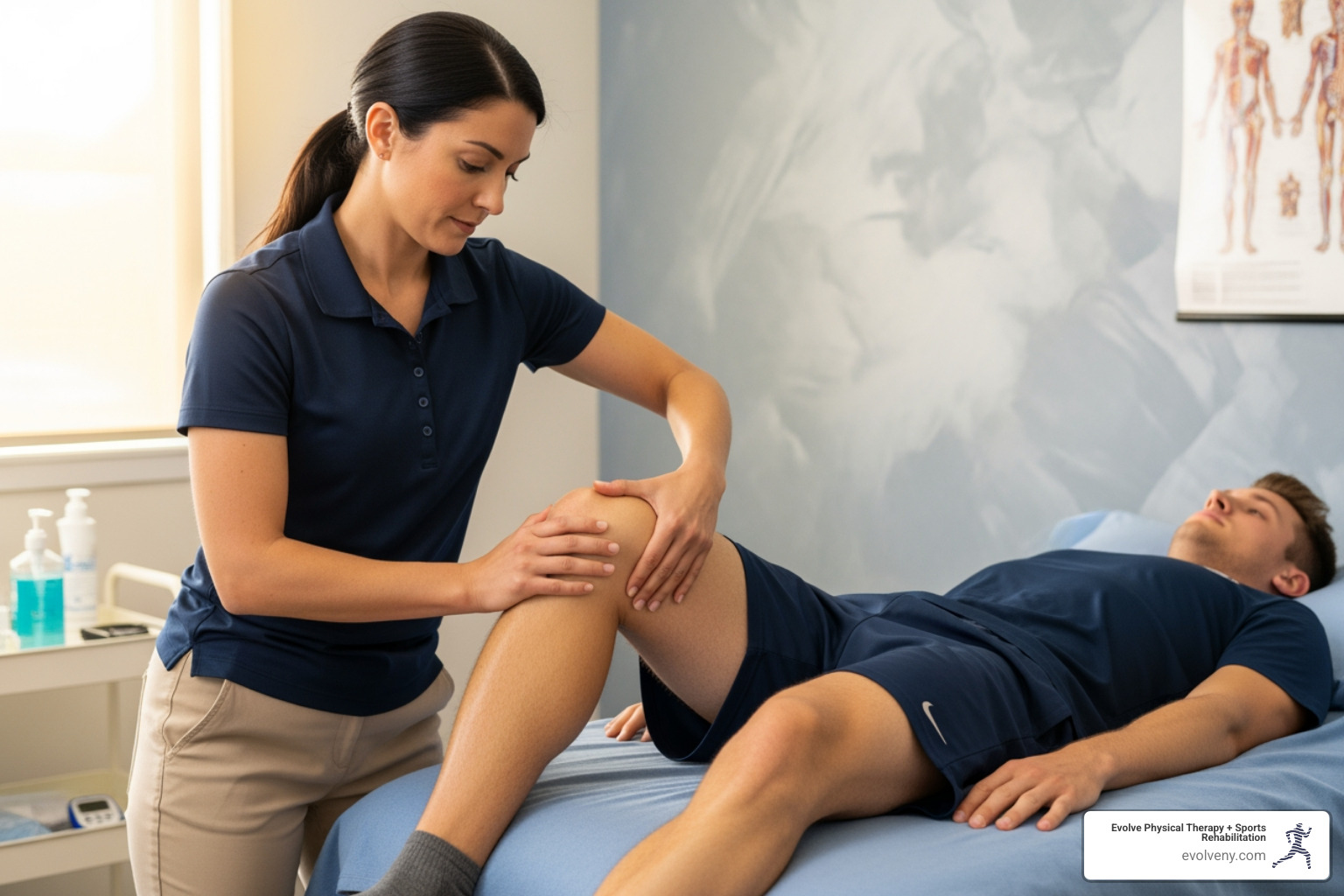
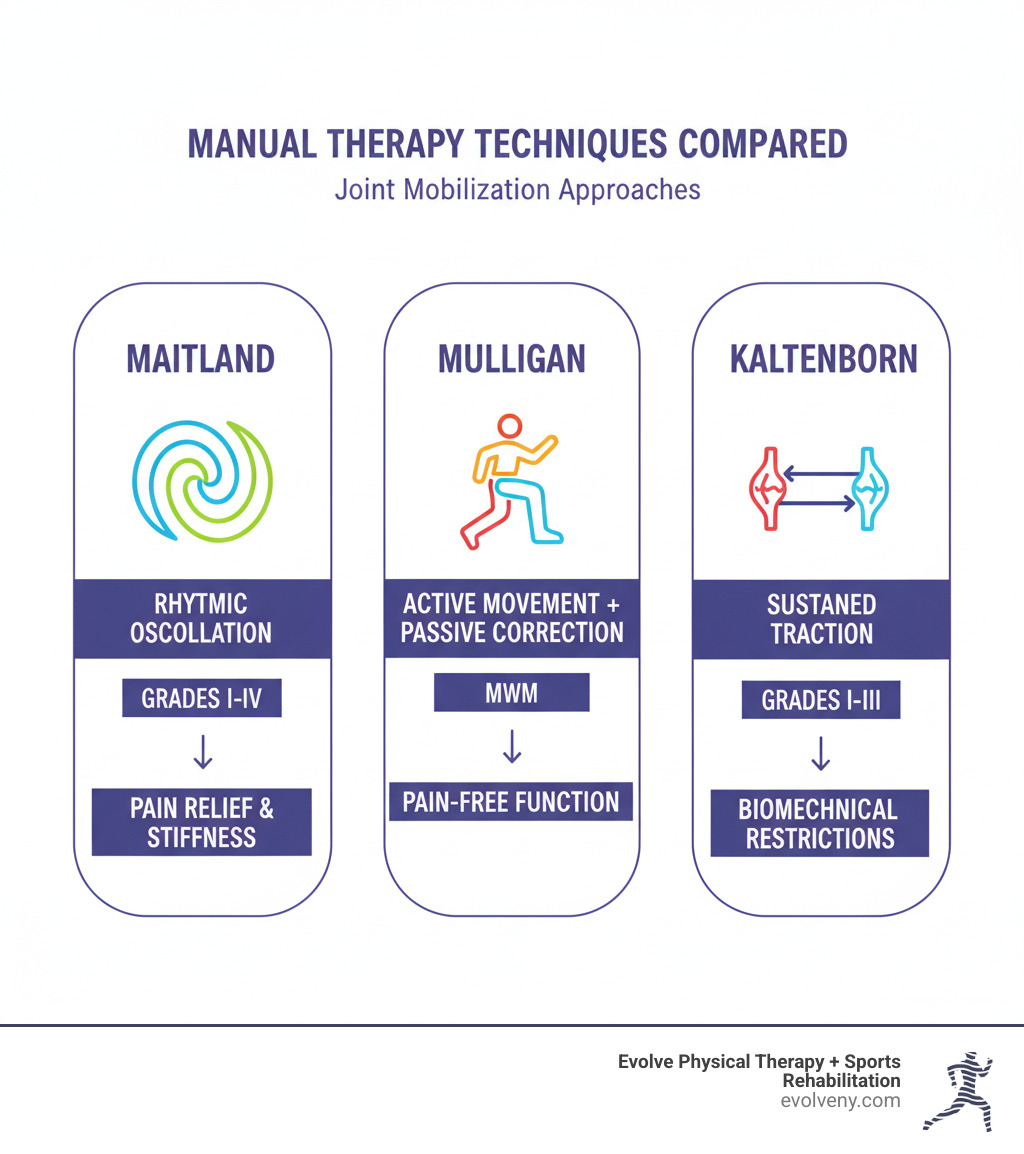
Maitland mulligan kaltenborn techniques are three distinct manual therapy approaches that physical therapists use to restore joint function and reduce pain. Here's how they differ:
| Technique | Core Approach | Best For |
|---|---|---|
| Maitland | Rhythmic oscillatory movements (Grades I-IV) | Pain relief and joint stiffness |
| Mulligan | Active movement + passive joint correction (MWM) | Restoring pain-free functional movement |
| Kaltenborn | Sustained joint traction (Grades I-III) | Biomechanical joint restrictions |
If you're dealing with joint pain or stiffness, you're not alone. Joint mobilization is a cornerstone of manual therapy that offers targeted ways to restore movement and alleviate pain. Understanding the different approaches can feel overwhelming, but each has a unique strength.
The truth is, there's no single "best" technique. Maitland uses graded oscillations to modulate pain and improve mobility. Mulligan emphasizes pain-free movement by combining your active participation with passive joint corrections. Kaltenborn takes a biomechanical approach, using sustained traction to restore normal joint mechanics.
As Lou Ezrick, founder of Evolve Physical Therapy, I've spent nearly two decades applying these techniques to help patients overcome complex musculoskeletal challenges. Understanding these three foundational approaches is essential for creating individualized treatment plans that address the root cause of dysfunction—not just symptoms.
The Maitland Concept: A Graded Oscillatory Approach
Developed by Australian physiotherapist Geoffrey Maitland, this technique provides a systematic way to address joint problems. The Maitland approach uses rhythmic, oscillatory movements to restore "joint play"—the subtle gliding and rolling that occurs in healthy joints.
Instead of forcing movement, we apply carefully graded oscillations. These gentle, repetitive movements can either soothe pain or gradually stretch tight tissues, depending on your body's needs. At Evolve Physical Therapy, the Maitland concept is invaluable during assessments, helping us form a hypothesis about why a joint isn't moving properly. For more details, visit our Manual Therapy blog category.
Core Principles and Grading System
The precision of maitland mulligan kaltenborn techniques is exemplified by Maitland's grading system. We use five distinct grades to control the amount and location of movement applied to a joint.
- Grade I: Small, gentle oscillations at the beginning of the joint's range, used primarily for pain relief via the Pain Gate Theory.
- Grade II: Larger oscillations within the available pain-free range, also for reducing pain and muscle guarding.
- Grade III: Large oscillations that move up to the limit of the range, designed to stretch tight tissues and address stiffness.
- Grade IV: Small, precise oscillations at the end of the available range, providing a targeted stretch to stiff joint capsules and ligaments.
- Grade V: A quick thrust technique, though Grades I-IV are the cornerstones of Maitland's oscillatory approach.
Lower grades (I and II) work on a neurophysiological level to reduce pain, while higher grades (III and IV) provide a mechanical stretch to lengthen shortened tissues. A key feature of the Maitland approach is continuous reassessment. We apply a technique, check your response (pain, movement), and adjust our approach accordingly. This feedback loop ensures your treatment is always customized. A comparison of Maitland and Kaltenborn mobilization techniques for shoulder pain has shown its clinical effectiveness in improving range of motion and reducing pain.
When is the Maitland Technique Used?
The Maitland technique excels in specific situations:
- Joint stiffness: Grades III and IV are highly effective for stretching stiff capsules and ligaments in conditions like frozen shoulder or arthritic knees.
- Pain-dominant conditions: The gentler Grades I and II can modulate discomfort without causing more pain, creating a window of opportunity for movement and exercise.
- Spinal and peripheral joints: Its versatility makes it one of the most widely applicable manual therapy approaches for the neck, back, shoulders, hips, and other joints.
- Complex or fluctuating symptoms: The continuous evaluation process makes Maitland ideal for cases where symptoms change, allowing us to adapt treatment quickly based on your response.
The Mulligan Concept: Mobilization with Movement (MWM)
Developed by New Zealand physiotherapist Brian Mulligan, this approach revolutionized manual therapy by involving the patient actively in their recovery. Mulligan's concept addresses minor "positional faults" or tracking issues in joints that cause pain during movement.
The core idea is Mobilization with Movement (MWM): a therapist applies a sustained passive mobilization while the patient actively performs the previously painful movement. This combination often allows the joint to move through its full range without any discomfort, effectively retraining the body's movement patterns in real-time. This active participation distinguishes it from other maitland mulligan kaltenborn techniques.
Core Principles and Application
The magic of Mulligan's approach is the combination of a sustained, corrective glide from the therapist and your own active movement. This "re-tracks" the joint into a more optimal position.
The most important rule is that it must be completely pain-free. If you feel any discomfort, we immediately adjust the technique. The process involves the therapist applying a sustained glide while you move the joint. At the end of your pain-free range, we may add gentle overpressure to improve mobility. This is repeated 6-10 times to reinforce the corrected pattern.
A key component is homework. We often teach "self-MWM" exercises with straps or bands, putting you in control of your recovery, a philosophy that aligns with our Active Release Therapy approach.
For spinal issues, Mulligan developed Natural Apophyseal Glides (NAGs) and Sustained Natural Apophyseal Glides (SNAGs), which apply the same principles to the spine. The immediate feedback is remarkable; restoring pain-free movement on the spot rebuilds confidence in your body.
When is Mulligan's Technique a Good Fit?
Mulligan's approach shines when movement itself is the problem. It is particularly effective for:
- Joint tracking issues: When a joint isn't moving smoothly, like a kneecap that doesn't track correctly, the corrective glide can normalize mechanics almost instantly.
- Pain with specific movements: If you have pain at a certain point when lifting your arm or turning your head, MWM can be transformative.
- Restoring functional movement: Because you are actively moving during treatment, we are retraining the exact patterns you need for daily life or sports.
- Immediate feedback: The pain-free principle provides instant confirmation that we've identified and corrected the issue, which is highly motivating for patients.
The Kaltenborn-Evjenth Concept: A Biomechanical Approach to Traction
If your joint feels "stuck" or hypomobile, the Kaltenborn-Evjenth concept is often the solution. Developed by Norwegian physiotherapists Freddy Kaltenborn and Olaf Evjenth, this approach is distinctly biomechanical, using sustained traction forces to create space and restore joint function.
Unlike the rhythmic oscillations of Maitland or active movements of Mulligan, Kaltenborn's method is rooted in the precise science of how joints move (arthrokinematics). At Evolve Physical Therapy, we find this systematic approach invaluable for stubborn joint restrictions that haven't responded to other treatments.
Core Principles and Traction Grades
The Kaltenborn concept uses translatoric movements—linear gliding, traction, and compression. These are sustained holds, not oscillations, and are graded based on their therapeutic purpose.
- Grade I (Loosen): Applies minimal traction to decompress the joint and relieve pain without separating the joint surfaces. It is ideal for acutely inflamed or irritated joints.
- Grade II (Tighten): Takes up the slack in the joint capsule to the point of tissue resistance. It is used for assessment and maintaining mobility.
- Grade III (Stretch): Applies a sustained stretch to the joint capsule and ligaments to increase mobility and lengthen shortened tissues. This grade is transformative for conditions like frozen shoulder.
This method is guided by the Convex-Concave Rule, a biomechanical principle that dictates the direction of mobilization based on the shape of the joint surfaces. This precision ensures we apply force in the most effective direction. Comparison studies have shown that understanding these mechanics leads to better outcomes. This level of precision is a key part of our Soft Tissue Therapy approach.
When is the Kaltenborn Method Applied?
The Kaltenborn technique is our go-to for mechanically restricted joints. It is ideal for:
- Joint hypomobility (stiffness): Grade III traction and glides systematically stretch the shortened capsule to restore lost motion, as seen in frozen shoulder.
- Pain relief through decompression: Grade I traction gently separates joint surfaces to reduce pressure on nerve endings, which is effective for arthritic or compressed joints.
- Restoring normal joint mechanics: After injury or surgery, this systematic approach corrects compensatory movement patterns and guides the joint back to normal function.
- Tight joint capsules: Sustained Grade III mobilizations provide the necessary low-load, long-duration stretch to improve the extensibility of the tough fibrous tissue surrounding the joint.
Comparing Maitland, Mulligan, and Kaltenborn Techniques
While maitland mulligan kaltenborn techniques are distinct, they are not competing methods. They are different tools in a therapist's toolbox, each designed for a specific purpose. Maitland is like a musician calming the nervous system, Mulligan is a coach retraining pain-free movement, and Kaltenborn is an engineer restoring precise joint mechanics.
Here's how they stack up:
| Feature | Maitland Concept | Mulligan Concept (MWM) | Kaltenborn-Evjenth Concept |
|---|---|---|---|
| Founder | Geoffrey Maitland (Australia) | Brian Mulligan (New Zealand) | Freddy Kaltenborn (Norway) |
| Core Principle | Graded oscillatory movements for pain & stiffness | Pain-free active movement combined with therapist-applied passive mobilization | Graded sustained traction/glides to restore biomechanics |
| Patient Role | Passive | Active (patient performs movement) | Passive |
| Type of Movement | Oscillatory (rhythmic, repetitive) | Active physiological movement with sustained accessory glide | Sustained translatoric traction or glide |
| Primary Goal | Pain modulation, increasing ROM, restoring joint play | Restoring pain-free functional movement | Restoring normal joint mechanics, increasing joint play |
| Theoretical Basis | Neurophysiological (Pain Gate, Descending Inhibition) & Mechanical | Positional fault correction | Biomechanical (Convex-Concave Rule, arthrokinematics) |
Key Differences in Maitland, Mulligan, Kaltenborn Techniques
The fundamental differences lie in their theoretical basis and application.
- Maitland uses a dual approach. Gentle oscillations (Grades I-II) work neurophysiologically to gate pain, while stronger oscillations (Grades III-IV) provide a mechanical stretch to stiff tissues.
- Mulligan is based on correcting minor "positional faults." By holding the joint in a corrected position while the patient actively moves, it retrains the movement pattern to be pain-free.
- Kaltenborn is purely biomechanical. It uses sustained traction and glides, guided by the Convex-Concave Rule, to systematically stretch the joint capsule and restore normal joint play.
The patient experience also differs. Maitland and Kaltenborn are passive treatments, while Mulligan requires active patient participation, which many find empowering.
How Therapists Integrate Maitland, Mulligan, Kaltenborn Techniques
At Evolve Physical Therapy, we don't pick a favorite; we integrate all three approaches based on a thorough assessment. Our clinical reasoning guides us to the right tool for each stage of your recovery.
For example, a patient with a painful shoulder might start with Maitland's gentle oscillations to reduce pain. As pain subsides, we might use Kaltenborn's sustained traction to stretch the tight joint capsule. Finally, to restore pain-free function like reaching overhead, we could apply Mulligan's MWM to correct tracking issues during the active movement.
This integrated approach allows us to address all facets of your problem: pain, mechanical restrictions, and faulty movement patterns. We combine these manual techniques with other interventions like the Graston Technique and targeted exercises to create a comprehensive, flexible plan that adapts to your specific needs.
Frequently Asked Questions about Manual Therapy
It's natural to have questions before starting manual therapy. At Evolve Physical Therapy, we believe understanding the process helps you feel more comfortable and confident.
Does manual therapy hurt?
No, manual therapy should not be painful. You might feel stretching or gentle pressure, but we always work within your comfort zone. Low-grade mobilizations (Maitland Grades I-II, Kaltenborn Grade I) are specifically designed for pain relief. The Mulligan technique's core principle is that all movements must be completely pain-free.
Communication is key. If you feel any sharp or increasing pain, tell us immediately. Your comfort and safety are our top priorities, and we will always adjust our approach.
How do I know which technique is right for me?
You don't have to figure this out alone—that's our job. A skilled physical therapist determines the best approach after a thorough evaluation. At Evolve Physical Therapy, we don't use a one-size-fits-all method. We consider:
- Your symptoms: The nature, triggers, and intensity of your pain.
- Our objective findings: Your range of motion, joint play, and functional movement patterns.
- Your goals: What you want to get back to doing.
- The joint's condition: Whether it's painful, stiff, or has a tracking issue.
Based on this comprehensive picture, we select and adapt the right combination of maitland mulligan kaltenborn techniques for your specific presentation and adjust the plan as you progress.
How many sessions will I need?
Every healing journey is unique, so there's no set number of sessions. The timeline depends on several factors:
- The condition's severity and duration: Acute injuries often respond faster than chronic conditions.
- Your individual response to treatment: Some bodies heal and adapt more quickly than others.
- Your commitment to your home program: Consistently performing your exercises is crucial for faster progress and fewer sessions.
- Underlying causes: Addressing related issues like muscle imbalances or poor posture is key to preventing recurrence.
We continuously reassess your progress and communicate openly about what to expect. Our goal is to empower you with the tools for long-term management, not to create dependency on therapy.
Your Path to Pain-Free Movement in Brooklyn
Understanding maitland mulligan kaltenborn techniques is one thing—experiencing their transformative power in skilled, caring hands is another. At Evolve Physical Therapy + Sports Rehabilitation, we believe in a holistic approach that addresses the root cause of your discomfort, not just the symptoms.
Our therapists are experts in Maitland's oscillations, Mulligan's Mobilization with Movement, and Kaltenborn's traction. More importantly, we know how to integrate these methods into a personalized, hands-on treatment plan that fits your life and goals. We combine these powerful manual therapies with personalized exercises and education to empower you for long-term health.
Whether you're struggling with a frozen shoulder, knee pain, or chronic back stiffness, we're here to help you move forward. Our goal is to give you the tools to take control of your recovery, not create dependency on therapy.
If you're in Brooklyn, Marine Park, Gravesend, Midwood, Park Slope, or Mill Basin, you don't have to live with pain or limited movement. Discover our approach to manual physical therapy in Brooklyn and take the first step toward a more active, pain-free life. We're ready when you are.
