

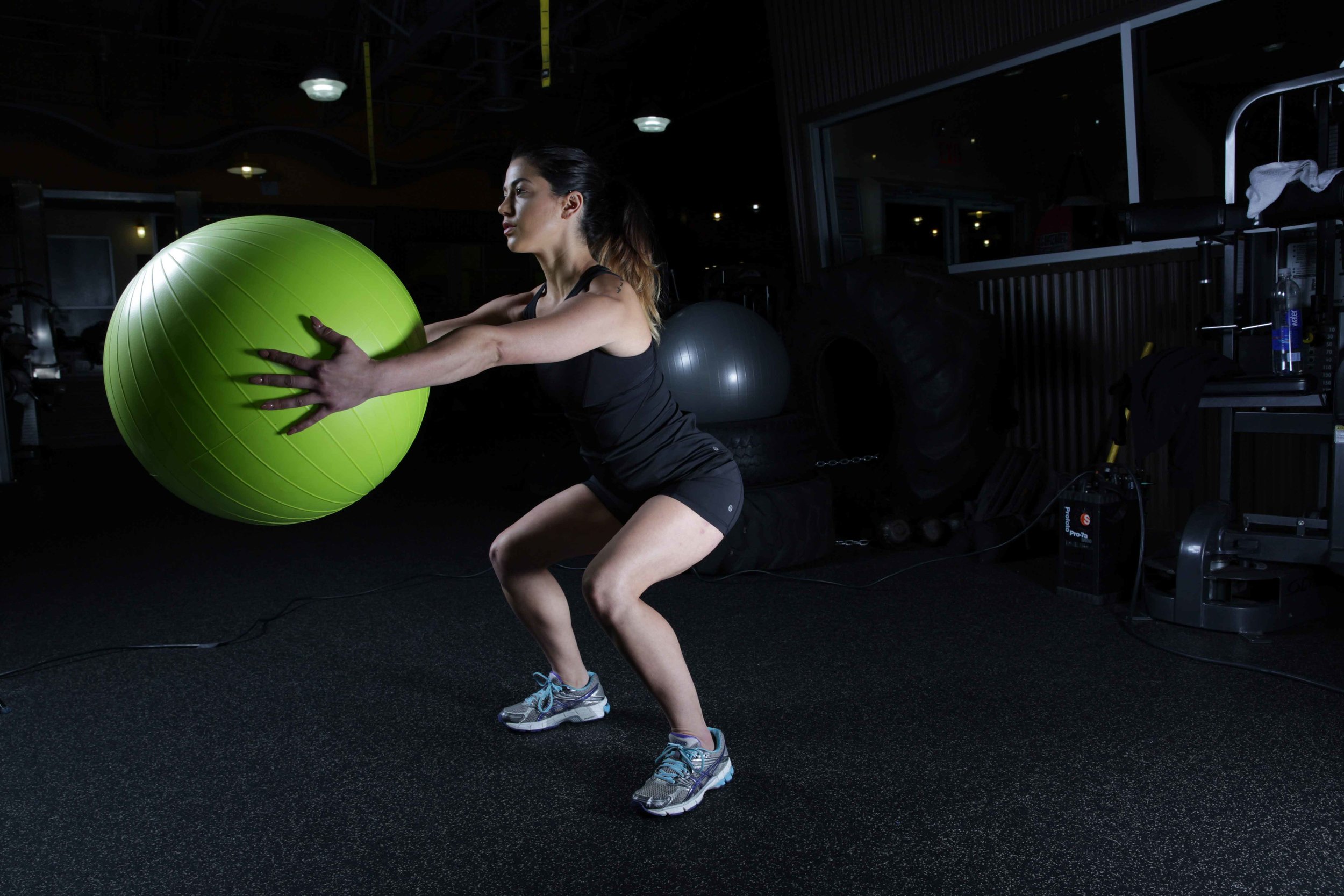
Brooklyn Physical Therapy News- Evolve NY
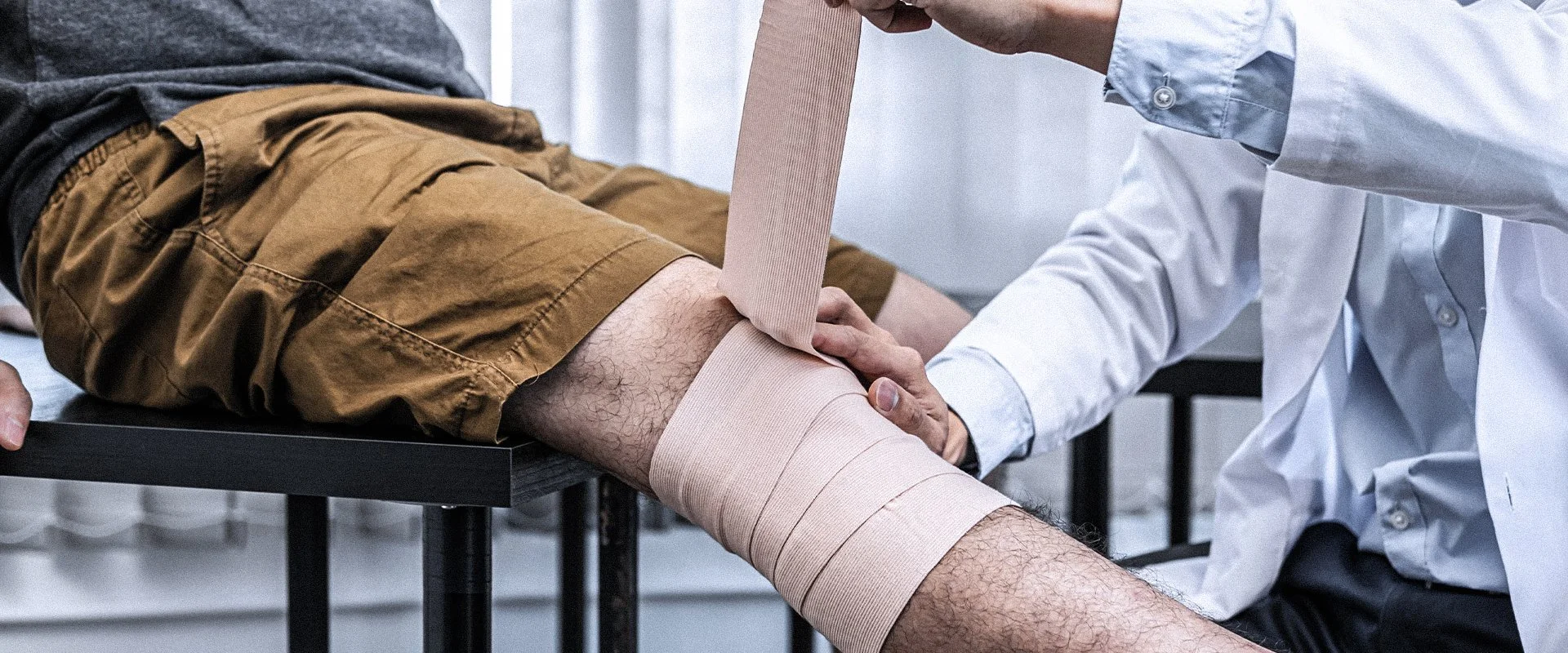
Brooklyn Sports Medicine That Keeps Athletes Winning
Why Sports Medicine Brooklyn NY is Essential for Every Active Person
Sports medicine Brooklyn NY offers comprehensive care for athletes of all levels, from weekend warriors to professional competitors. Whether you're dealing with a nagging injury or looking to optimize your performance, Brooklyn's sports medicine landscape provides cutting-edge treatments and rehabilitation services.
Top Sports Medicine Services in Brooklyn:
- Non-surgical treatments: Physical therapy, injections, regenerative medicine
- Surgical options: Arthroscopic procedures, joint reconstruction, fracture repair
- Specialized care: Pediatric sports medicine, women's sports medicine, concussion management
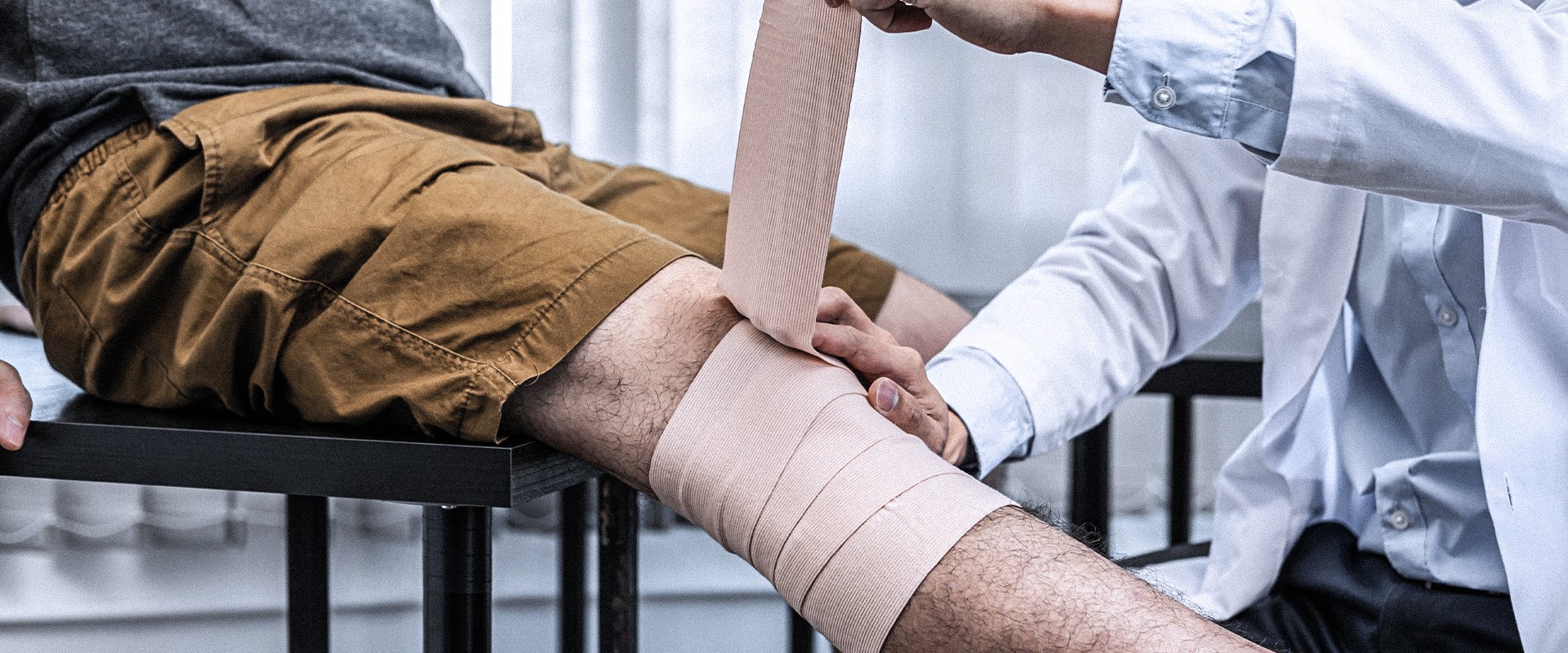
- Advanced facilities: On-site imaging (MRI, X-ray), rehabilitation gyms, diagnostic equipment
- Comprehensive teams: Sports physicians, physical therapists, nutritionists, athletic trainers
Brooklyn's sports medicine providers treat everything from acute injuries like sprains and fractures to chronic conditions such as tendonitis and overuse injuries. The philosophy is inclusive, serving everyone from elite dancers to recreational runners dealing with knee pain.
Common conditions treated include:
- ACL and meniscus tears
- Rotator cuff injuries
- Tennis and golfer's elbow
- Ankle sprains and shin splints
- Concussions and return-to-play protocols
I'm Lou Ezrick, founder of Evolve Physical Therapy + Sports Rehabilitation, and I've spent nearly two decades helping Brooklyn athletes recover from injuries and optimize their performance through hands-on manual therapy and individualized treatment plans. My experience treating complex cases, from chronic pain syndromes to post-surgical rehabilitation, has shown me that effective sports medicine Brooklyn NY requires both advanced clinical expertise and a patient-centered approach that addresses the root cause of dysfunction.
The Spectrum of Sports Medicine Services in Brooklyn NY
Sports medicine Brooklyn NY is for everyone who moves. Whether you're training for a marathon or dealing with nagging pain from weekend activities, the local sports medicine community is here to help. Brooklyn combines cutting-edge technology with genuine care, offering on-site imaging like X-rays and MRIs for fast answers and specialized rehabilitation gyms to streamline your recovery.
This integrated approach means your care team can communicate better and adjust your treatment faster, getting you back to what you love as quickly and safely as possible.
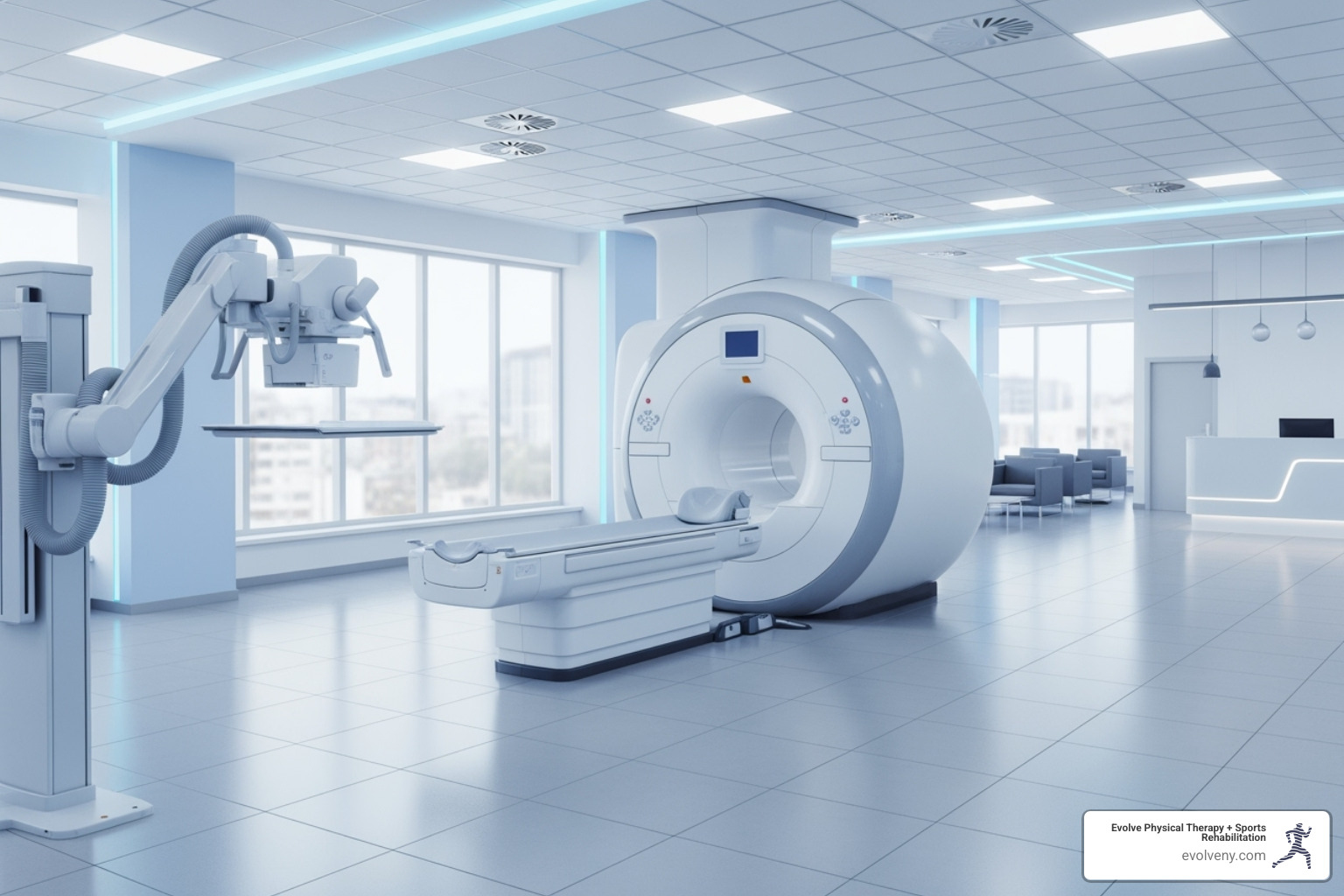
What Types of Sports Medicine Services are Available in Brooklyn?
Sports medicine Brooklyn NY involves a collaborative team working together. Your circle of care may include:
- Primary care sports medicine physicians: Experts in the athletic body who diagnose injuries and create non-surgical treatment plans. The American Medical Society for Sports Medicine highlights their specialized training in keeping athletes of all ages active.
- Physiatrists (PM&R doctors): Focus on restoring proper body function after injury or surgery.
- Podiatrists: Go-to specialists for foot and ankle issues, crucial for runners and dancers.
- Licensed physical therapists: Movement experts who guide rehabilitation, strength, and injury prevention—this is our specialty at Evolve Physical Therapy.
- Certified athletic trainers & sports nutritionists: Provide additional on-field care, taping, and nutrition strategies to support performance.
Surgical vs. Non-Surgical: Finding Your Treatment Path
Good news: over 80% of musculoskeletal injuries improve without surgery. Providers of sports medicine Brooklyn NY start with the gentlest approaches first.
- Conservative treatments: This is the first stop and includes physical therapy, rest, and activity modifications. Most sprains, strains, and tendonitis respond well to these methods.
- Minimally invasive procedures: For when conservative care isn't enough, options like arthroscopic surgery offer faster recovery. We often recommend prehab for arthroscopic procedures to improve outcomes.
- Regenerative medicine: Exciting options like Platelet-Rich Plasma (PRP) injections use your body's own healing factors. Cortisone injections offer powerful anti-inflammatory relief, and shock wave therapy can stimulate healing in stubborn tendons.
- Surgical intervention: Necessary for severe injuries like complete ACL tears or complex fractures, this path involves close collaboration with rehabilitation specialists.
Specialized Care for Every Brooklyn Athlete
Brooklyn's diversity is reflected in its specialized sports medicine programs:
- Pediatric sports medicine: Recognizes that kids' growing bodies have unique needs. We offer specialized pediatric sports PT for young athletes.
- Women's sports medicine: Addresses the unique physiology of female athletes, including hormonal effects and bone health.
- Performing arts medicine: Crucial in Brooklyn's arts scene, this helps dancers, musicians, and other performers whose body is their instrument.
- Geriatric sports medicine: Helps older adults stay active safely by managing age-related changes.
- Adaptive sports medicine: Ensures athletes with disabilities can participate in sports safely and effectively.
Common Injuries Treated by Brooklyn's Sports Medicine Experts
Whether you're a seasoned athlete or just starting, injuries are a reality of an active life. The good news is that sports medicine Brooklyn NY specialists are experts at getting you back in the game. Injuries can be acute (from a sudden fall), chronic, or from overuse (repetitive motion without enough rest).
Effective treatment starts with understanding not just what hurts, but why. As detailed in our guide to Sports Physical Therapy: Common Sports Injuries, a proper diagnosis is the foundation of recovery. Common injury types include sprains (ligaments), strains (muscles/tendons), fractures, and dislocations.

Upper Body Injuries: From Shoulder to Fingertip
- Rotator cuff tears: This common shoulder injury can cause sharp pain and weakness when lifting your arm. Many cases respond well to conservative care, and our approach to How to Rehabilitate Rotator Cuff Injury focuses on restoring strength and mobility.
- Shoulder impingement: Occurs when tendons get pinched in the shoulder, causing pain during overhead activities. It's common in swimmers and tennis players.
- Tennis elbow: An overuse injury causing pain on the outside of the elbow, affecting more than just tennis players. Our Physical Therapy for Tennis Elbow targets the root cause.
- Golfer's elbow: Similar to tennis elbow but affects the inner side of the elbow. We provide dedicated Physical Therapy for Golfer's Elbow for this condition.
- Bicep tendonitis: Inflammation of the biceps tendon causing pain in the front of the shoulder, often from repetitive overhead lifting.
Lower Body and Core Injuries: The Foundation of Movement
- ACL tears: A feared knee injury often requiring surgery, caused by sudden stops or direction changes. Our ACL Rehab Brooklyn program guides patients through every stage of recovery.
- Meniscus tears: A tear in the knee's cartilage cushion that can cause clicking or locking. Our Physical Therapy for Torn Meniscus Brooklyn helps patients recover, sometimes avoiding surgery.
- Ankle sprains: One of the most common sports injuries. Proper treatment is key to preventing chronic issues. Our Physical Therapy for Sprained Ankle focuses on restoring stability.
- Shin splints: A common overuse injury for runners causing pain along the shin bone. Our Physical Therapy for Shin Splints addresses underlying biomechanical issues.
- Hip labral tears: A tear in the cartilage ring of the hip socket causing deep pain or clicking. Our Physical Therapy for Labral Tears helps manage symptoms and improve function.
- Plantar fasciitis: Causes heel pain that is often worst in the morning. This common condition responds well to targeted treatment.
Concussions and Overuse Conditions
- Concussion management: Involves guiding recovery from brain injuries to ensure a safe return to activities. Our Physical Therapy for Concussion Injuries addresses symptoms like balance problems and neck pain.
- Tendonitis: Inflammation of a tendon from repetitive stress. Our approach to Physical Therapy for Tendonitis Brooklyn focuses on reducing inflammation and addressing the cause.
- Stress fractures: Tiny cracks in a bone from repetitive force, common in runners. Our Physical Therapy for Bone Stress Fractures promotes healing and helps prevent future fractures.
- Runner's knee: A general term for pain around the kneecap, often from overuse. Our targeted Physical Therapy for ITB Syndrome helps correct the movement patterns that contribute to pain.
The Crucial Role of Rehabilitation and Performance Improvement
In sports medicine Brooklyn NY, recovery doesn't just mean the pain is gone. True healing means restoring your body to its full potential and often making it stronger. This is where rehabilitation transforms your relationship with movement and performance.
Think of rehabilitation as your personal comeback story. Our comprehensive Sports Rehab Physical Therapy Brooklyn programs are designed to guide you through every chapter of your recovery, helping you emerge stronger, smarter, and more resilient.
Physical Therapy: The Cornerstone of Recovery
Physical therapy is where your body's natural healing abilities get the expert support they need. Our hands-on approach ensures you receive individualized care.
- Manual therapy: Using skilled hands-on techniques, we restore normal movement patterns and reduce pain.
- Therapeutic exercise: Our Therapeutic Exercise Brooklyn programs are carefully crafted to strengthen muscles, improve flexibility, and restore balance.
- Soft tissue mobilization: Through our specialized Soft Tissue Therapy Brooklyn, we release tension and improve circulation.
- Kinesio taping: Our Kinesio Taping Brooklyn techniques provide support without restricting movement, helping to reduce swelling.
- Therapeutic modalities: Tools like ultrasound and electrical stimulation help manage pain and promote tissue healing.
Prehabilitation ("Prehab"): Getting Stronger Before Surgery
If surgery is in your future, prehab is a secret weapon. Getting stronger before surgery leads to better outcomes and faster recovery.
- Injury prevention: Prehab strengthens the muscles around the surgical site, preventing additional injuries post-op.
- Improved surgical outcomes: Surgeons report better results when patients enter surgery stronger and more prepared.
- Faster recovery: Starting post-op rehab from a position of strength gives you a head start. Our Prehabilitation Therapy Brooklyn programs are designed to provide this advantage.
For ACL patients, our guide on How to Prepare for ACL Surgery with Prehab Physical Therapy outlines how this preparation can transform your experience. We also offer specialized Prehab for Arthroscopic Procedures.
Return-to-Sport and Athletic Performance
Getting back to your sport is about feeling confident and capable. Our return-to-sport protocols are structured to ensure you are physically and mentally prepared.
- Gait analysis: Our Running and Gait Therapy Brooklyn services identify biomechanical inefficiencies that could hold you back.
- Return to running programs: Our Return to Running Physical Therapy approach ensures you're not just running again, but running better.
- Return to throwing programs: Essential for overhead athletes, these protocols carefully rebuild arm strength and mechanics.
- Core stabilization: The foundation of all athletic movement. Our Physical Therapy for Core Stabilization programs create a stable platform to improve power and prevent injury.
- Athletic performance training: Our Athletic Performance Training programs help athletes improve speed, agility, and power, turning recovery into an opportunity for growth.
How to Choose the Right Sports Medicine Provider in Brooklyn
Finding the right sports medicine Brooklyn NY provider is a crucial step in your recovery. It's about finding a professional who understands your goals, communicates clearly, and inspires confidence in your treatment plan.
Think of it like choosing a running partner; you need someone who matches your pace and style. The right provider will make all the difference in your recovery, whether you're dealing with a minor sprain or rehabilitating from major surgery.

Evaluating Credentials and Specialties for Sports medicine Brooklyn NY
Credentials are your assurance of quality care. Start by looking for board certification, which shows a physician has completed rigorous training and exams in their specialty. Fellowship training indicates an even deeper level of focus, as the physician has spent extra time after residency concentrating specifically on sports medicine.
For physical therapists, look for the Doctor of Physical Therapy (DPT) degree and advanced certifications like the Orthopedic Certified Specialist (OCS) designation.
The best sports medicine Brooklyn NY facilities accept a team approach, where sports physicians, physical therapists, athletic trainers, and nutritionists collaborate on your care. This model ensures every aspect of your health is considered, sometimes including resources like a comprehensive conditioning exercise program from the American Academy of Orthopaedic Surgeons. Shoulder Conditioning Exercise Program
Considering Logistics: Insurance, Location, and Appointments
Practical considerations are key to a smooth recovery.
- Insurance coverage: Before booking, confirm the provider accepts your insurance. Understand your co-pays, deductibles, and whether you need a referral. While in-network providers are often cheaper, the right out-of-network specialist can sometimes save you time and money in the long run by providing more effective care.
- Location: A convenient clinic makes it easier to stick with your treatment plan. We have locations across Brooklyn, including Marine Park, Gravesend, Midwood, Park Slope, and Mill Basin, to make care accessible.
- Appointment availability: Look for clinics with flexible scheduling and online booking. For acute injuries, ask about same-day or walk-in availability, which some facilities offer.
Finding the Best Sports medicine Brooklyn NY Fit for You
The personal connection with your care team is vital. Look for these qualities:
- Individualized treatment plans: Your body and goals are unique, and your treatment plan should be too. Avoid providers who use a cookie-cutter approach.
- Communication style: A good provider listens, explains things clearly, and welcomes questions. This builds the trust essential for a successful recovery.
- Understanding your goals: Your provider should align your treatment with your personal aspirations, whether that's returning to professional competition or playing with your kids pain-free.
- Patient-provider relationship: This should be a partnership. You should feel comfortable expressing concerns and being an active participant in your care.
- Holistic approach: The best providers consider your overall health, including sleep, stress, and nutrition. Our Orthopedic Physical Therapy Services at Evolve Physical Therapy embody this commitment, focusing on the whole person, not just the injury.
Frequently Asked Questions about Sports Medicine
When it comes to sports medicine Brooklyn NY, we hear many of the same thoughtful questions. Here are answers to the most common ones.
What is the difference between a sports medicine physician and an orthopedic surgeon?
This is a great question. The roles are different but complementary.
- A sports medicine physician is a non-surgical specialist who excels at diagnosing injuries and creating conservative treatment plans. They focus on avoiding surgery through methods like physical therapy and injections, with an eye on injury prevention and performance. Over 80% of sports injuries don't require surgery and can be managed this way.
- An orthopedic surgeon is a surgical specialist for issues like complex fractures or complete ligament tears (e.g., ACL reconstruction). While many also handle sports medicine, their primary expertise is in surgical procedures.
The two work together as a team. The sports medicine physician manages non-operative care and refers to an orthopedic surgeon only when surgery is truly necessary, ensuring you get the right level of treatment.
Do I need a referral to see a sports medicine specialist in Brooklyn?
The answer depends on your insurance plan and the specialist.
- For physicians: PPO plans typically don't require a referral to see a specialist, while HMO plans usually do. Always check with your insurance provider first.
- For physical therapists: New York State has "direct access," meaning you can see a licensed physical therapist for up to 30 days or 10 visits without a physician's referral. This is a huge benefit for starting your recovery quickly. We encourage you to contact us directly to discuss your options.
How long will my recovery from a sports injury take?
This is the most common question, and the honest answer is: it varies. Recovery time depends on several factors:
- Type and severity of injury: A minor ankle sprain might take a few weeks, while a surgical ACL repair is a nine-to-twelve-month journey.
- Your overall health: Your pre-injury fitness level, age, and nutrition all influence how quickly you bounce back.
- Commitment to your treatment plan: This is crucial. Consistency with your physical therapy and following your provider's advice can significantly speed up or slow down your recovery.
- Individual variability: Everyone heals at a different pace.
Your care team will provide a personalized timeline based on your specific injury and progress. Patience is key to getting back stronger than before.
Conclusion: Your Next Step to Peak Performance in Brooklyn
In the vibrant and active borough of Brooklyn, sports medicine Brooklyn NY stands as a guide of hope and healing for every individual who accepts movement. From the elite professional athlete pushing the boundaries of human performance to the weekend warrior enjoying a casual game in the park, and even to those simply seeking to move without pain in their daily lives – our community is committed to supporting your journey.
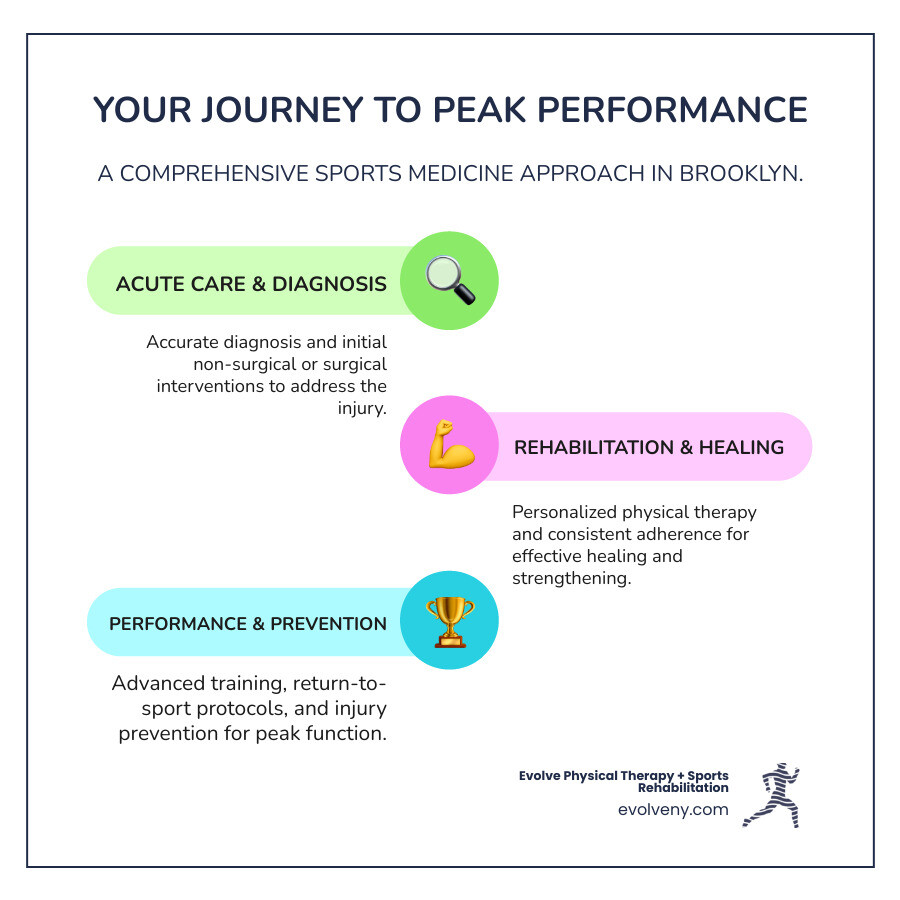
Throughout this guide, we've explored how comprehensive care can truly transform lives. The combination of advanced diagnostics, diverse treatment options (both surgical and non-surgical), and dedicated rehabilitation creates a powerful foundation for recovery. Whether you're dealing with a rotator cuff tear, an ACL injury, or chronic pain that's been holding you back, the right approach can make all the difference.
Proactive care is at the heart of effective sports medicine. Rather than waiting for injuries to sideline you, the best outcomes come from addressing issues early and building strength to prevent future problems. This philosophy of getting ahead of injuries, rather than just reacting to them, is what sets exceptional care apart.
At Evolve Physical Therapy + Sports Rehabilitation, we're proud to be a vital part of this robust sports medicine ecosystem. We understand that your body is your most important equipment, and we're dedicated to helping you keep it running smoothly. Our unique hands-on approach ensures that every session is custom to your specific needs, focusing on not just healing your injury but also strengthening your body to prevent future setbacks and lift your performance.
What makes our approach different is our commitment to personalized recovery. We don't believe in cookie-cutter solutions because no two bodies are exactly alike. Your recovery journey should be as unique as you are, whether you're a dancer preparing for your next performance or a runner training for your first marathon.
The path from injury to recovery to peak performance isn't always linear, but with the right support team, it's absolutely achievable. We've seen countless patients not only return to their previous activities but actually surpass their former capabilities. That's the power of comprehensive sports medicine Brooklyn NY – it's not just about getting back to where you were; it's about becoming stronger than before.
Whether you're dealing with a new injury, a nagging chronic condition, or simply looking to optimize your athletic capabilities, we are here to help. Don't let pain or fear of re-injury keep you on the sidelines. Every day you wait is another day you're not moving toward your goals.
Take the first step towards a stronger, healthier, and more active you. For more information about our comprehensive physical therapy services and how we can help you evolve, please visit us at More info about physical therapy services. We look forward to helping you get back in the game and keep winning!

Mental Game Strong: Becoming a Certified Mental Performance Coach
Why Mental Performance Coaching Is Essential for Peak Performance
A certified mental performance coach helps athletes, performers, and professionals develop the mental skills needed to excel under pressure and achieve consistent peak performance. Here's what you need to know about becoming one:
Quick Answer - Certified Mental Performance Coach Requirements:
- Education: Master's or doctoral degree in sport science, psychology, or related field
- Coursework: Complete 8 knowledge areas (K1-K8) including ethics, sport psychology, and research methods
- Experience: 400 hours of mentored experience (minimum 200 hours direct client contact)
- Certification: Pass the AASP certification exam
- Certifying Body: Association for Applied Sport Psychology (AASP)
- Salary Range: $50,000 to $115,000 annually (median $85,000)
The mental game accounts for up to 90% of athletic performance, yet most coaches lack the tools to address it effectively. As one industry expert notes: "The biggest problem in coaching is that most coaches and trainers don't know how to help the people they coach develop the mental skill set" for consistent high performance.
Mental performance coaching bridges this gap. Unlike sports psychologists who diagnose and treat mental health conditions, Certified Mental Performance Consultants (CMPCs) focus specifically on optimizing performance through mental skills training. They work with everyone from elite athletes to corporate professionals, helping clients develop confidence, focus, resilience, and the ability to perform under pressure.
The demand for mental performance coaching continues to grow as organizations recognize that physical training only tells half the story. Studies consistently show that mental skills training significantly improves athletic performance, making this field both impactful and financially rewarding.
As Lou Ezrick, founder of Evolve Physical Therapy + Sports Rehabilitation, I've seen how mental readiness directly impacts physical recovery and athletic performance. Understanding the path to becoming a certified mental performance coach can help you bridge the critical gap between physical capability and mental execution.
What is a Certified Mental Performance Consultant (CMPC)?
A certified mental performance coach, officially known as a Certified Mental Performance Consultant (CMPC), is a specialized professional who helps people open up their potential and perform at their best under pressure. They focus on the mental side of performance, helping clients develop crucial skills like concentration, confidence, and resilience.

CMPCs work with a diverse range of clients who need to perform in high-stakes environments. This includes elite athletes in the NFL, NBA, and MLB; performers like dancers and musicians; first responders such as military personnel and firefighters; and corporate professionals looking to improve focus and manage stress.
The gold standard for certification comes from the Association for Applied Sport Psychology (AASP). This organization sets the rigorous educational, experiential, and ethical standards that define a qualified certified mental performance coach.
CMPC vs. Sports Psychologist: Understanding the Key Differences
While both CMPCs and sports psychologists work in the mental performance space, their roles and training are distinct. The table below highlights the key differences.
| Feature | Certified Mental Performance Consultant (CMPC) | Licensed Sports Psychologist |
|---|---|---|
| Primary Focus | Performance optimization, mental skills training, human potential development | Diagnosis and treatment of mental health conditions, clinical interventions |
| Scope of Practice | Empowering individuals to achieve peak performance, manage stress, build resilience, improve focus, set goals, and improve overall well-being in performance contexts. | Addressing diagnosable mental illnesses (e.g., anxiety disorders, depression, eating disorders) and psychological issues impacting performance. |
| Licensure | Certification (e.g., AASP CMPC) signifies meeting professional standards; it is not a license to practice psychology. | Requires state/provincial/territorial licensure to practice psychology, involving strict educational, supervised experience, and examination requirements. |
| Educational Path | Typically a Master's or Doctoral degree in sport science, psychology, or a related field, with specific coursework in applied sport psychology. | Typically a Doctoral degree (Ph.D. or Psy.D.) in clinical, counseling, or sport psychology, followed by extensive supervised clinical hours. |
| Treatment | Focuses on coaching, education, and mental skills training; does not diagnose or treat mental illness. | Can diagnose mental health conditions and provide psychotherapy or other clinical interventions. |
| Professional Title | Certified Mental Performance Coach, Certified Mental Performance Consultant (CMPC) | Licensed Psychologist, Licensed Sport Psychologist |
In short, a CMPC is a mental skills trainer focused on optimizing performance. A licensed sports psychologist can diagnose and treat clinical mental health conditions that may impact performance. This distinction ensures individuals receive the appropriate type of support for their specific needs.
The Growing Demand for Mental Performance Coaching
The demand for mental performance coaching is rapidly increasing. This growth is driven by greater mental health awareness and the universal desire for a competitive edge in sports, business, and the arts. When physical skills are equal, mental preparation often becomes the deciding factor.
Studies show coaching improves performance, with some experts attributing up to 50% of elite performance to mental factors. At Evolve Physical Therapy + Sports Rehabilitation, we see this mind-body connection daily. Our Athletic Performance Training programs recognize that physical healing and mental readiness are intertwined, leading to faster recovery and better results.
The Path to Becoming a Certified Mental Performance Coach
Becoming a certified mental performance coach is a demanding and structured journey. The CMPC certification from the Association for Applied Sport Psychology (AASP) is nationally accredited by the National Commission for Certifying Agencies (NCCA), representing the gold standard for professional practice.
This rigorous process ensures every CMPC has the knowledge, skills, and ethical foundation to guide others toward peak performance. The path involves three core steps: establishing an educational foundation, gaining mentored experience, and passing the certification exam. This structured approach provides professional validation that clients and employers trust. You can find more on the CMPC certification program directly from AASP.

Step 1: The Educational Foundation
The journey begins with a significant academic commitment. You'll need a master's or doctoral degree from a regionally-accredited institution in a sport science or psychology-related field.
Beyond the degree, you must complete specific coursework across eight distinct knowledge areas (K1-K8). This comprehensive curriculum ensures every certified mental performance coach is grounded in scientific principles and practical skills. The knowledge areas include:
- Professional ethics and standards (K1)
- Sport psychology (K2)
- Sport science (K3)
- Psychopathology (K4)
- Helping relationships (K5)
- Research methods and statistics (K6)
- Psychological foundations of behavior (K7)
- Diversity and culture (K8)
Step 2: Gaining Mentored Experience
After establishing your academic foundation, you must complete 400 hours of mentored experience. This hands-on training is structured to provide meaningful, real-world exposure to the field.
The hours are broken down as follows:
- 200 hours (minimum) of direct client contact, delivering mental skills training.
- 150 hours (maximum) of support activities, such as preparing materials or reviewing sessions.
- 50 hours (minimum) of mentorship with an approved CMPC mentor.
A crucial requirement is that at least 200 hours across all categories must be with competitive sport populations, ensuring you gain specialized experience in high-stakes athletic environments. This practical training transforms textbook knowledge into real skills. At Evolve, our Athletic Performance Coach roles also emphasize supervised experience to deliver the best results. You can see all CMPC requirements for the most current details.
Step 3: Passing the Certification Exam
The final step is passing the CMPC certification exam. This comprehensive, 90-minute assessment evaluates your mastery of all required knowledge areas, from ethical considerations to practical application strategies.
Once your application and prerequisites are approved, you have six months to take the exam, either at an approved testing center or via live online proctoring. Passing the exam signifies you have the expertise needed to guide individuals toward peak performance.
For detailed information, refer to The CMPC Candidate Handbook, your complete guide to this final step.
Career Paths and Salary Expectations for a CMPC
Becoming a certified mental performance coach opens up a diverse world of career possibilities. Your expertise in mental skills training is highly transferable across various industries, as the core principles of managing pressure, building confidence, and performing at one's best are universal.

Typical Career Opportunities
The career paths for a certified mental performance coach are as varied as they are rewarding. Common opportunities include:
- Professional and Collegiate Sports: Working with teams and athletes to develop mental toughness.
- Military and High-Risk Occupations: Helping soldiers, firefighters, and police officers perform under extreme pressure.
- Performing Arts: Assisting dancers, musicians, and actors in overcoming stage fright.
- Corporate Wellness and Business: Coaching executives and teams on stress management and resilience.
- Private Practice: Building your own coaching business to specialize in areas of interest.
- Academic Settings: Mentoring students and conducting research at schools and universities.
Just as we create Customized Physical Therapy Training Programs at Evolve Physical Therapy + Sports Rehabilitation, a CMPC crafts personalized strategies to help each client perform at their absolute best.
What is the Salary Range for a Certified Mental Performance Consultant?
The financial outlook for a certified mental performance coach is promising. According to a 2020 AASP survey, the average annual salary for a CMPC ranges from $50,000 to $115,000, with a median annual income of $85,000.
Actual earnings depend on several factors, including:
- Experience Level: Seasoned CMPCs with established reputations command higher fees.
- Geographic Location: Rates are often higher in major metropolitan areas like Brooklyn.
- Client Base: Working with elite professional athletes or Fortune 500 companies typically pays more.
- Industry Specialization: Corporate consulting often offers higher rates than other sectors.
Private practice offers the highest earning potential but requires strong business development skills. Many CMPCs start in organizational roles to build experience before transitioning to private practice.
The CMPC Toolkit: Skills for Open uping Peak Performance
Working with a certified mental performance coach provides a proven toolkit of concrete strategies to apply in high-pressure situations. It's a form of mental training designed to strengthen the mind, much like physical therapy strengthens the body.
Mental performance coaching is about practical application. A certified mental performance coach blends psychology, cognitive behavioral techniques, and mindfulness to create a personalized approach that helps clients optimize their existing abilities and open up their full potential.
What Specific Mental Skills Does a Certified Mental Performance Coach Teach?
A certified mental performance coach teaches a range of mental skills that form a comprehensive approach to peak performance. Key skills include:
- Goal-Setting: Creating specific, effective goals that provide clear direction.
- Focus and Concentration: Enhancing attentional control to stay locked in under pressure.
- Confidence: Building unshakeable self-belief through strategic self-talk and positive reinforcement.
- Resilience: Developing the ability to bounce back from setbacks and adversity.
- Emotional Regulation: Managing performance anxiety, frustration, and other emotions constructively.
- Self-Talk: Recognizing and reframing negative internal dialogues into supportive ones.
- Visualization and Imagery: Mentally rehearsing successful outcomes to prepare for performance.
- Stress Management: Using practical tools like mindfulness and breathing techniques to stay calm.
- Process Over Outcome Focus: Concentrating on controllable actions rather than uncontrollable results.
- Team Cohesion and Communication: Improving group dynamics and conflict resolution.
- Performance Evaluation: Learning to constructively assess performance for continuous improvement.
Consistent practice of these skills leads to mastery, creating a more confident, focused, and resilient performer. For more insights, check out our page on Mental Performance Coaching.
Frequently Asked Questions about CMPC Certification
For those considering this career, here are answers to some of the most common questions about becoming a certified mental performance coach.
How long does it take to become a CMPC?
The timeline varies, but the entire process typically takes 3-7 years. This includes 2-5 years to complete a master's or doctoral degree, followed by an additional 1-2 years to complete the 400 hours of mentored experience and pass the certification exam.
Is CMPC certification recognized internationally?
Yes, the CMPC credential is highly respected worldwide. It is accredited by the National Commission for Certifying Agencies (NCCA) in the U.S., and the AASP has a formal partnership with the Canadian Sport Psychology Association (CSPA-ACPS). This makes the CMPC certification the gold standard for mental performance coaching in North America and beyond.
Can I become a CMPC without a psychology degree?
Yes. A degree in a related sport science field, such as kinesiology or exercise science, is acceptable. The key requirement is that your master's or doctoral degree is from a regionally-accredited institution and that you complete all required coursework across the eight knowledge areas (K1-K8). This ensures every certified mental performance coach has a comprehensive understanding of foundational psychological principles.
Conclusion: The Future of Performance is Mental
The path to becoming a certified mental performance coach acknowledges a fundamental truth: the mental game is everything. While physical training is crucial, it's the mental toolkit that separates good performers from great ones under pressure.
CMPCs teach concrete skills—from goal-setting to visualization—that bridge the gap between potential and performance. With salaries ranging from $50,000 to $115,000 and growing demand across sports, business, and the arts, this career offers both financial stability and deep personal fulfillment.
The mind-body connection is the foundation of peak performance. At Evolve Physical Therapy + Sports Rehabilitation, our holistic approach across Brooklyn, Marine Park, Gravesend, Midwood, Park Slope, and Mill Basin embodies this principle. We know that mental readiness accelerates physical recovery and builds resilience. When an athlete recovers from an injury, rebuilding confidence is as important as rebuilding strength.
Peak performance happens when mental preparation meets physical capability. For athletes ready to accept this integrated approach, our Physical Therapy for Athletes services can help you return to your sport stronger, more confident, and mentally prepared for any challenge. The future of performance is mental, and a certified mental performance coach is at the forefront of this evolution.

Finding Your Circle – Parkinson's Caregiver Support Groups Guide
The Evolving Journey of Parkinson's Caregiving: Finding Your Support Circle

Being a caregiver for someone with Parkinson's disease (PD) is a journey unlike any other. It's a role that changes constantly, bringing new challenges as the disease progresses. This evolving path can feel incredibly isolating. But you don't have to walk it alone.
Parkinson's caregivers support groups offer a vital lifeline. They provide a space where shared experiences light the way.
Here’s why these groups are so important:
- Reduced Isolation: Caregiving can be lonely. Support groups connect you with others who truly understand your daily challenges.
- Shared Wisdom & Practical Tips: Learn from peers about managing symptoms, navigating healthcare, and finding local resources.
- Emotional Support & Understanding: A safe space to vent, share feelings, and receive empathy from those on a similar journey.
- Improved Coping Skills: Gain new strategies and perspectives to better handle the evolving demands of Parkinson's care.
As Alice Templin, a Parkinson's patient, once said, "You talk about Parkinson’s with your family but you don’t want to do that all the time, so when you get together once a month with the group, it’s a good opportunity to do that." This highlights the unique, essential role of a dedicated support network.
As Louis Ezrick, the founder of Evolve Physical Therapy, my nearly two decades of experience in holistic physical therapy and rehabilitation have shown me the profound impact of comprehensive support. This extends to recognizing the critical need for Parkinson's caregivers support groups, which play a vital role in the well-being of both the care partner and the person with Parkinson's. This guide will help you understand and find these invaluable communities.
The Lifeline of Shared Experience: Why Support Groups are Essential for Parkinson's Caregivers
At Evolve Physical Therapy, we know caring for a loved one with Parkinson's disease is a constantly changing journey. The role is demanding and can feel lonely, which is why Parkinson's caregivers support groups are a true lifeline.
These groups provide a safe space to share experiences, exchange practical tips, and discuss the realities of Parkinson's with others who understand, without burdening family. The benefits are powerful. They reduce the profound isolation many caregivers feel, connecting you with a community that \"gets it.\" Members gain improved coping abilities by sharing struggles and successes, learning new strategies to handle daily challenges. Groups are a goldmine of practical advice and resources, from managing symptoms to navigating healthcare. They also offer a safe outlet for emotional release and encourage prioritizing self-care, which is crucial for your health and the quality of care you provide.
Organizations like Parkinson Society Canada, with its 240 support groups, show how vital these communities are. For broader caregiving challenges, resources like the Caregiver Action Network are also highly recommended.
Specific Challenges Addressed in Groups
Support groups are a crucial forum for tackling the unique challenges of Parkinson's caregiving head-on:
- Caregiver burnout: Members share strategies for managing stress and recognizing the signs of burnout, emphasizing that it's okay to prioritize your own well-being.
- Navigating the healthcare system: Groups offer practical tips on advocating for your loved one, coordinating with specialists like neurologists and physical therapists, and understanding insurance.
- Managing motor symptoms: Peers share real-world coping mechanisms for tremors, rigidity, and balance problems, offering insights that supplement professional medical advice.
- Understanding non-motor symptoms: These often invisible symptoms—like anxiety, depression, and cognitive changes—can be distressing. Groups provide a space to discuss these sensitive topics and learn about management strategies.
- Relationship changes: Parkinson's can impact family dynamics. Groups offer a safe space to discuss shifts in roles, intimacy, and communication.
- Financial strain: Groups may share information on financial planning, government programs, and other resources to help ease the financial burden of care.
- Anticipatory grief: This \"living loss\" is a unique challenge. Specialized groups provide a compassionate space to process these complex emotions.
- Finding time for self-care: A recurring theme, groups reinforce the importance of self-care and share creative ways to carve out personal time to recharge.
Navigating Your Options: Types of Parkinson's Caregivers Support Groups
Just as Parkinson's is unique to each person, caregiver needs are diverse. Thankfully, Parkinson's caregivers support groups are equally varied, allowing you to find the perfect fit for your situation.
How to Find the Right Parkinson's Caregiver Support Group for You
Finding the right Parkinson's caregivers support groups is a bit like finding a good pair of shoes—it needs to fit just right. It's truly worth exploring different options until you find the community that resonates with you and provides the comfort and support you need.

The first step, of course, is knowing where to look. National organizations are fantastic starting points, acting as huge hubs for information and referrals. But don't forget to look closer to home, as local resources can offer incredibly specific and community-driven support.
Starting Your Search: National and Local Resources
When you're ready to begin your search, a great place to start is with the large national organizations. They often have extensive networks and can point you in the right direction. For example, the Parkinson's Foundation offers a helpful helpline (1-800-4PD-INFO) that's a treasure trove of information and referrals to professionals and community resources. They also have a fantastic guide to finding support on their website. Other leading organizations include the American Parkinson Disease Association (APDA), known for its resources and robust support networks, and the Davis Phinney Foundation, which focuses on helping people with Parkinson's live well today, providing valuable tools for both patients and caregivers. While primarily focused on research, the Michael J. Fox Foundation also offers valuable information and community links. And for broader caregiving support, the Family Caregiver Alliance offers general resources for family caregivers across various health conditions, though it's not specific to Parkinson's.
Beyond these national names, remember to check out local chapters and affiliates. Many of the big organizations have local branches that host community-specific Parkinson's caregivers support groups. For instance, Parkinson Society Canada has numerous regional offices ready to help you find a group nearby.
Your loved one's medical team can also be a huge help! Hospital networks and medical centers, especially those with neurology departments or movement disorder centers, frequently host or can refer you to support groups. Don't hesitate to ask their neurologist or movement disorder specialist for recommendations, as they are often very aware of local groups and resources.
And don't overlook your community's local hubs. Senior centers and community centers frequently host support groups for various conditions, including Parkinson's. If you're in Brooklyn, exploring centers in neighborhoods like Marine Park, Gravesend, Midwood, Park Slope, or Mill Basin can definitely lead you to some great options.
When searching online, try using specific terms like "[Your City/Region] Parkinson's caregiver support group" or "online Parkinson's caregiver support group." Websites like MyParkinsonsTeam also offer online communities specifically for those living with Parkinson's and their caregivers. Once you find a potential group, reach out to the organizer. They can provide details on the group's focus, format, and help you decide if it's the right fit for your needs.
What to Expect from Parkinson's Caregivers Support Groups
Stepping into any new group can feel a little daunting, right? But understanding what generally happens can make the process much easier. Most Parkinson's caregivers support groups are designed to be positive, welcoming, and supportive spaces where your privacy and confidentiality are always respected. What's shared in the group, stays in the group—this is key to creating a truly safe and non-judgmental space for everyone.
Groups might be led by a professional, such as a social worker or a medical professional, who can offer expert guidance. Or they might be peer-led, guided by experienced caregivers who truly understand what you're going through. Both models can be incredibly effective, offering different but equally valuable perspectives.
While formats can vary, a typical meeting usually has a friendly flow. It might start with quick introductions, giving everyone a chance to share their name and perhaps how they're feeling that day. This helps break the ice and build connections. Sometimes, groups will host guest speakers, bringing in experts on topics relevant to Parkinson's or caregiving, like neurologists, physical therapists, or even financial planners. The heart of many meetings is the open discussion, where members can share experiences, ask questions, and offer advice. There's often dedicated time for resource sharing, where people bring information about new programs, local services, or helpful articles they've finded. And, just as importantly, there's usually time for informal socialization—those casual chats can be just as valuable as the structured discussion.
One of the most important things to remember is that there's no pressure to speak. Your participation is entirely voluntary. It's perfectly okay to attend simply to listen and absorb. Many caregivers find immense benefit just from hearing others' stories and realizing they are truly not alone in their struggles. Meetings typically last no more than 90 minutes, sometimes with a short break, and a regular schedule (like once a month) helps build strong, lasting relationships.
Resources and Information Shared in Groups
One of the most valuable benefits of joining Parkinson's caregivers support groups is the sheer wealth of practical information and resources that are shared. This exchange of knowledge can significantly boost your ability to manage and steer the complexities of Parkinson's care.
You'll often find discussions around practical caregiving tips, covering everything from managing medications and preparing meals to using adaptive equipment and daily living strategies. Members frequently share recommendations for local services, including home care agencies, vital respite care options (which are so crucial for a caregiver's well-being!), adult day programs, and specialized therapists like physical therapists, speech-language pathologists, or occupational therapists.
Groups can also be a fantastic source for information on clinical trials and research updates, helping you stay informed about the latest advancements in PD treatment and potential opportunities to participate. Navigating the financial side is often a big concern, so groups might discuss insurance and benefits, offering advice on Medicare, Medicaid, private insurance, and other financial assistance programs for medications or care. You might also learn about assistive technology—new devices or tech solutions that can improve the quality of life for the person with Parkinson's and ease your caregiving burden.
Beyond the practical, there's usually a focus on emotional well-being. Groups often provide emotional and mental health support, and can offer referrals to therapists, counselors, or other mental health resources to help caregivers manage stress, depression, or anxiety. And for the future, you might find discussions on legal and financial planning, covering topics like wills, power of attorney, and long-term care considerations.
These groups are often a place where you can learn about Parkinson's-specific programs, like Rock Steady Boxing, an exercise program designed specifically for people with PD. Here at Evolve Physical Therapy + Sports Rehabilitation in Brooklyn, we proudly offer this program, and discussions in support groups can often lead caregivers to find new avenues for support and well-being for both the care partner and the person with Parkinson's.
Beyond the Meeting: Integrating Support and Self-Care
Attending a Parkinson's caregivers support group is a powerful step, a true act of self-care in itself. But the good news? Its benefits don't stop when the meeting ends! We truly believe that feeling well comes from weaving those lessons and that wonderful support into your daily life.

Think of your support group as a powerful tool. It's where you gather great ideas and smart strategies. Then, you can use these tools to prevent feeling totally worn out, to make your own health a top priority, and to find quiet moments of peace. The importance of respite and self-care for caregivers simply cannot be overstated. It's not selfish; it's absolutely essential. A caregiver who feels refreshed and has new energy will bring that positive spirit directly to the person they care for.
Simple techniques like mindfulness, meditation, or even just deep breathing can be learned and practiced to help manage stress. And let's not forget physical activity! Things like yoga or specialized exercise programs are fantastic for keeping your own body and mind strong. Here at Evolve Physical Therapy + Sports Rehabilitation, we take a whole-person approach. We understand that your physical well-being as a caregiver is just as vital as the emotional support you receive. Our team can help you find the right physical activities and therapeutic exercises to keep you feeling strong and ready for anything.
Making Self-Care a Priority
Making self-care a part of your life isn't about finding more hours in the day. It's about making smart, mindful choices.
One key step is setting boundaries. It's okay to say "no" when you need to. And don't be afraid to let others know your limits. This helps protect your energy.
Next, make sure you're scheduling personal time. Even short breaks can make a huge difference. Maybe it's a quick walk, reading a few pages of a book, or just listening to your favorite song. Treat these "appointments" with yourself as something you absolutely cannot skip.
It’s also important to maintain hobbies and interests. Don't lose touch with the activities that bring you joy, even if you do them less often. These are so important for who you are, beyond your caregiving role.
Remember to communicate your needs to family. Have open chats with other family members about needing support and time for yourself. They might not realize how much you need a break unless you tell them.
And here's a big one: accepting help! When someone offers to help, say "yes!" Whether it's an hour of respite, bringing over a meal, or running an errand, taking assistance is a sign of strength, not weakness.
Finally, always remember the clear connection between caregiver health and patient well-being. Your own health directly affects the quality of care you can give. A caregiver who is healthy and less stressed is simply better able to support their loved one with Parkinson's. This special partnership truly thrives when both people, in their unique roles, feel as supported and cared for as possible.
Frequently Asked Questions about Parkinson's Caregiver Support
We often hear common questions from caregivers exploring support groups. Here, we address some of the most frequent inquiries to help you feel more confident in taking the next step.
Is there a cost to join a support group?
We get this question a lot, and it's a good one! The great news is, most Parkinson's caregivers support groups are absolutely free. They’re often run by wonderful non-profit organizations, foundations, or passionate volunteers who are just committed to helping out the Parkinson's community. Think of it as support, freely given.
Sometimes, if a group is led by a licensed therapist or social worker (a "professionally-facilitated" group), there might be a small fee. This usually just helps cover their time or administrative costs. But don't worry, they'll always be upfront about it.
Our best advice? Always check with the group organizer or the host organization directly. They can give you all the specific details about any potential fees. Here at Evolve Physical Therapy, we truly believe that getting the support you need should be as easy and barrier-free as possible.
What if I'm not comfortable sharing my personal story?
Feeling a bit shy about sharing your personal journey? That's totally normal, and it's one of the most common worries we hear! Please know that participating in a Parkinson's caregivers support group is always, 100% voluntary. You'll never be pressured to say anything you're not ready for.
In fact, many people attend their first few meetings—and sometimes even many more—just to listen. And guess what? Listening is a powerful form of participation! You can gain so much just by hearing others' experiences, picking up valuable insights, and realizing that you're truly not alone in what you're going through. It’s comforting to know others share similar struggles and feelings.
When you feel ready, whether that's at your first meeting or your tenth, you might choose to share a little, or a lot. These groups are built on a foundation of safety and non-judgment, designed for you to open up at your own pace. Sometimes, simply being present in a room (or a virtual one) with people who just "get it" can be incredibly healing and therapeutic.
Can I attend a group with the person I care for?
This is a great question, and the answer really depends on the specific Parkinson's caregivers support group you're looking at! Support group formats can vary quite a bit.
- Combined Groups: Some groups are designed for both the person with Parkinson's and their care partner to attend together. These can be wonderful for building mutual understanding and working on coping strategies as a team.
- "Caregiver-Only" Groups: However, many groups are specifically for caregivers only. These "caregiver-only" spaces are often highly valued because they offer a private environment. Here, you can discuss those really sensitive topics, vent frustrations, or share challenges that you might not feel comfortable bringing up in front of your loved one. Caregivers often tell us they need a place to "vent, share, learn tips and resources, and receive support from others walking the same path" without worrying about upsetting or burdening the person they care for. It's about having a safe space just for you.
So, before you attend, it’s always best to check the group's description or contact the organizer directly. They can tell you exactly what the group's format is and who it's for. This way, you can be sure you're finding the perfect fit for your needs and comfort level.
Conclusion
Caring for someone with Parkinson's disease is truly a unique and demanding journey. It’s filled with moments of deep love, alongside significant challenges. We hope this guide has shown you that, no matter how tough it gets, you are not alone.
The incredible power of community, especially within Parkinson's caregivers support groups, offers a lifeline of strength, understanding, and practical wisdom. It’s where shared experiences light the way forward, and where you find others who genuinely "get it."
Taking that first step toward seeking support might feel a little scary, but trust us, it’s a profoundly courageous act of self-care. As the saying goes, "A journey shared is a burden lightened." You'll find renewed energy and a fresh perspective, not just for yourself, but for your loved one too.
At Evolve Physical Therapy + Sports Rehabilitation, with our locations across Brooklyn (including Marine Park, Gravesend, Midwood, Park Slope, and Mill Basin), we truly believe in a holistic approach to well-being. We know that your physical health, emotional support, and community connection are all deeply intertwined. That’s why we offer specialized programs, like our Rock Steady Boxing program, which isn't just about physical activity for those with Parkinson's; it's also about building a powerful, supportive community through shared activity.
We warmly encourage you to reach out, explore the many resources available, and find your circle. Whether it's through a formal support group, a physical activity program, or a combination of both, building a supportive community is absolutely key to navigating the evolving path of Parkinson's care. We're here to help you evolve, every step of the way.
More info about our Parkinson's programs
Mobility Magic: Exercises to Boost Your Range of Motion
The Best Mobility Movements for Key Body Areas
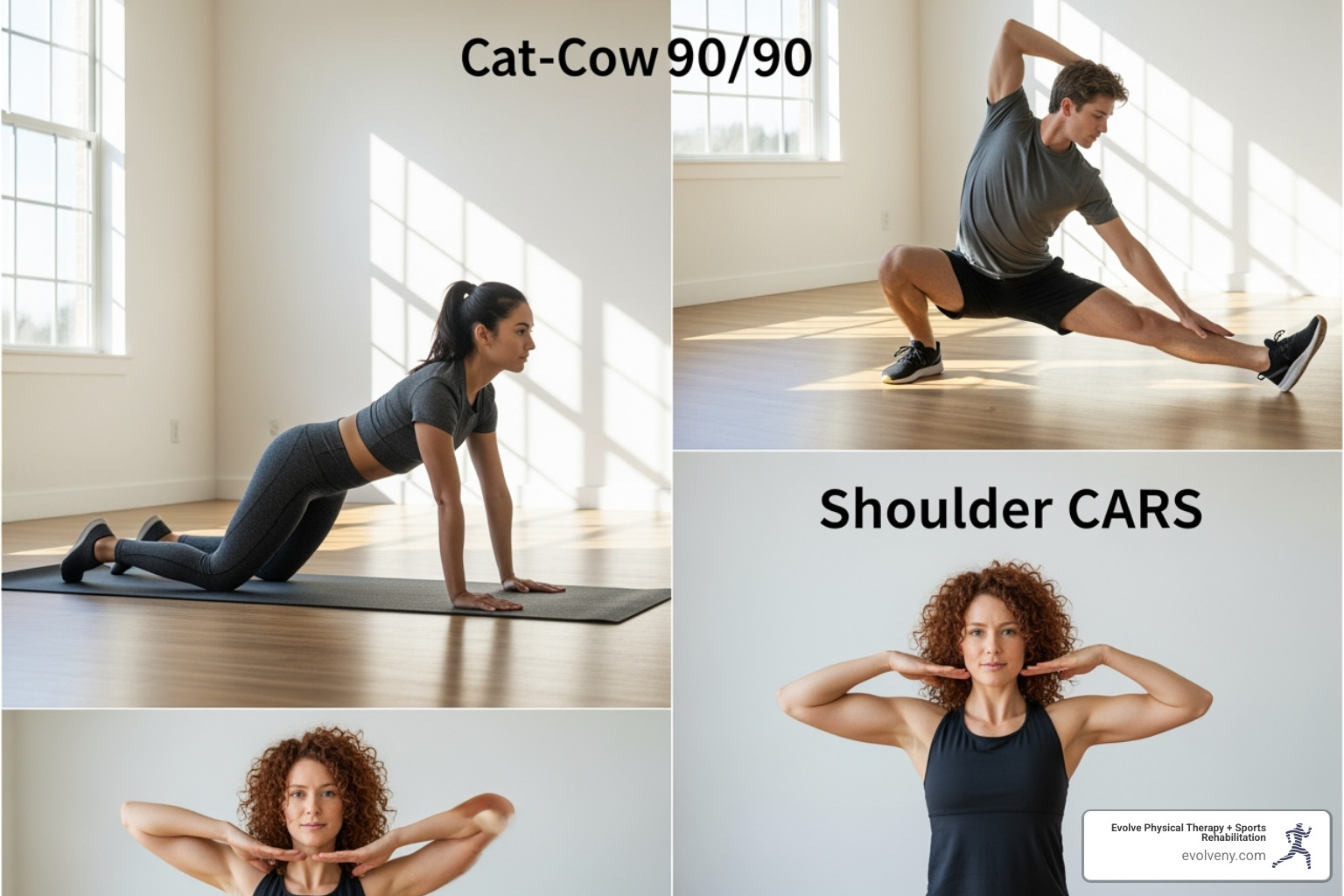
Ready to put mobility theory into action? The best mobility movements are those that take your joints through their full range of motion with control and purpose. These aren't just stretches—they're dynamic movements that prepare your body for action and improve how you move every day.
Think of mobility work as giving your joints a daily tune-up. Just like your car runs better with regular maintenance, your body performs better when you regularly move your joints through their full range of motion. We use these exact movements in our Therapeutic Exercise Programs to help our patients heal faster and move better.
The movements we're about to share target the three areas that matter most for daily function: your hips, lower back, and shoulders. These are the spots where stiffness tends to creep in first, and they're also the areas that give you the biggest bang for your buck when it comes to feeling better.
Best mobility movements for hip health
Your hips are the unsung heroes of your lower body. When they're happy and mobile, everything else tends to fall into place. When they're tight? Well, that's when your lower back starts complaining, your knees feel cranky, and even your posture suffers.
The good news is that hip mobility responds beautifully to consistent work. Whether you're dealing with tight hip flexors from sitting all day or need better rotation for your golf swing, these movements will help you move with more ease and confidence.
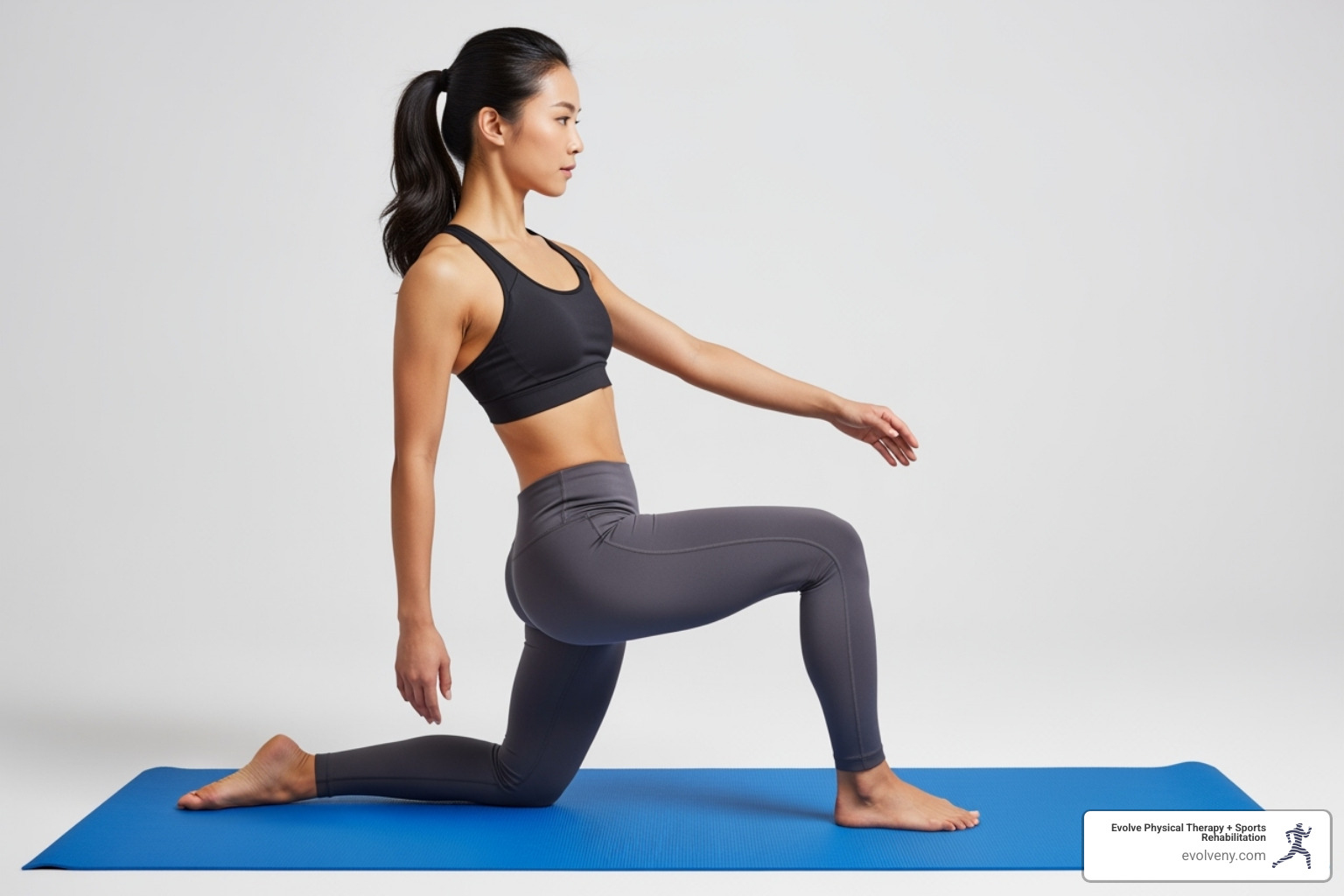
90/90 Hip Switches are fantastic for improving both internal and external hip rotation—movements that often get neglected in our daily lives. Sit on the floor with both knees bent at 90 degrees, one leg internally rotated in front of you and the other externally rotated to the side. Slowly switch the position of your legs, moving from your hips rather than forcing it with your knees. Start with 5-10 switches per side, focusing on smooth, controlled movement.
The Spider Lunge with Thoracic Rotation, often called the World's Greatest Stretch, lives up to its name by targeting your hip flexors, hamstrings, and upper back all at once. From a push-up position, step your right foot outside your right hand into a deep lunge. Keep your left hand planted and rotate your right arm up toward the ceiling, twisting your torso. This movement feels incredible after a long day of sitting.
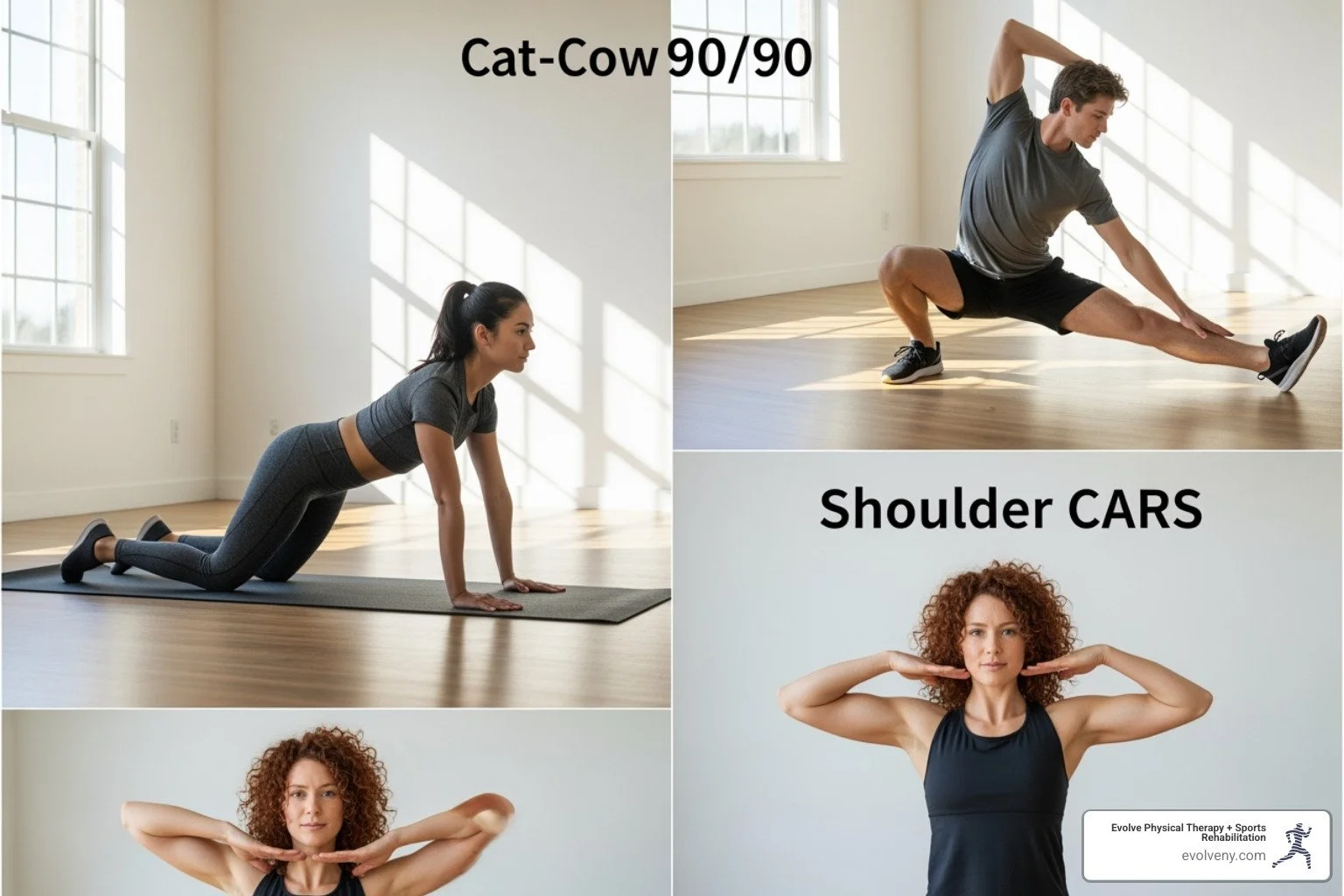
Cat-Cow might seem like it's just for your spine, but it also gently mobilizes your pelvis and helps your entire core move more freely. Start on all fours and flow between arching your back (Cow) and rounding it toward the ceiling (Cat). The key is coordinating the movement with your breath—inhale as you arch, exhale as you round.
Standing Hip CARs (Controlled Articular Rotations) actively take your hip through its complete range of motion while building strength and control. Standing tall with one hand on a wall for balance, lift one knee to 90 degrees and slowly trace the largest possible circle with your knee—forward, out to the side, back, and around again. Keep your torso still and move only from the hip.
Cossack Squats are excellent for targeting those often-tight inner thigh muscles (adductors) while improving single-leg stability. Stand with your feet wide apart, then shift your weight to one side, squatting down on that leg while keeping the other leg straight. It's like a deep lateral squat that really opens up your hips.
For even more hip-focused movements, check out our guide on 5 Hip Movements to Help Strengthen and Prevent Pain.
Best mobility movements for a resilient lower back
Your lower back bears the brunt of modern life—hours of sitting, poor posture, and general stress all take their toll. But here's the thing: a resilient lower back isn't just about having strong muscles. It's about having a spine that can move freely and a core that provides the right amount of stability at the right times.
These movements focus on gently mobilizing your spine while teaching your body how to move with more control and awareness. They're particularly helpful if you spend a lot of time at a desk or if you wake up feeling stiff and creaky.
Segmented Cat-Cow takes the classic movement and adds a layer of spinal awareness that's incredibly beneficial. Instead of moving your whole spine at once, start from your tailbone and slowly articulate one vertebra at a time, like a wave moving up your spine. This teaches your brain to control individual spinal segments, which is crucial for healthy movement patterns.
Side-Lying Thoracic Rotations (also called Open Books) target your mid-back while keeping your lower back stable. Lie on your side with your knees bent and stacked, arms extended in front of you. Keep your bottom arm on the floor and slowly open your top arm like a book, rotating your torso while keeping your knees glued together. This movement feels amazing and helps counteract the forward-rounded posture many of us develop.
Supine Windshield Wipers provide gentle rotational movement for your lumbar spine and hips. Lying on your back with knees bent, slowly let both knees fall to one side while keeping your shoulders on the floor, then bring them back to center and over to the other side. It's simple, relaxing, and incredibly effective for reducing lower back tension.
If you're dealing with desk-related back issues, our guides on Ideal Desk Posture and Physical Therapy for Core Strengthening can provide additional strategies for keeping your back healthy.
Best mobility movements for shoulder function
Your shoulders are incredibly complex joints designed for an amazing range of motion. Unfortunately, modern life—with all its typing, texting, and hunching over devices—tends to lock them into limited positions. This can lead to stiffness, pain, and that rounded-forward posture that makes you look older than you feel.
The key to healthy shoulders isn't just stretching the front of your chest (though that helps). It's about improving the mobility of your entire shoulder complex, including your mid-back, which plays a huge role in shoulder function.
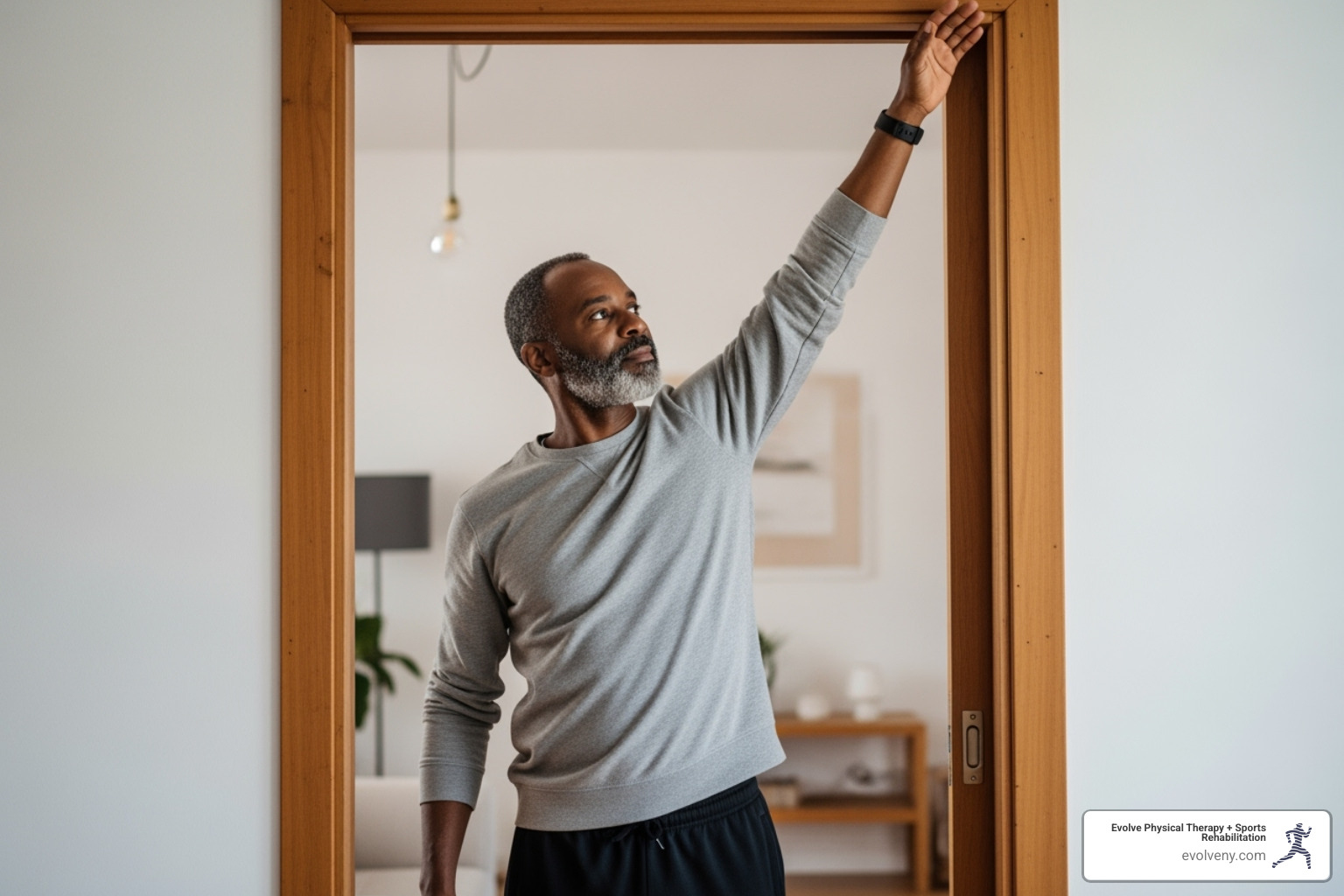
Shoulder CARs are among the best mobility movements for actively building shoulder strength and control throughout the entire range of motion. Standing tall, make a fist with your thumb inside and slowly trace the largest possible circle with your straight arm—forward, up, out to the side, and back behind you. The key is maintaining control without letting your torso compensate. It's harder than it sounds, but incredibly effective.
Dead Hangs might sound intimidating, but they're fantastic for decompressing your spine and improving your grip strength and overhead shoulder range. Simply hang from a pull-up bar with an overhand grip, letting your body relax completely. Even 30 seconds can make a difference, and you can work up to longer holds over time.
Wall Slides (or Wall Angels) promote proper shoulder blade movement while strengthening your upper back muscles. Standing with your back against a wall, press your forearms flat against the wall and slowly slide them up and down like you're making a snow angel. This movement helps counteract the forward-rounded posture that's so common today.
Thoracic Extension over a Foam Roller targets the stiffness in your mid-back that often limits your ability to move your arms overhead. Lie on your back with a foam roller positioned under your shoulder blades, hands supporting your head, and gently extend your spine over the roller. This movement can be a game-changer for improving overhead shoulder mobility.
Understanding how your mid-back affects your shoulders is crucial, which is why we've written extensively about Thoracic Mobility: Why Is It Important?. You can also learn more about the benefits of foam rolling in our guide What Does Foam Rolling Do for Me?.
How to Integrate Mobility Training Into Your Life
We understand that adding something new to an already busy schedule can feel overwhelming. But the good news is, integrating best mobility movements doesn't have to mean hours in the gym. Consistency is truly key here; short, frequent sessions are often more effective than sporadic, lengthy ones. Think of it as a "movement snack" you can incorporate throughout your day, perhaps as part of your warm-ups, cool-downs, or even active recovery. For more ideas on how to weave movement into your routine, check out our tips on Daily Stretches to Keep You Limber.
How Often Should You Do Mobility Work?
The ideal frequency and duration for mobility work depend on your individual fitness levels and goals, but we recommend doing it consistently. It's far more beneficial to practice mobility five times a week for 5 to 10 minutes each time, rather than trying to squeeze in a single, hour-long session once a week.
You can easily add mobility training as part of your warm-up or activation routine before a workout. Or, you can integrate functional unilateral movements that challenge stability and strength in multiple planes right into your existing workouts. It can also be a fantastic way to start your day, end your day, or serve as active recovery on non-training days.
As we always tell our patients, "the best kind of exercise is the one that you can find time for." Even five minutes a few times a week will have a positive benefit. So, start slow, listen to your body, and gradually build it into a habit. Our goal for you is to move comfortably through life, and consistent mobility work is a cornerstone of that.
Equipment and Tracking Your Progress
The cool thing about mobility training is that you can usually do it anywhere, with minimal or no equipment. Most of the best mobility movements we've discussed only require your bodyweight and perhaps a yoga mat for comfort. However, some simple tools can be quite helpful. A foam roller is excellent for self-massage and targeting tight areas like your lats or thoracic spine. Resistance bands can be used to add resistance to movements or provide assistance for stretches. And for those stubborn, pinpointed trigger points in smaller muscles like those in your hips or feet, a small mobility ball (like a lacrosse ball) can work wonders.
Tracking Your Progress: How do you know if you're actually improving? Mobility progress can be subtle, but there are several fantastic ways to track it.
One of the best ways to get objective feedback is to film yourself. Try performing key movements (like a deep squat or an overhead reach) before you start a dedicated mobility routine and then again after a few weeks. You'll often be surprised by the visual improvements.
Another simple yet powerful method is to keep a workout journal. Note how your body feels during and after exercises. Are you able to go a little deeper into a stretch? Does a certain movement feel less restricted? Are your daily aches diminishing?
Always remember to focus on quality over quantity. When performing mobility exercises, prioritize proper form and control over the sheer range of motion. It's not about how far you can push, but how well you can control the movement throughout its full range. We always say, Prioritize control and form—it's the foundation of effective exercise.
Finally, a simple but effective strategy is to test and re-test. Before focusing on a specific area, perform a simple mobility test (like a deep squat assessment or an overhead reach test). Work on that area consistently for a few weeks, then re-test to see the improvements you've made.
Frequently Asked Questions about Mobility Movements
Here at Evolve, we hear these questions a lot! It's great to see so many people curious about how mobility can transform their lives. Let's explore some of the most common questions we get.
Who can benefit most from mobility training?
Who exactly can benefit from focusing on best mobility movements? Honestly, it's pretty much everyone! Whether you're a hardcore athlete or someone who spends most of their day at a desk, mobility training brings a world of good.
Think about it: If you're a desk worker, prolonged sitting can make your hips tight, your lower back stiff, and your shoulders rounded. Mobility work is like a secret weapon to undo all that, helping you sit taller and feel more comfortable.
For athletes, no matter your sport, better mobility means better performance. It helps you move more efficiently, reach optimal positions, and seriously lowers your risk of injury.
And for our seniors, keeping good mobility is absolutely vital for staying independent and enjoying daily life. It helps prevent falls and keeps you moving comfortably for years to come. In fact, we even have specialized Balance Training for Seniors programs to help with this!
If you're an individual with stiffness or chronic aches – those morning creaks, "cranky hips," or nagging lower back pain – mobility exercises can offer huge relief by getting your joints moving better and balancing your muscles.
Finally, for people recovering from injury, mobility work is a crucial piece of the puzzle. Always with professional guidance, of course, it helps restore your full range of motion and keeps those injuries from coming back.
Can mobility training help with pain?
This is a big one, and the answer is a resounding yes! Mobility training can be incredibly powerful in easing, and sometimes even getting rid of, many common types of chronic pain. It's truly a game-changer for how your body feels.
Here’s how those best mobility movements work their magic against pain: First, they reduce stiffness. By gently moving your joints through their full range, you're helping them get more "lubricated," which just makes everything feel less creaky and tight.
Next, mobility improves joint function. When your joints move the way they're supposed to, they share the load better. This means less stress on those specific spots that might be causing you grief.
It also corrects tricky movement patterns. Sometimes, pain shows up because your body is trying to compensate for stiffness elsewhere. Mobility training gets to the root of the problem, helping your body refind its natural, efficient ways of moving.
And finally, it alleviates muscle tightness. While mobility is different from pure flexibility, many mobility drills actively help lengthen muscles and release that built-up tension that often causes discomfort.
Now, a quick but important note: if you're dealing with sharp or ongoing pain, please don't try to tough it out alone. It’s always best to chat with a professional. Physical therapists, like us here at Evolve, are experts at figuring out why you’re hurting and creating a plan just for you.
Should I do mobility before or after a workout?
This is where understanding the type of mobility work really helps. The short answer is: both, but with different goals in mind.
Before a workout, think dynamic mobility. These are those active, controlled movements that get your blood flowing, gently wake up your joints, and tell your nervous system it's time to move! Think leg swings, arm circles, or a gentle Cat-Cow. These are perfect to get your body ready for action and maximize your performance in the main workout.
After a workout, it's time for more static or passive mobility. This is when those longer, held stretches come into play. Holding a stretch for 20-30 seconds helps your muscles gently lengthen, improves overall flexibility, and aids in your body's recovery. It's like giving your muscles a nice, gentle thank-you for all their hard work.
And here’s a bonus: mobility work can also be a fantastic standalone session. On recovery days, or simply any time you feel a bit stiff, a dedicated mobility session can do wonders. Short, frequent "movement snacks" throughout your day can often be more effective than one long, infrequent session. Consistency really is key!
Conclusion: Move Better, Feel Better
We truly hope this guide to the best mobility movements has opened your eyes to a world of possibility! It’s all about empowering you to take charge of your physical well-being. Think of it as investing in your future – a future with less pain, better performance in everything you do, and the ability to move freely for years to come.
Remember what we covered: mobility isn't just flexibility. It’s about having active, controlled movement through your joints. This makes a massive difference in preventing injuries, boosting your athletic prowess, and simply making daily life feel easier.
The magic word? Consistency. You don't need huge, marathon sessions. Even short, regular "movement snacks" can add up to incredible benefits. Start small, listen to what your body tells you, and celebrate every little win along the way. That feeling of reaching a little further, or moving with less stiffness, is a victory!
However, we understand that sometimes, pain can be persistent, or movement limitations feel overwhelming. If you're struggling with ongoing discomfort or feel stuck, please don't hesitate to reach out. Our dedicated team at Evolve Physical Therapy + Sports Rehabilitation in Brooklyn is here to help. We offer holistic physical therapy services, focusing on a hands-on approach to evaluate, heal, and strengthen your body. We can provide a personalized plan designed just for you, helping you truly move better and feel better. Why not get a professional movement analysis with physical therapy today? Your body will thank you!